Lest we forget or are forgotten

Tags

, , , ,

In 2013 Richard Harries’ “The Image of Christ in Modern Art” was published. In his book he outlines four specific criteria for considering a piece of modern art as being ‘religious’. They are:

  1. All genuine art has a spiritual dimension, just by being good art.
  2. It is possible to point to the work of believing Christians regardless of their subject matter because it is still an expression of faith.
  3. It expresses or evokes certain characteristics associated with the Christian faith such as redemption, forgiveness and loving kindness.
  4. It is related to in some way, traditional Christian iconography. (Harries, 2)

Harries exploration of modern art having to come to terms with and express a seismic rupture as well as contend with expressing faith in an increasingly secular society is laudable and the book is recommended on that basis (it would make an nice companion piece to Tarnas’ Passion of the Western Mind for undergraduates). However, there are a number of areas where issue has to be taken with the treatment provided within the text. For the purposes of this posting I am going to focus on the four criteria and relate them to the specific context of Northern Ireland.

The first criteria immediately rings alarm bells, what is genuine art? Can art exist that is not genuine but false? A quick read through the introduction and first chapter quickly reveals that what Harries means by good art is high art, there is an added layer of exclusivity to the art under consideration. Why then does high art have a spiritual dimension, and low art, by implication, not? The third criteria could have a blog posting on its own on the basis of why are those qualities associated with Christianity alone, when they exist in other contexts including secular ones? However Harries does make it clear he is only dealing with ‘Christian art’ and the Christian faith so I leave that for another time.

It is with the second and fourth criteria that I want to focus in on. Both assume that personal faith, religion to be a distinct and separate thing capable of motivating an individual by force or will. The fourth criteria further assumes a timeless quality and universalism to iconography and its images and symbols. Neither seem to realise, or acknowledge, as Nietzsche did that art is the highest form of expression of the human spirit (The Birth of Tragedy). As such an expression it carries a clear intent for the artist regardless of how well that translates to the viewer. What the viewer interprets comes from his own perspective. Finally, art and artistic expressions are not encapsulated forms of religious expression. In his posting Per-Erik Nilsson argued that:

religion and secularism are contingently articulated categories bound to power and ideology … these articulations have been used to legitimate Western politics and expansion (colonialism, neo-colonial politics and imperialist ambitions).

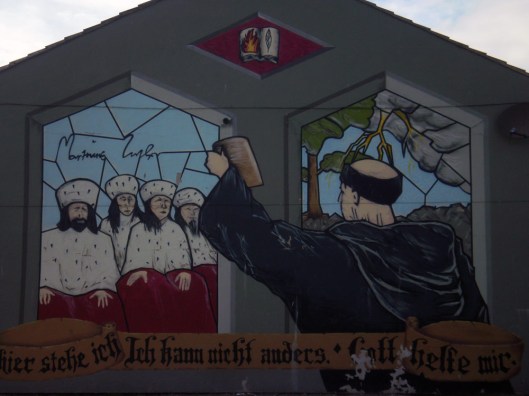
In Northern Ireland we have a long tradition, on both sides of the divide, of painting wall murals. These are often imbued with what Harries would consider elements of traditional Christian iconography or imagery. Below are two such, the first from Hopewell Crescent in the strongly loyalists Lower Shankill area of Belfast. It depicts Martin Luther nailing his treaties to the Wittenberg door and has a banner stating in German “Here I stand. I cannot help it. God help me. Amen” (Camera did not capture the Amen which is lower down).

Hopewell Crescent, Lower Shankhill Road, photo © Francis Stewart

Hopewell Crescent, Lower Shankhill Road, photo © Francis Stewart

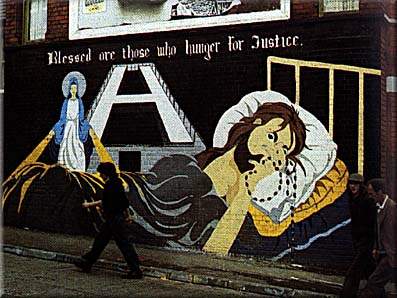
The second is from the nearby Republican area of Divis Street. It depicts the Virgin Mary standing over a dying hunger striker who is saying his rosary and contains the script “Blessed are those who hunger for justice.”

Virgin Mary watches over a hunger striker

Virgin Mary watches over a hunger striker

Are these forms of Christian art as Harries would perhaps argue (although given they are not high art he may well desist) or are they rather an example of Nilsson’s articulations of categories bound to power and ideology? I would argue for the latter, there are clear political messages in both – the giving of one’s life through starvation for a cause one believes in, and a defence of the very essence of Protestantism, which in this context means a defence of one’s community and right to remain British.

What I would argue about these murals is that they are a means of remembering the past and ensuring that one’s current struggles are not forgotten. Tom Shippey (writing of the works of Tolkien, but none the less pertinent) reminds us:

The very fragility of record in such societies makes memory all the more precious, its expressions both sadder and more triumphant. (Shippey, 97)

The religious imagery, if one can call it that, is used in these murals as a means to an end there is no distinct religious or spiritual impulse behind them. They serve the purpose of telling the past when those in authority or power will not listen. I do not agree that those in weaker positions are voiceless, they are perfectly capable of speaking; those in positions of power must learn to listen. Michael Marten reminds us:

What we need is a realistic exploration of ‘historically specific acts of resistance’ to avoid silencing the subaltern. (Marten, 231)

In creating these murals, the people of Northern Ireland are finding a way round the deaf ears of those in power. They are telling and retelling their history, speaking of their hopes for the future, speaking out against injustices done on them and in the process adding to the further division of the country and the re-entrenchment of their own communities. These are not forms of spiritual or religious art but an engagement with critical religion in that they demonstrate the entire interdependancy of religion, secular, political and power and the tangled web they weave.

——

Richard Harries, The Image of Christ in Modern Art, (Surrey: Ashgate, 2013).

Michael Marten, “On Knowing, Knowing Well and Knowing Differently: Historicising Scottish Missions in 19th and Early 20th Century Palestine” in Ellen Fleischmann, Sonya Grypma, Michael Marten and Inger Marie Okkenhaug, Transnational and Historical Perspectives on Global Health, Welfare and Humanitarianism, (Kristiansand: Portal Books, 2013) p210 – 238.

Tom Shippey, J.R.R.Tolkien Author of the Century, (London: HarperCollins, 2000).

Contextualizing yoga: modern practices in a western world

Tags

, , , , ,

For many people across the world yoga is a way of ensuring a healthy life away from sedentary habits, a way of decreasing stress and increasing general wellbeing. However, the religious or spiritual element present in the practice of yoga may scare people who are concerned about religious purity or the integrity of their beliefs. Some might believe that yoga contradicts their religion, others might think of it as devil’s work. But is modern yoga a form of spiritual or religious practice?

Yoga as encountered in the West, is foremost based on Hatha Yoga and as such places emphasis foremost on bodily postures, breathing exercises and meditation. Indeed ‘yoga, as it appears today, is a recent interpretation of an ancient practice’ (Hoyez 2007: 114) which originates from the Indian subcontinent. Because of its origins yoga has often been thought as ‘hindu’, a term that is in itself very broad.

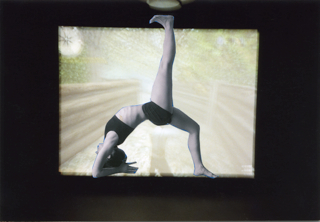
Mik365

Image © M.T. Vaczi

Yoga stems from the Vedas, the holy texts composed around 1900BC, which also form the basis of three major religions: Hinduism, Jainism and Buddhism. Patanjali’s ‘Yoga Sutras’, dating from approximately 2000 years ago is considered the first text that distinguishes Yoga from other systems of thought and religious practice. In his book Patanjali advocates a complete and complex way of life and not only a set of physical exercises. His ‘eight limbs’ of yoga, which still inform practice today, include abstentions (development of compassion), observances (awareness of ourselves and others), bodily postures (chanelling energy), breathing practices (controlling life force), abstraction (managing the senses), concentration (focusing) and meditation (total absorption) (Alter 2005). Each school of Yoga builds upon these elements, combining and interpreting them in a specific manner.

Often thought as an elaborate form of gymnastics, modern western yoga has lost most of its original philosophical underpinnings and has taken distance from most of its religious roots. Yoga has become a western practice whose popularity has been made possible by the process of individualization and its formation of ‘new-age’ spirituality, but also by the commodification of urban wellbeing. After becoming global, yoga has become increasingly decentralized and the Indian influence has been gradually lost. We live in a time of ‘indigenous yogas’ with a baffling diversity of styles and types, often adapted to specific local circumstances (Hoyez 2007) that highlight foremost wellbeing, health and internal peace. Furthermore, emphasis is placed foremost on its physical aspects while its spiritual or religious parts are contrived, if present at all. The specific combination of these factors makes modern yoga resemble more a therapeutic practice (Hoyez 2007) than a spiritual or religious one.

However, modern yoga is a therapeutic system of bodily exercises that also voices philosophical, cultural or political concerns. Furthermore, it is experienced as an active form of changing one’s life to the better. It emphasizes on self-realization (Alter 2004, De Michelis 2004). As such, modern yoga has constructed an alternative form of being religious or spiritual which creatively picks up and repackages a few elements of the Indian traditions while combining them with specific global and local concerns. For example, in yoga discourse, the consumption of raw- and super-foods is connected as much to the formation of a healthy body, to maintaining a good world energy, contributing to fair trade and to sustaining ecological system. These concerns are both extremely varied and tailored to specific audiences: yoga games targeting children require players to perform postures imitating animals while yoga for older adults yoga will make use of props for attaining some bodily postures (Patel el al. 2011). While children yoga will ‘play’ with the ‘inner child’, older adult yoga allows one to ‘find the right energetic balance’ and ‘age youthfully’. Furthermore, yoga can be practiced as a form of union with the ‘universe’, ‘God’, ‘nature’ or ‘oneself’, depending on the inclinations and beliefs of its practitioners. Some yoga classes use a borrowed religious imaginary: the yoga mat becomes a prayer mat while some postures recall prayer. Some classes include the chanting of Hindu sutras, others refer to a ‘life force’ or ‘energy’. A session may include a greeting of ‘namaste’ or a gesture of prayer. There might be a moment of meditation or time for chanting the ‘Om’ considered as the primordial sound by both Hindus and Buddhists. While these might be considered spiritual activities, they do not come to the fore in every yoga practice. Some classes and schools of yoga may make no overt reference to spirituality at all.

Nevertheless, modern yoga makes both physical and inner, ‘spiritual’ transformation possible, as yoga practitioners explained to me. Modern yoga, they highlighted, works through the effort of the body and ends in a general feeling of ‘feeling good about myself’. Yoga practices create an awareness of the self and a possibility of directly ‘improving’ one’s life. One realizes that ‘there is something bigger out there’. One ‘learns’ what are one’s possibilities, and through repeated exercise, learns also to ‘deal with that terrible pain’ and ‘overcome one’s limits’. Yoga offers its practitioners a permission to be happy ‘as I did the best I could for myself’ but also creates the feeling of ‘being in control’ and being in touch with ‘something bigger’. However, some of the practitioners I have been talking to have not described their experience as necessarily religious or spiritual, rather as an encounter with the ‘real self’ that requires no belief, but ‘just happens’.

This baffling inner diversity of practices points out that yoga is far from being a unitary phenomenon. Although most forms of yoga have their roots in the Indian subcontinent, each different school and group works with a specific interpretation of what yoga is, tailored to the more immediate concerns of western practitioners. The religious or spiritual content of yoga classes does not only depend on each yoga school’s approach, but also on the personal aspirations and capabilities of yoga practitioners. As such, western yoga practices have a different view of spirituality and make different use of religious elements then ‘Indian’ yoga, where the ultimate goal is moksha or liberation. Furthermore, western yoga can mainly be considered as a form of physical exercise that increases general wellbeing. In order to ensure and expand the state of wellbeing and relaxation, spiritual and religious practices may be used or hinted at. However, in the context of western modernity, yoga’s goal of ultimate liberation transforms foremost into the celebration and glorification of the self.

—–

Alter, J. S. 2005. Modern medical yoga: struggling with a history of magic, alchemy and sex. Leiden: Brill.

De Michelis, E. 2005. A history of modern yoga. London: Continuum.

Hoyez, A.-C. 2007. The ‘world of yoga’: The production and reproduction of therapeutic landscapes. Social Science & Medicine. 65 (1): 112-124.

Patel, N. K., S. Akkihebbalu, S. E. Espinoza, and L. K. Chiodo. 2011. Perceptions of a Community-Based Yoga Intervention for Older Adults. Activities, Adaptation & Aging. 35 (2): 151-163.

Strauss, S. 2005. Positioning yoga balancing acts across cultures. Oxford: Berg.

The ‘Secularity’ of Neoliberalism in India

Tags

, , , ,

The on-going campaigns for the upcoming 2014 Parliamentary elections in India have put Mr Narendra Modi as the National Democratic Alliance candidate (NDA) headed by the right-wing political party, Bharatiya Janata Party (BJP). The coalition currently in power, the United Progressive Alliance (UPA) headed by the Indian National Congress party, has been mired in various corruption scandals, a reason for increasing favorability for the NDA. But Mr Modi has been a very controversial politician. As a four-term (and current) Chief Minister of the north-western state of Gujarat, Mr Modi has been accused of expressing discriminatory opinions against minorities, specifically, Muslims. He is a member of the right wing Hindutva group, Rashtriya Swayam Sevak. In fact, a year into his first term as the Chief Minister in 2002, Gujarat saw a period of horrific communal violence that began when Muslim groups were accused of burning a train coach in Godhra that killed Hindu activists, which spiraled into violence against Muslim communities. Mr Modi has long been dogged by allegations that he refused to prevent the post-Godhra retribution committed against the Muslim communities after the train-burning incident.

Despite such a controversial history, Mr Modi’s polls numbers are indicating an increase in popularity and favorability as the next Prime Minister of India. As Desai has argued in this article, there is an issue of middle-class voters not opposing (at least openly) the Hindutva ideology of Mr Modi and the BJP. Importantly, Mr Modi’s campaign rhetoric has touted the neoliberal economic policies that he adopted in his home state of Gujarat that has seen significant growth of its economy. He has presented this as a divide between caste and religion on the one hand and development on the other; and he is presenting himself as a candidate pro-development. Thus, neoliberalism is used to show the seeming ‘secularity’ credentials of Mr Modi. He has repeatedly argued that his ideology of ‘inclusivity’ has been central to Gujarat’s trade policies, thereby ‘leveling the playing field’ for all and transcending differences in caste and religious identities. In fact, such a notion was put forward by CNN’s Fareed Zakaria, a popular Indian-American proponent of neoliberalism, who has argued that Gujarat’s (and in fact, India’s) economic growth has transcended political, caste and religious differences. To an electorate experiencing a series of corruption scandals under the UPA government and stagnant economic growth, one can see why this rhetoric seems appealing.

However, this raises a question whether neoliberalism can be seen as a ‘secular’ ideology that transcends those identity markers in India that are often associated with ‘religion’ such as the caste system. The question of understanding economics as ‘secular’ science has been dealt with on many occasions in this Critical Religion blog. My focus here is to reflect on what understanding of neoliberalism pertaining to India one should consider. On the ‘new India’ that Zakaria sees as emerging, he wrote:

Starting in the early 1990s, New Delhi has been overturning the license-permit-quota raj and opening up the economy. The result is an India that is quite different from the one its founders might have imagined—a motley collection of communities, languages, and ethnicities living together in an open political and economic space.

This kind of narrative furthers the idea that Friedman argued in his now famous text, The World is Flat, that somehow, ‘secular’ economics would triumph and transcend the underdevelopment that exists on the ground because of ‘religion’, specifically caste and closely associated with that, class. Critiques of Mr Modi have pointed out how uneven the development brought in by neoliberalism in Gujarat has been. For instance, Desai argues that despite Mr Modi’s claims, his economic policies have benefitted the already existing middle-class Hindu communities whilst poverty and malnourishment has affected minority communities, especially the Muslim communities. Similarly, an article in First Post has argued that the Dalits continue to experience discrimination in society.

Workings of neoliberal policies are embedded in the social context. To look at these economic policies as the ‘secular’ solution towards development is problematic. Both Mr Modi and Mr Zakaria are disembedding the capitalistic benefits of these policies for their own ends. Within the context of India, neoliberal policies do not transcend caste or class identities but are shaped by them and politicians who have the power to administer and shape these policies. This is not to mean that the UPA government, as a ‘secular’ alliance, would have made these policies work better for minority communities. The ‘season of corruption scandals’ certainly did not leave the electorate reassured. But looking at neoliberalism as something that is removed from its social contexts, as Zakaria does in his essay, only lets campaigns such as Modi’s reframe the narrative to conceal the reality on the ground, that neither these policies nor Modi’s approach ensure ‘inclusivity.’ Zakaria himself says “Economic growth has created one more common element in the country—an urban middle class whose interests transcend region, caste, and religion,” which begs us to question, what about those communities that are being left behind? What is even more problematic with the Modi campaign and the BJP is that in addition to ‘lower’ class and caste communities being left behind, the BJP’s Hindutva connection reframes neoliberal development into a development of Hindu communities by a) emphasizing the superiority of the ‘Hindu’ identity; b) deliberately leaving other minority communities behind.

Hence, it is important to scrutinize (as some news outlets, such as the ones I have referenced above, have been doing) the rhetoric of the Modi campaign to ensure that development is not presented as an abstract concept that would render certain communities voiceless.

Conference Report: Women in Secularism 2

Tags

, , , , , , , , ,

Washington, D. C., May 17-19, 2013

Washington, D. C., May 17-19, 2013

Washington, D. C., May 17-19, 2013

October 2013:
Note on Critical Religion:
It is my assumption that scholars engaged in critical religion are essentially the atheists, feminists and de-colonists in the field of Religious Studies. I had dinner with a group of Religious Studies majors a few nights ago, and I was interested and somewhat disappointed to note that they generally defined ‘the religious’ as those who self-identified in that way. While Religious Studies departments can be replete with scholars drawing lines around ‘religious’ art or ‘religious’ clothes, implicitly using the adjective as an analytical category rather than as data itself, to my understanding, ‘Critical Religion’ particularly is a meta-religion-studies, looking at what people are calling ‘religion’, who is employing this label and for what reasons they are doing so. Critical Religion means examining the modern social attitude called ‘religious’, rather than apologetically calling human behaviour ‘religious phenomena’, something which does not exist, so naturally it is impossible to track or even define. Feminists have challenged and reconstructed history with a place for women within it, and de-colonists have given voice to a historically silent subaltern perspective. A large and contemporary body of work in Religious Studies is in many ways surprisingly still engaged in writing histories as (patriarchal, colonizing) Cultural Christians. Feminist and de-colonial theory, devoted to revealing and questioning unexamined systems of power, are the avenues which lead to Critical Religion. This seems to produce atheism, which is why the Women in Secularism conference series is relevant to Critical Religionists.

Atheism & Feminism

On May 17, 2013, some 50 core participants gathered at the Downtown Marriott Centre in Washington D. C. for the second annual conference about women’s involvement in secular movements. Up to 200 others attended for the keynote speakers. The conference was organized by the Centre For Inquiry, a not-for-profit organization which mobilizes on a variety of issues surrounding ‘secular’ concerns, such as scientific education in public schools, grief services for nonbelievers, and the demystification and de-vilification of all things contraceptive.

Over the course of the weekend, women engaged in atheist feminist activism had the opportunity to meet and discuss their work. Some women were best-selling authors, others scientists in the academy, and others were leaders in support groups within their communities. It is important to note that most of these women were and are actively engaged in journalistic activism via online blogs, Twitter, and other social media. (For a list of all the speakers and their lectures, click here.)

Toxic Religion and Toxic Patriarchy are the Same

Many of the activist-oriented conference speakers and panelists encouraged a coalition between the feminist movements and the secular ones, both to get more feminists to be atheists and to make the secular movement less elitist and oppressive. Essentially the secularists were engaged in convincing the feminists of the toxicity of religion and religion’s interference with the state, and the feminists were convincing the secularists that the fight to empower women is the keystone in reducing religion’s political influence. The result was feminists getting equipped with a more detailed understanding of the role of Christianity and Islam and patriarchy, and the secularists gaining a deeper appreciation for the role of feminist struggles in working towards secularism. Secularists and feminists were engaged in a process of seeing the dismantling of toxic masculinity and the dismantling of toxic religion as the same endeavour.

CFI Washington D. C.’s president and conference organizer Melody Hensley said that “issues of secular movements are issues of women’s safety and freedom.” The anti-feminist thrust of the predominant atheist movements, led by Richard Dawkins and others, suggests this is not a universal notion. Atheist groups consisting largely of wealthy, educated white males are focused on the science of anti-God-ness. Dawkins calls himself a “cultural Christian”, supporting ‘traditional marriage’ and other Christian constructions while intent on disproving the existence of an all-powerful God, male or otherwise. It follows that Dawkins supports ‘traditional’ gender roles and the idea of the father as head of the household. In this way, atheist movements may protect and inscribe oppression of women; they can erode Grand Narratives in one way, and perpetuate them in others. While I see feminism and atheism as part of the same project, it troubles me that this Dawkinsian atheism, disproving God with science, could potentially be the extent to which the secular movement goes. It is incredibly important to demonstrate the connection between the cultural institutions of Christianity and the cultural institutions of patriarchy. As Kathlyn Pollitt said, “religious texts are the rulebooks of misogyny.” Radio personality Sarah Moglia pointed out that statistically speaking, all social movements that do not reach the working classes (and women make up 70% of the world’s poor) are doomed to fail as they do not reach the institutionalization phase. The conference made clear that secularism as a social movement will not take root until it is inclusive, pervasive and skeptical, deeply penetrating not only the imaginary god but the system which both creates and is created by notions of it.

Another important discussion at this conference was that of nomenclature. There were many discussions and disagreements about what the movement should be called, how people should self-identify, and other issues which can be (and were) paralleled to the gay rights movement. I got the sense generally that although there were a few people who disliked the ‘secular’ title and preferred out-and-out atheist, there was an acceptance of allies in the movement. It was noted that as the term ‘feminist’ often precipitates a strong counter-reaction, so the word ‘atheist’ denotes criticism of the hegemonic paradigm and can’t be softened. This makes me think of Richard Cimino’s definition of atheism, which is “an oppositional identity in a culture of theism.” This oppositional identity creates many apologists, and potential allies of the secular (and women’s liberation) movements often focus on religion as a notion of ‘The Good’, or the positive effects of religions rather than the endemic oppression they inscribe. There has also been a great deal of ‘historical’ focus on religious persecution and religious freedom, and church-related abuses and violence are called ‘situational’, or ‘representative of the times’. Pollitt remarked that one need only read the Bible itself for an account of human rights abuses. The pervasive desire to imagine religion as ‘The Good’ results in a social forgetfulness that obscures the modern and political projects deploying God in state and in law. God went on the money and in the Pledge in the United States in the 1950s, and in contrast, France separated church and state in 1905. Investing the state with God-the-Father, and pretending he was always there is both anachronistic and political. Speaker and writer Jennifer Hecht notes that the feminist atheist movement needs to “establish a long history of secular women because the Christian world can be overwhelming,” and that “we have to be the ones to cultivate this memory.” When asked what the future would look like if atheist and feminist movements were successful, Pollitt responded that it would look as though atheism and feminism had always been popular. Whether or not that is the case remains to be seen, but every story told and every voice that speaks moves the discourse forward.

Critical Religion

One of the most interesting parts of this conference was that scholars of Religious Studies were not invited. The doctors of Science, Political Studies, History and Women’s Studies seemed to recognize that much of the work in Religious Studies, while likely well-intentioned, is apologetic and somewhat evangelical. Ultimately, Religious Studies scholars seem to be more committed to their subjects of study than to human rights, or perhaps conventional Religious Studies departments do not offer the anti-oppressive theoretical education which has become typical in some Social Sciences.

Critical Religionists are often adept at pointing out the flaws of our peers, but the work which is crucial to developing the movement lies in constructing better theoretical frameworks than the ones which exist currently in the field of Religious Studies. Work like Goldenberg’s Vestigial State Theory move beyond “standing in the conceptual space carved out by theistic religion” (Sam Harris, 2007). Indeed, scholars of religion are only beginning to have the language with which to describe “vestigial states called ‘religion’”. Feminist and post-colonial academic and activist circles are a fantastic place to see these developing frameworks in action; these are the frameworks that Critical Religion needs.

—-

Videos of the entire conference can be found here.

[Editor’s note: This article was modified on 11 April 2016 at the author’s request]

Rethinking Secularism (Again)

Tags

, , , , ,

It appears to me that we are and have been for some time in the midst of a formative period of ‘secularism studies’. It also appears to me that this formative period is, and has been, marked by a desire for the search of the true essence of secularism.

It moreover seems to me as the will to hegemonize this newly emerging academic field is guided by a neglect of the insights from related disciplines such as critical religion theory and postcolonial research on religion, namely that a) there is no sui generis religion to be found which should call for caution in searching for a sui generis secularism, b) religion and secularism are contingently articulated categories bound to power and ideology, c) the secular state apparatus’ judiciary is most often involved in defining the boundaries of the religious and the secular by defining religion, d) the last centuries’ scientific articulations of religion have had deep ideological and political implications not the least in creating a European exception and a European universalism, and e) that these articulations have also legitimized Western politics and expansion such as colonialism, neo-colonial politics, and imperialist ambitions.

Now, the sociologist José Casanova has forcefully argued that the assumption that secularization is a historical fact attained a ‘truly paradigmatic status within the social sciences’ from the 19th century and onward. And that it was first during the latter half of the 20th century that theories of secularization were developed into more comprehensive systems of thought (with for example Thomas Luckman, Peter Berger, and Bryan Wilson). Together with the development of theories of secularization we have also seen a rise in interest and theorization of the ‘secular’ and ‘secularism’, especially during the Post Cold War era. The reasons for this interest can be explained by the somewhat sudden realization that ‘religion’ not only still had a grip of human daily life around the globe, but that it could be a force for political action where 9/11 is often taken as the emblematic evidence. Following Casanova’s line of argument, the reason for neglecting religion as a social and political force can thus be explained by the hegemony of the secularization thesis in the humanities and social sciences. ‘Religion’ is for example still a non-existent subject in many social science departments in European and American universities.

Recent research on the genealogy of the trinity ‘secularization-secular-secularism’ have helped to highlight and explain many of the epistemic and hegemonic assumptions that are inbuilt into the various disciplines of the humanities and the social sciences. However, given the recent interest in the trinity it is a curious thing that it has been ‘rethought’ so many times. Here I will discuss one specific ‘rethinking’ of secularism.

Rethinking Secularism (Oxford UP, 2011) is the name of a recent publication by a number of eminent scholars working on ‘secularism’ from a wide variety of angles. The editors of the book are Craig Calhon, Mark Juergensmeyer, and Jonathan VanAntwerpen. The title indicates first of all that secularism has been thought and secondly that this ‘thought’ secularism is in need of revision. My first presentation as a graduate student in 2007 was also called Rethinking Secularism. This is not to suggest that I was ahead of the above publication, nor is it to suggest that it plagiarizes my presentation, it certainly does not. Instead, I wonder what exactly I thought was in need of being rethought with secularism? Today when I look back at the presentation, I guess I wanted to pose a critique to what I understood to be a reigning hegemony in analysis of secularism. As it turned out, my choice in naming my endeavor as a ‘rethinking’ was perhaps unfortunate since what I ended up doing in my thesis was a deconstruction or on undoing of secularism (that is French secularism, or laïcité), rather than rethinking ‘it’. And herein lies a problem in the rethinking of something since it presumes that there is something to rethink.

To be clear, the editors of Rethinking Secularism state that secularism is “often defined negatively” against religion, meaning that the category “in itself” is not “neutral”. (loc. 168) I could not agree more. My own epistemological home ground (in discourse theory, poststructural theory, postcolonial theory, and critical religion theory) and my own research suggest that contemporary (French) secularism is a purely negative category. It is given meaning differently in different contexts and its articulated differently in different discourses. In France, although secularism is a highly non-contested category, there is no consensus on its essential meaning among researchers, among politicians, or among political activists; e.g. it is an important identity marker for the political left as well as the political far-right. Just as the editors suggest, secularism is here given meaning through a negative identification process based on the logic ‘I am not what you are’. This logic is made possible through a negative secular-other, which then most often is ‘religion’.

Based on the editors’ description of ‘secularism’ as a negative category, their conclusion comes as somewhat of a surprise to me. They suggest: “Secularism should be seen as a presence. It is something, [a phenomena in its own right], and it is therefore in need of elaboration and understanding”. (loc. 169) The editors thus seem to suggest that secularism, although being a negatively articulated political concept, still has a positive core, an essence if you may. In other words, they seem to suggest that although secularism is a political category void of essence, we should still act as if essence there is and furthermore that it is the task of the researcher in the social sciences and the humanities to find out what this essence is.

One seminal case in point in finding out this ‘something’ of secularism is the chapter in Rethinking Secularism written by the aforementioned José Casanova. Here I will only touch upon Casanova’s discussion of a) the relation between secularism, secularization, and the secular and b) the relation between secularism and religion.

a) Casanova sets out to analytically separate the trinity of secularization-secular-secularism. He argues that ‘the secular’ is a modern “epistemic category”, that ‘secularization’ is an “analytical conceptualization of modern world-historical processes”, and that ‘secularism’ is a “worldview and ideology”. (loc. 1308) Casanova then goes on to suggest that secularism “refers more broadly to a whole range of modern secular worldviews and ideologies which may be consciously held and explicitly elaborated into philosophies of history and normative-ideological state projects, into projects of modernity and cultural programs, or, alternatively, it may be viewed as an epistemic knowledge regime that can be he held unreflexively [sic] or be assumed phenomenologically as the taken-for-granted normal structure of modern reality, as a modern doxa or an ‘unthought’”. (loc. 1329) If ‘the secular’ is a modern ‘epistemic category’ and ‘secularization’ an ‘analytical conceptualization of modern world-historical processes’ I wonder what separates these two categories from ‘secularism’ (an ‘epistemic knowledge regime’ and a ‘philosophy of history’). If ‘secularism’ is such a potent ‘something’ that it enters into our ‘unthought’, if it is an epistemic knowledge regime creating a philosophy of history, is not the pertinent question to ask how secularism produces notions of secularization as an historical process and the secular as an epistemic category in the first place?
It seems to me that Casanova takes for granted that ‘secularization and ‘the secular’ have an independent meaning outside of ‘secularism’ and that it is secularism that somewhat perverts their true meaning. This leads Casanova to argue that “the core of the [secularization] thesis, namely, the understanding of secularization as a single process of functional differentiation of the various secular institutional spheres of modern societies from religion, remains relatively uncontested”. (loc. 1463) The problem with secularism is according to Casanova that it renders “the particular Western Christian mode of secularization into a universal teleological process of human development from belief to unbelief, from primitive to irrational or metaphysical religion to modern rational postmetaphysical secular consciousness”. (loc. 1430) Instead Casanova suggests, we should acknowledge secularization “for what it truly was, namely a particular Christian and post-Christian historical process, and not, as Europeans like to think, a general or universal process of human or societal development”. (loc. 1560.)
While I believe Casanova to be right in the assumption that one fundamental problem with secularism is how it seeks to universalize the theory of secularization, I am not so sure that a) secularization is a historical European fact and b) that ‘Europeans’ disagree here. One of the ideological problems, to use Casanova’s lingua, is that irrespectively of whether the secularization thesis is taken to be applicable on the entire globe or only on Europe, it still feeds into a modernist imaginary where Europe becomes the only successfully developed secular universal civilization, exceptionally developed and/or exceptionally unique.

b) To distinguish and qualify the analysis of secularism Casanova suggests that it “may be fruitful to begin by drawing an analytical distinction between secularism as statecraft doctrine and secularism as ideology”. (loc. 1591) With secularism as statecraft Casanova understands “simply some principle of separation between the religious and political authority… Such a statecraft doctrine neither presupposes nor needs to entail any substantive “theory,” positive or negative, of “religion”. (loc. 1594) However, Casanova argues that “the moment the state holds explicitly a particular conception of ‘religion’, one enters into the realm of ideology. One could argue that secularism becomes an ideology the moment it entails a theory of what ‘religion’ is or does”. (loc. 1597) If secularism as statecraft ‘simply’ is the separation of the ‘religious’ and the ‘political authority’, how is this separation done without the state deciding where to draw this separation by deciding what ‘religion’ is and does? Since one of the core arguments of Rethinking Secularism is that secularism and religion are negative categories, I cannot see how a non-ideological secularism could be fashioned at all, that even the ‘simple’ separation of the ‘religious’ and ‘political authority’ is a performative act entangled with power and ideology.

To conclude: I wonder if the desire to be a part of the emerging field of secularism studies does not lead some researchers into curious paradoxical epistemological predicaments, as I have tried to (very briefly) show here. It is as if the lessons from critical disciplines are listened to but not heard, as if they are brought up to be neglected, as if certain scholars know that it is very complex but at the same time ignores this complexity.

“Overt and Conspicuous”: Religion and the Charter of Québec Values

Tags

, , , , , , ,

Religious freedom has become a a hot topic in the world of Canadian law again this autumn, as the Parti Québécois presented a new bill, Bill 60, which seeks to enact the “Charter of Québec Values”. The proposed charter aims to prohibit the wearing of “overt and conspicuous” religious symbols by government officials and public servants. The rumoured charter was widely discussed across Canadian news outlets throughout September and October, and was finally tabled in front of the Québec legislature on November 7th, 2013 as the “Charter of Québec Secularism”. The proposed new law would amend the Québec Charter of Human Rights and Freedoms in an attempt to prevent religious symbols to form part of the public sphere; this echoes the measures of state secularism eschewed by other governments, such as that of France.

The bill was the object of much controversy as the stipulations of the charter suggest “common values” that target the removal of hijab, yarmulkes and turbans for the purposes of equality. Below are the widely-circulated images which became representative of the guidelines proposed by Bill 60:

Figure 1: Types of permitted religious symbols.

Figure 2: Prohibited religious symbols.

According to ReligionNews.com, the charter “would prohibit public employees from wearing large crosses and crucifixes, Islamic headscarves, Sikh turbans and Jewish yarmulkes as a way to establish ‘religious neutrality’ in public. The prohibitions would apply to civil servants, teachers, law enforcement officers, firefighters, doctors, nurses and public day care employees. Elected officials would be exempt.” Thus, anyone seeking to serve in the public service would be required to disregard their own personal religious practices if these could be interpreted as “overt”.

While media reports and online discussions have concentrated on the possibility of these guidelines being a disguise for racist or xenophobic motivations, I believe they are missing the essential dilemma that characterizes the problems with Bill 60. The proposed measures aim to limit the infringement of citizens’ religious freedoms by preventing others from imposing their beliefs by virtue of wearing visible symbols. However, as I have written before, there is no official agreement in Canadian federal or provincial law about what constitutes a “religious symbol”. Freedom of religion has been discussed in Canadian human rights law since the 1950s and no unanimous decision about what constitutes “religion” has been reached. Therefore, the allegations that the guidelines provided by Bill 60 are racist or targeted toward minority groups skim the surface of a deeper, more troubling realization: that perhaps there is no such thing as stable concepts of “religion” and “secular”, and that the insistence that there is such a distinction leaves room for deeply troubling lines to be drawn arbitrarily.

The realization of the lack of objective, clear-cut categories and its consequences is at the heart of work done by scholars of critical religion. My recently completed Master’s dissertation, as well my first blog post for the Critical Religion Association, have dealt with the consequences of work discussing critical religion in relation to processes of law.  I argued that defining what is “religious” and what is “secular” for the purposes of enforcing the religious freedom in Canada is impossible, as provincial and federal law do not (and cannot) define “religion” in their most important documents. The definition of “religion” is left to the interpretation of the courts at key moments of dissension; the courts, in turn, rely on both outdated legislation and on precedence dated back to an era where Canada was understood to be “a Christian country”.

Attempts have been made to remove tradition-specific language from legal statements, but without the context from which the word “religion” and its cognates emerge, statements about “religion” and its essence leave an overwhelming amount of room for processes of power to dictate, at any point in time, what is permitted and what is prohibited. The decision of what constitutes a religious symbol is left in the hands of lawmakers, who necessarily have their own idea of what religion “is”. Little room is left for debate over whether the symbols depicted in Figures 1 and 2 are understood by their wearers as religious. Those who wear items such as the hijab or the yarmulke might not categorize those items as “religious”, but rather as “cultural” or “traditional”. They may even consider these reasons to be as equally important as so-called “religious” values, and believe that these deeply-held values should be honoured in a similar fashion.

Therefore, the line that the “Charter of Québec Values” draws between permitted “religious” symbols and prohibited ones assumes a number of things. First, it assumes that the distinction between “religion” and “secular” is clear-cut and that lawmakers have an objective view of what counts as a religious symbol.  Secondly, it assumes that that “objective” point of view is somehow completely segregated from a history of precedence that relies on Christian categories from the 1950s. Thirdly, the Parti Québécois even assumes that the residents of Québec would only accept a very narrow range of symbols in the public sphere!

I believe it would be helpful to those seeking to analyse this recent development in Canadian law (and, for that matter, any developments regarding “religion” in human rights law worldwide) to take into account the arguments of scholars in critical religion. Using these insights, critics may be able to tackle what is, as I see it, the larger issue: that the ongoing existence of “religion” as a legal matter without a clear definition leaves room for harmful assumptions to be made and for these assumptions to become law.

A Profession of Imaging Religion

Tags

, , ,

Robert Sowers (1923-1990) created some of the most remarkable stained glass windows in the US during the twentieth century, including the 30,000 panel American Airlines wall at what is now called JFK Airport.  His work in 1960 was the largest stained glass window in the world at the time.  Terminal 8 stood for 48 years then was demolished for remodeling in 2007, and along with it, the enormous window.  One source reports people referred to the airport terminal as ‘The Cathedral’, when in fact, Sowers was a pioneer stained glass artists creating major commissions outside the church. It was demolished less than five decades after its commissioning with suggestions to turn pieces of its glass into key chains for airline employees.

Stained glass reached its height of glory in the medieval period when the average person would not have much exposure to vibrant colors and use of light outside the church.  Their experience in the church would have made a physical and spiritual impact.  The actual light translated in illuminated visual images was analogous to the scriptural light of God overcoming the evil or chaos of darkness.

The transition from Romanesque to Gothic architecture is most evidenced in the Abbey of St. Denis from the late 12th century under Abbot Suger, who wrote on the theological significance of architectural decisions:

Thus, when – out of the delight in the beauty of the house of God – the loveliness of the many-coloured gems has called me away from external cares, and worthy meditation has induced me to reflect, transferring that which is material to that which is immaterial, on the diversity of the sacred virtues: then it seems to me that I see myself dwelling, as it were, in some strange region of the universe which neither exists entirely in the slime of the earth nor entirely in the purity of Heaven; and that, by the grace of God, I can be transported from this inferior to that higher world in an anagogical manner.  [Thiessen, 2005, p116]

Sainte-Chapelle, Paris (photo by P M Medlock Johnson)

Sainte-Chapelle, Paris (photo by P M Medlock Johnson)

Gothic architecture achieved verticality and light by developing certain structural elements (pointed arch, rib vaulting, flying buttresses); this skeletal structure vastly opened up wall space for windows.  Stained glass windows were designed to vertical extremes that translated light in color, altering worship atmosphere and illustrating biblical theology.  The makers of stained glass knew the limits and possibilities of the material with which they worked in such a way that they could facilitate the optimal brilliance of the finished piece by means of the media.  These craftsman knew not only color theory, but that of glass that permits, prohibits, translates, and radiates light.  What would a red piece do next to blue rather than clear when sunlight burns through it?  What piece would dominate, or recede, or pierce the air?  What combination would confuse or enhance the image and the visual experience?  Or the worship experience?  What would affect the communication and reception of the image, which was generally a biblical message for the common person unable to read the Word.  Stained glass of Gothic architecture either illustrated the entire bible, as Sainte-Chapelle has for eight centuries, or a main theme of sinful humanity with hope of salvation through Christ.  Alternately, some windows center Christ within purposefully arranged references to other parts of scripture demonstrating rich theological cross-referencing and skilled thoughtful design.

Two factors led to a major shift in the stained glass profession from its height of glory in the Middle Ages to becoming a ‘lost art’ in the Renaissance and Reformation.  First, art making became less material-inspired and more imitative of easel painting.  Second, iconoclasm (‘image breaking’) of the Protestant Reformation and Dissolution of Monasteries questioned visual imagery as a scriptural violation rather than theological hermeneutic, and effectively removed stained glass from Christian architecture.

But it did not disappear forever.  Sir Herbert Read writes, “In our own time, as part of a general return to aesthetic integrity, the art of stained glass has been reconsidered and, indeed, rediscovered.  The guiding principle of translucency has been re-established, and, as in the Middle Ages, the greatest artists of our time have experimented in this medium.”  [Sowers, 1954, p8]  He could rightly foresee glass as an important element of architecture: hiding unsightly views and coloring space, honoring the integrity of art forms, and turning public spaces into inspiring places.  In addition to modern artists such as Matisse and Chagall turning from paint to glass, stained glass of the Craft Movement (especially Morris in England, Mackintosh in Scotland, and Wright in America) restored the art from its medieval glory to a contemporary aesthetic, and positioned it as a major element of modern architecture.

Robert Sowers writes, “When art is working it heightens both the materiality and the fantasy of the image; the two are fused in exaltation.  But when the material is excited to no purpose, or the image rooted in no material there can be no deep-rooted art.” [Sowers, 1954, p28] His own record-breaking Terminal 8 stained glass window was contracted to Olde Good Glass in New York City to be dismantled and reclaimed into new objects for public sale.  Was he wrong?

Stained glass has been installed and removed from religious and secular institutions for seemingly different reasons: sacrilege and outdatedness; it means too much and it means not enough.  Perhaps there is an underlying threat worth questioning that only the material can shed light on: glass is an antithetical mediatory material.  Isobel Armstrong says we need to work through the paradoxes and contradictions inherent in glass, saying,

They are perceived at a purely formal or aesthetic level unless they generate a “restlessness”, which both reorders a problem and the mind that works on it.  This mediation is, in Heidegger’s words, “the form of the very thinking which thinks itself”.  It is “the conceiving of oneself—as the grasping of the not-I”.[Armstrong, 2008, p12]

The stained glass process (photo by P M Medlock Johnson)

The stained glass process (photo by P M Medlock Johnson)

Humans do not like to grasp the not-I, and if stained glass positions the viewer in such tension, even when crafted in awe-inspiring otherworldly visual ways, it will be removed only to be reinstalled elsewhere.  The stained glass profession has thrived and dwindled, but what it professes will not be extinguished.  The artistic profession of stained glass making not only revived, but returned its focus to the inherent qualities of the glass.  Where stained glass orders chaos by assembling broken pieces into a structured design that illuminates a space with intentionality, it continues to embody the relevance of a timeless yet cutting-edge visual hermeneutic.

Resources

  1. Armstrong, Isobel.  Victorian Glassworlds: Glass Culture and the Imagination 1830-1880. Oxford: 2008.
  2. Sowers, Robert. The Lost Art: A Survey of One Thousand Years of Stained Glass. NYC: 1954.
  3. Thiessen, Gesa Elsbeth. Ed. Theological Aesthetics: A Reader. Grand Rapids/Cambridge: 2005.

Remembrance: “The battles we remember…”

Tags

, , ,

On the run-up to Armistice Day – and the numerous other days that are marked by public commemoration – I want to think about the focus of our remembering. During the first years of having come over to Scotland from Germany especially, Armistice Day, and the dozens of war memorials, as well as the never ebbing rhetoric that would equate “the Nazis” uncritically with “the Germans”, I found public expressions of commemoration both unhelpful and disturbing. I have since changed my attitude and this is largely to do with a change of focus in what these kinds of public acts may also achieve. I want to take my cues from a lesson learnt in a poem (see below) by the late German theologian, activist and poet Dorothee Sölle (1929-2003), titled “Memories of audrey lorde” (Loben ohne lügen, Berlin: Fietkau, 2000:47; my translations). Maybe it is a problem of the “late-comer” generations, such as myself, that all we seem to recall with poppies etc. is that there was – or if we let ourselves be made conscious of it, that there is – war, with many victims no less. Despite much protesting and campaigning for innumerable causes of lived and living injustices, we lose sight of a vision for justice expressed in the solidarity with the dead, and our connection to the past and “its” struggles more generally – be that in the context of a military war, on the side of soldiers or civilians, or the many other battles faced in day-to-day living that make public commemorations of the dead so powerful.

Audre Lorde (1934-1992) – the anniversary of her death (from cancer) is only weeks away – was a Caribbean-American poet and activist. The kinship between Sölle’s and her activist concerns, especially on questions of emancipatory movements is striking, despite their radically differing contexts. Audre Lorde, as a Black, lesbian Feminist living through the American civil rights movement seems to have so little in common with the White, German academic theologian and writer, despite her spokes-role in the German Peace movement. And yet, their ties go beyond the mutual recognition of the struggles and pains with cancer (Sölle’s close writer-friend Heinrich Böll (1917-1985) is subject of various of Sölle’s poems; he died of cancer). Their poetic engagement and their belligerent verse is testament to a love for justice that makes hopeful.

While “Memories of audrey lorde” is interesting in structure as much as in content from the outset, it is the finishing words that I want to draw on most closely in view of this brief exposition. In Protestant theology the task of translation, and of continuous retranslation, holds a special place. The poem speaks with candour about what visions are lasting and outlasting the existential threat posed by death and fear in living. Although there is of course a need for awareness of the fears and the deaths suffered, in past and current wars, military or otherwise, commemorative events fall short in their own trajectory if they stop at giving information on the extent of past hardships. Meditating past suffering by oneself, too, can be a dangerous game. In the poem, noting that fear becomes ‘less and less important’ (l.4) the fear of death is undercut by a personal integrity that cares for ‘our vision’ (l.23). While Lorde’s quote in the opening lines is taken from her work The Cancer Journals (San Francisco: Aunt Lute Books, special ed. 1997:13), it is not a defeatist perspective onto death we are reading, but it is commonly understood to purpose individual empowerment in face of terminal illness. The way Sölle prefaces her prayer with these lines, and shifts their emphasis in her strugglesome desire to share in this perspective is particularly notable in the cross-over from ‘me’ to ‘our’: ‘i am not free / to use my power / for our vision’ (ll.21ff.). The markers strewn throughout the text of that which makes the poetic persona unfree vary – ecological, physiological and social – at heart cancer stands in for a whole range of fears that perpetually cloud the vision of the poetic persona. The reader who suddenly finds her (or him)-self amidst this ‘our’ of the vision is no better off. Elsewhere Lorde says: ‘Our visions begin with our desires’ (Claudia Tate, Black Women at Work, New York: Continuum, 1983:107) The poem then becomes a contribution, in its desired tribute to Lorde’s suffering, for breaking down the isolating grip of pain and death which Lorde’s rejection of being defined by cancer elucidates. Suddenly, fear is not everything, and we readers are no longer alone.

Identifying herself in relation with other people’s struggles, also their struggle for life against illness, the poetic persona locates the strength of overcoming fear for oneself (and the fear for others) in the collective vision, of being towards one another, and thus, not being reduced to the material dimension of the body as a conglomerate of bodily functions. In this sense, the transcendence bespoken by the poem in existential terms finds retranslation into the theological vocabulary by the name ‘eternity’ (l.30). Eternity gathers together both the living and the dead. This is not a vision of heaven in an afterlife that is in temporal terms everlasting, it is an existential qualification of a theological concept that evaluates personal involvement in such a way as to see the potential of a person not at the measure of their inhibitions and fears, or their in- or disabilities. Eternity is the recognition of being part and party to every living being, even unto and beyond “individual” death. It is then the continuity with others, rather than dull repetitiveness that marks out the stability commonly associated with the word eternity.

In the context of a ‘Memory of audrey lorde’ (l.1), this memory is not rooted in past reflection, recalling fragmentary passages of times gone by, rather it is a creative encounter with the text that is itself the product of retranslation, or presencing, occasioned by the text. Audre Lorde’s vision, courage and encouragement remain a living voice in the body of the poem. This creation does not eradicate the pains felt by those who mourn. But it co-memorates, it shapes them for those too far removed in time and situation to realise these losses first hand. Bringing to life that in past struggles death is not necessarily defeat, I say, let us re-member once again.

—-

Memories of audrey lorde [LL 47]

      When i dare to be powerful
to use my strength in the service of my vision
then it becomes less and less important
whether i am afraid

I am afraid my sister
the sun is becoming poisonous without protective shell
the breath is becoming short more asthma for everyone
and the dreams go astray

It does not matter
you say to me
your fear
is not the most important thing about you

But i cannot let go of fear
it is after all the cancer that has eaten you up
and my brother
and my women friends cancer wants
fear holds me captive
sometimes i get time off
for a while
but i am not free
to use my power
for our vision

It is less and less important
if you are afraid
you say to me

Ach i say once more
it is as if you had
translated anew
the word eternity

Jackie Kay’s encounter with double-consciousness and religion

Tags

, , , , , , ,

Jackie Kay was born in Edinburgh in the 1960s to a Nigerian father, and a white mother from the Highlands. She was adopted by a white couple who were active members of the Communist party. And she is a graduate of, and holds an honorary doctorate from, the University of Stirling. She is the author of novels such as The Trumpet (Picador: London, 1998) and collections of poetry such as The Adoption Papers (Bloodaxe Books: Northumberland, 1991). She has recently published her witty and heartfelt memoirs, Red Dust Road (Picador: London, 2001), about her upbringing and being reunited with her birth parents. The opening chapter is an amusing account of her first meeting with her birth father in a hotel room in Nigeria, which raises fascinating questions about ‘religion’, and identity:

And now we’re in the room. I’m about to have a conversation with my birth father for the first time.

Jonathan is moving about from foot to foot, shifting his weight from side to side, like a man who is about to say something life-changing. He begins: ‘Before we can proceed with this meeting, I would like to pray for you and to welcome you to Nigeria.’ I feel alarmed. Extreme religion scares the hell out of me. It seems to me like a kind of madness. But it is obvious to me that Jonathan won’t be able to talk at all if I try and skip the sermon, ‘OK, then,’ and he says, ‘Sit, please.’ And I sit.

He plucks the Bible from the plastic bag. Then he immediately starts whirling and twirling around the blue hotel room, dancing and clapping his hands above his head, then below his waist, pointing his face up at the ceiling and then down to the floor, singing, ‘O, God Almighty, O God Almighty, O God Almighty, we welcome Jackie Kay to Nigeria. Thank you…’ He does some fancy footwork. He’s incredibly speedy for a man of seventy-three. He’s whirling like a dervish.

I shift uneasily in my seat. Christ Almighty, my father is barking mad…

When I tell my mum about it on the phone, down an incredibly clear line from Abuja to Glasgow, how he doesn’t want to tell any of his children, and how I must remain a secret, how he feels I am his past sin, she says: ‘By God, did we rescue you!’ (Kay, 2010: 3-11).

As an academic in Scotland specialising in critical religion and culture, and in postcolonial literature, what do I do with this extract? As a teacher, and a researcher, here are some of the questions I would start with: How do we make sense of the concept of ‘religion’ that is portrayed? What does it tell us about national identity, about Scottish identity? What role does the humour play? How can this whole extract inform us to think creatively about writing about religion and postcolonial literature?

In many ways, the reader is presented with the meeting of European rational thought, and non-western modes of thought. The awkwardness of this incredibly personal moment makes us laugh. For Jackie Kay this is the meeting with the fabric of herself, her ancestry, and therefore a significant part of her identity, an identity that is also rooted in European and Scottish rational thought, an identity that rests on a safe distance maintained between religious and secular spaces. The imposition of this almost ecstatic religious display within the confines of a Hilton hotel room leaves Jackie Kay in a state of semi-consciousness: “I’ve zoned out now, drugged by his voice. I go in and out of consciousness like somebody who’s very ill. I can’t see properly” (Kay, 2010: 6). Kay playfully suggests that she has succumbed to a religious trance and is loosing grip on her post-Enlightenment, rational, secular self. I am intrigued by the complexity and contradictions of this exchange; the banal yet often embedded notion of appropriate religious behaviour or the impact of colonial violence? Are we laughing because we can safely sit in our armchairs knowing that we are choosing not to believe, or that we at least know how to contain our religious self appropriately? Or what about what Kay sees, which is the crude imposition of Christianity on African culture leaving behind a ludicrous mimicry and madness. To classify Jonathan’s display as a colonial mimicry is to subjugate and ‘exoticise’ his voice again, but this time by the western (postcolonial) academic. Graham Huggan talks about the risk that the marketing of postcolonial literature takes by ‘replicating the exotic consumption of otherness’ (Huggan, 2001: 37). Is our laughter merely a crude consumption of this display of ‘otherness’?

Mary Keller states that if we, as western academics, continue to correlate the word ‘religion’ with the word ‘belief’, we continue to limit our understanding of “religiousness in the modern world”. She writes: “those whose religiousness is expressed in their work, in their wars… or in public displays have slid into the anachronistic space of backwardness. They are suspected of being mentally needy because they cannot contain their bubble of belief properly” (Keller, 2002: 7). Kay’s diagnosis that her father is indeed insane makes us laugh; it makes us laugh because we are uncomfortable with this inappropriate display of religiousness, and made reassuringly comfortable again with Kay’s playful diagnosis of her birth father being mentally needy, so we can section this display off into a safe category, mentally ill.

But there is a more personal story, with sadness and humour, which goes beyond academic categorisations and theories. Kay’s upbringing as a black child, with white parents, in a predominantly white suburb of Glasgow, gave her an identity of difference, of both wanting to belong and wanting to understand her difference more fully. She describes the moment she arrives in the Igbo village of her ancestors and father. She takes off her shoes and walks down the red dust road:

The earth is so copper warm and beautiful and the green of the elephant grasses so lushly green they make me want to weep. I feel such a strong sense of affinity with the colours and the landscape, a strong sense of recognition. There’s a feeling of liberation, and exhilaration, that at last, at last, at last I’m here. It feels a million miles from Glasgow, from my lovely Fintry Hills, but, surprisingly, it also feels like home (Kay, 2010: 213).

But then only hours later, her affinity with the land is shaken as the local villagers, look at her and gather around her saying “Oyibo”, meaning white person:

I spent some of my childhood wishing I was white like the other kids and feeling like I stuck out like a sore thumb; and now in Nigeria, I’m wishing I was black and feeling like I stick out like a sore thumb. It’s the first time in my life that I have properly understood what it means being mixed race (Kay, 2010: 216).

This neither-nor identity, or what W. E. B. DuBois called “double consciousness”, (DuBois, 1903/1994: 2) leaves Kay searching for her multiple homelands. She is one of many ‘hyphenated bodies’, to take Vijay Mishra’s term (Mishra, 1996), from diasporas across the world. In Kay’s case, this trauma is even more astute for it is the personal separation from her birth parents.

Jackie Kay’s memoir demonstrates and celebrates the complexity of Scottish identity and culture; a place that, especially now in the eve of the referendum on Independence, is even more aware of its borders, of its imaginary and real homelands scattered around the world, and its relationship with the imperial centre. Jackie Kay allows us to see that its beauty is in its fluid borders and global presence.

—-

Works cited:

  • W.E.B. DuBois The Souls of Black Folk (New York: Dover Publications, 1903/1994).
  • Graham Huggan The Postcolonial Exotic: Marketing the Margins, (London: Routledge, 2001).
  • Jackie Kay Red Dust Road (London: Picador, 2010).
  • Mary Keller The Hammer and the Flute: Women, Power and Spirit Possession (Baltimore: John Hopkins University Press, 2002).
  • Vijay Mishra “The diasporic imaginary: theorizing the Indian diaspora” in Textual Practice 10 (3) 1996: pp. 421 – 447.

Auden’s O: The Loss of One’s Sovereignty in the Making of Nothing

Tags

, , ,

I am delighted to announce the publication of my new book, Auden’s O: The Loss of One’s Sovereignty in the Making of Nothing, published by SUNY Press, 2013.

Andrew W. Hass, Auden's O

Andrew W. Hass, Auden’s O

The publisher writes: “In this groundbreaking, interdisciplinary history of ideas, Andrew W. Hass explores the ascendency of the concept of nothing into late modernity. He argues that the rise of the reality of nothing in religion, philosophy, and literature has taken place only against the decline of the concept of One: a shift from a sovereign understanding of the One (unity, universality) toward the “figure of the O”—a cipher figure that, as nonentity, is nevertheless determinant of other realities. The figuring of this O culminates in a proliferation of literary expressions of nothingness, void, and absence from 1940 to 1960, but by century’s end, this movement has shifted from linear progression to mutation, whereby religion, theology, philosophy, literature, and other critical modes of thought, such as feminism, merge into a shared, circular activity. The writer W. H. Auden lends his name to this O, his long poetic work The Sea and the Mirror an exemplary manifestation of its implications. Hass examines this work, along with that of a host of writers, philosophers, and theologians, to trace the revolutionary hermeneutics and creative space of the O, and to provide the reasoning of why nothing is now such a powerful force in the imagination of the twenty-first century, and of how it might move us through and beyond our turbulent times.”

There will be more about the book in forthcoming blog postings, but in the meantime, you may be interested in my earlier postings on this topic: ‘The Squaring of Zero’ part 1, part 2.