• Home
  • What is Critical Religion?
  • Blog
  • Events
  • Scholars
  • Links
  • Recordings
  • Organisation
  • Ekklesia
  • Contact

The Critical Religion Association

~ Critical Approaches to the Study of Religion

The Critical Religion Association

Tag Archives: science

Postcolonial and Subaltern Rethinking of Critical Religion

17 Saturday Sep 2016

Posted by Dr Rajalakshmi Nadadur Kannan in Critical Religion, University of Groningen

≈ Comments Off on Postcolonial and Subaltern Rethinking of Critical Religion

Tags

colonial era, Critical Religion, Hindu, Hinduism, mission, mission history, nationalism, postcolonial, science, spiritualities

The early 20th century formulations of Indian identity involved using the constructions of specific understandings of religion, and gender. Critical Religion (CR) has provided a crucial methodology to understand the workings of these ideological operators in identity formation within such colonial contexts. In this line, CR has rightly shown that constructions of religion/secular, sacred/profane dichotomies enabled the legitimisation of hegemonic colonial discourses. It is crucial for us to look at the question of ‘how’ these appropriations were carried out by the colonised.

Historical archives show conflicting and complex narratives on the indigenous understandings and usage of religion both as an ideological category and as a term. For instance, the archives show that South Indian nationalists often used the terms religion, sacred, secular, science, and profane in their discourses on Hindu/Indian identity. Much as these terms were appropriated, they were not necessarily used as the colonial narratives intended. Thus, whilst secular was criticised as modern, modern here meant materialistic — that is pertaining to materiality such as corporeality (sex), objects (wealth), etc., and therefore, profane). Science was often seen as a ‘Western value’ that potentially contributed to materiality when it was not thoroughly grounded in spirituality as Hindu philosophy was. Sometimes, science was cast aside as ‘not Indian’ . This understanding shifted when science was used to define Hinduism as superior to Western society. Science when grounded in Hindu philosophy was understood as a body of knowledge. Other times nationalists quoted medical knowledge from the ancient texts (for example, Ayurveda and the Vedas) to show that science was embedded in Hindu philosophy.

Thus, Indian nationalistic discourses used the language (terms and categories) of the colonisers to beat them at their own game, as it were. For CR, semantics are important for our understandings of these discourses, but nationalists’ mere use of these terms should not be seen as their adoption of a colonial, Christian understanding of these categories. The nationalists indeed used these terms religion, secular, science, and materialism in some instances that pointed to a colonial understanding of these categories. However, there were other complex ways in which these terms were used. As we can see from the examples give above, these terms had multiple meanings depending on the contexts within which they were used. These also transformed depending on who the discourses were aimed at, whether the colonisers or the subaltern groups. For instance, the regional linguistic nationalism that was a subaltern counter-movement to the hegemonic Indian nationalist movements in South India often advocated the importance of rejection of religion, and embracing science as the objective method of understanding human nature. Strongly grounded in Enlightenment values, these movements, whilst rejecting ‘Hinduism’ as a brahmanical religion, did not reject other faiths because their primarily objective was to hoist a counter-argument to what they saw as brahmanical hegemony. Arguably, the agenda of these movements swayed the way these ideological terms and categories were used.

This emphasizes the fact that we cannot assume that appropriation of the colonial categories were homogenous. We must delve deeper into these movements to provide a contextualized understanding of identity formations. Deconstructing ideological categories and to do away with them might clear the discourses of modernity clouding our understandings of historical, colonial developments. But it does not fully provide a postcolonial subaltern understanding of historical indigenous discourses. To put it simply, the question should not only be whether the term religion was used, and where they learned the term, it is to also ask how the term was used. To not take that into account is to make the mistake of succumbing to the orientalist discourse of a pre-Christian indigenous era when religion and secular were one and the same, and a Christian/colonial indigenous era where these distinctions were introduced, which the nationalists appropriated. This, then, would be a good example of Aditya Nigam argues as a postcoloniality that is an echo of modernity. If we look at the regional anti-colonial discourses, it is obvious that the indigenous nationalists had more agency than that. Subaltern Studies stands as a testimony to it. Perhaps, I should make a point very clear: I am not suggesting that we should abandon Critical Religion (and given the space this blog post is published in, that would be rather ironic!). But, if we are to provide a historical postcolonial subaltern understanding of religion, then we must move beyond (as in, add to) the scope of Critical Religion to listen when the said subaltern speaks. We now have two issues at hand: a) how do we understand the heterogeneity of anti-colonial, and nationalistic discourses; b) how do we listen when the subaltern engages with these heterogenous anti-colonial, and nationalist discourses?

In an article soon to be published by Sikh Formations: Religion, Culture, Theory, I have attempted to answer the first question using Dipesh Chakrabarty’s now famous theorisation of histories. Chakrabarty theorises History 1 as the ‘universal history of capital’ that abstracts labor as a function that is removed from its contexts, and Histor(ies) 2(s) as ‘numerous other tendencies . . . intimately intertwined with History 1 . . . to arrest the thrust of capital’s universal history and help it find a local ground’. At the outset, History 1 and Histor(ies) 2(s) can be seen as polar opposites that History 1 is the secular capital and Histor(ies) 2(s) are the indigenous traditions, i.e., religion. However, as Chakrabarty has shown, Histor(ies) 2(s) are present in History 1 in order for the capital to function; rituals invoking the divine, such as worshipping tools for weaving, etc. Thus, within these indigenous contexts, religion/secular categories, with the emergence of capitalism, does not function dichotomously. Rather the ‘religious’ is embedded in the secular to prevent a total takeover of the secular. However, this theorisation provides tools to understand only certain nationalistic discourses. For example, it points to the phenomenological aspects of orthopraxy. There are such multitude of hegemonic nationalistic discourses that need to be acknowledged to understand how colonial categories were appropriated. Moreover, we must also look at how subaltern groups engaged with these hegemonic discourses – both of the nationalists and the colonisers. After all, it is rather evident that the methodological tools used to understand the hegemonic nationalist discourses cannot be used to understand the engagement between the hegemonic and subaltern groups.

Michael Marten’s theorising of ‘religious alterity’ helps us to provide a better understanding of these discourses.* Discussing the missionary narratives in the Middle East in the early 20th century, Marten argues that the Protestant missionaries’ understood the native practices and faiths as an Otherness, an ‘alterity’, that was somehow ‘religious’ in a way. In other words, Protestant missionaries encountered practices and faiths that they saw as definitely ‘religious’, but understood them as an alterity, by Othering these native practices. Christian missionaries in the colonies were by no means postcolonial or subaltern. Nor were their understandings of indigenous faiths and beliefs. But as Marten argues, it is important to understand moments of Othering ‘whilst . . . hearing and respecting the language used by the individuals being discussed’. How does this work pertaining to the discourses of South Indian nationalists, and the subaltern groups? In using the colonial categories, South Indian nationalists were involved in two forms of Othering – a) towards the colonisers through consistent differentiation between their ‘superior Hinduism’, and the colonial ‘Western values’; b) towards the subaltern groups that challenged their hegemony — here the distinction was drawn between their version of Hinduism and that of the ‘degenerative’ versions of the Others. Within these forms of alterity, the nationalists used ‘religious’ in multitudinous ways some of which have been describe above. I acknowledge the risk of arguing that the nationalist discourses involved Othering the colonisers. At a fundamental level, this would be akin to making a case for ‘occidentalism’. That is certainly not what I am trying to do here. Rather, I am pointing to the indigenous nationalistic discourses that used similar, if not the same, language of alterity used by the colonisers (and the missionaries) to assert their position and agency in the domain of colonial politics. In doing so, they certainly indulged in ‘religious alterity’ with the subaltern groups. Acknowledging this would enable us listen to the language of the nationalists, and accept that they had more agency than what we admitted that they did. Acknowledging this would also provide us with a new methodology to listen to the ways in which subaltern groups responded to such alterity.


* Marten, Michael. “Missionary Interaction as Implicit Religion”. Presented at Implicit Religion conference, Salisbury, 2016. The author kindly shared this with me; I understand it is being prepared for publication.
The slippery and solipsistic nature of categories

13 Tuesday Jan 2015

Posted by Francis Stewart in Critical Religion, University of Stirling

≈ 7 Comments

Tags

categories, Critical Religion, Deborah Stockdale, intersectionality, Lenin, Northern Ireland, Paul Nurse, privilege, religion, revolution, science

In mid-December a friend and I took a brief trip to London. During various activities we took in two very different events at two museums. On 11.12.14 we went to the Annual Science Lecture at the Natural History Museum. This was delivered by Sir Paul Nurse and was entitled “Science as Revolution”. In the hour or so that he spoke, he outlined various scientific advances that revolutionised how we understand the world – the discovery of a heliocentric world, the theory of evolution, the application of atomic energy, and others. Following his lecture there was a 45 minute question and answer section in which topics ranged from science specific issues on GM crops (his current research) to the existence of alien life, to the frustrations of science education in the UK.

However throughout he repeatedly used a taxonomy that was frustrating, uncritical and increasingly asinine. This was in regards to his use of categories, as though science, religion, politics and economy were singular, definable entities that exist a priori. Furthermore, science was to be protected – indeed, in responding to one of the questions he all but argued that it should be protected and not questioned or critiqued – from the interferences of the others as they were unmoveable bulwarks to progress, scientific discovery and revolution.

Throughout his lecture (and answers) religion was only every described as “religion” and when pushed for details he focused on those groups whom the media would describe as “fundamentalists”. There was no awareness, it seemed, that some scientists could have an agenda – and not necessarily a benign one at that, or even that some scientists are not exclusively non-religious or atheist. Politics was limited to the personal agendas of politicians or the militarisation of weapons. Science was equally poorly nuanced but was, unsurprisingly, seen as the only way forward, the only means of progress and revolution.

Yet the entirety of the lecture proved otherwise, as the scientific revolutions he lauded were abstracted from their context and thus stripped of their revolutionary potentiality. Revolutions are a confluence of events, never a singular happening (see for example Lenin’s four conditions for revolution in his The State and Revolution, London: Penguin, 2009 edition). Within any revolution there are scientific, religious, cultural, political, economic upheavals and advances (consider, for example, the importance of the French Revolution on science through the work of Jean-Baptise Lamarck and Georges Cuvier). There was no acknowledgement of other factors as leading motivators and flash points spurring a revolution in the lecture by Nurse, indeed if one was unfamiliar with European history one could get the impression that revolution depended upon science for cause, means and outcome.

Categories are slippery, hard to define and impossible to separate out. This is for a simple reason – they do not exist because they exist, they are not tangible coherent entities as Nurse wanted to present. Rather they are constructs that we create and use for various purposes. Like all constructs they are contingent upon their creators not for definition, but for existence. With their creators they share the qualities of being multi-faceted, duplicitous, and interdependent.

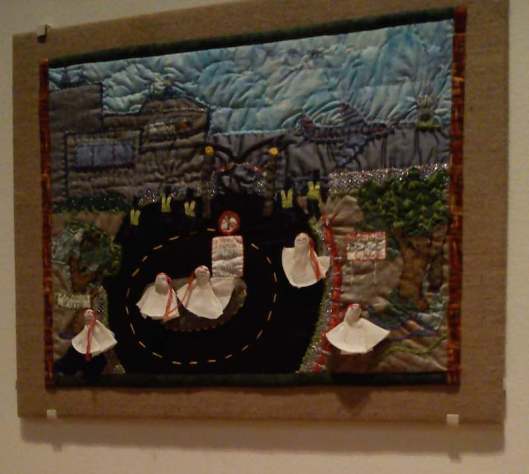
The second event we undertook was an exhibition entitled Disobedient Objects at the Victoria and Albert Museum. This was a visual display on how everyday objects have been used as objects of protest, civil disobedience and social change or revolution. There was quite a small array on display – most related to areas of extreme poverty or civil war. It was a fascinating exhibition (and one I highly recommend) and at times shocking. One particular object is being focused on here and this is the use of an art form known as arpilleras in Chile as a means for women to tell their own story. One caught my attention.

Deborah Stockdale, "Shannonwatch"

Deborah Stockdale, “Shannonwatch”

It was designed by Deborah Stockdale, an American textile artist living in Donegal in Ireland and was entitled “Shannonwatch”. It was accompanied by the following explanation:

“Donegal Ireland, 2011

The arpilleras made in Chile have inspired women around the world to use the technique to tell their own stories of survival and resistance. This recent arpilleras was made by an America textile artist living in Ireland. It depicts the activities of Shannonwatch, who are monitoring the use of Shannon Airport by the American military. The protestors wear white burkas in support of Afghani women caught up in the ‘War on Terror’. Deborah Stockdale”

Shannon Watch is a protest group, and their purpose is to stop or at least highlight the use of Shannon Airport by the US military (it is also worth noting that Shannon Airport – close to Limerick, is over 174 miles from Stockdale’s home in Donegal). However Stockdale has misused, in my opinion, their protest in her artwork. There is no record of any of the group having worn burqas of any colour or made any comment or protest about the oppression of women in Afghanistan. Their sole concern is the improper use of the airport by another military force. Therefore her artwork does not depict the actions of the protest group, instead she has hijacked them to make her own personal statement.

Shannon Watch are an important protest group and their cause a worthy one but they are not oppressed minorities – nor are they all, or even majority, women. Using this form of material and protest to highlight one’s own ideas demonstrates the solipsistic nature of categories. The protest at the airport is about the use of Irish airspace, not about the oppression of Afghani women. The presence of the burqa as the dominant image immediately brings it into the misinformed and heavily biased discussion of the burqa as a means of religious oppression of women (see, for example, here and here).

Furthermore, these forms of artwork are typically used by women in areas of oppression to express themselves when other means are not available to them. Stockdale can make no such claim, she is a citizen of one of the most powerful nations in the world today, she is able to make a living as an artist in the country she chooses to live in and her voice and ideas are heard in other countries. In other words, this relates to the question of ‘white privilege’ and indeed further feeds into that privilege because the voice of the dominant, normative, educated is being placed over the voices of those without said privilege. Stockdale is what Peggy McIntosh describes as “a participant, an unfairly advantaged person, in a damaged culture.” There are of course nuances needed within the ‘white privilege question’ as oppression is really more about intersectionality, as Gina Crosley-Corcoan notes. Often white privilege is gained, not through the colour of skin, but through education status, employment, economic stability, and familial circumstances. One form of oppression is no less important, or impacting, than the other

Choosing to have your work displayed alongside those who are oppressed and whose voice is not heard by the dominant, smothers or drowns what they are saying for the purposes of having someone else speak who already has a voice and a platform. These arpilleras, once a means for the subaltern to speak, have now become a means for them to be spoken over once again, and indeed to be spoken for. The subaltern has a voice, we need to stop speaking over them and instead listen.

Both Nurse and Stockdale have misused categories and have in different ways demonstrated the dominance of the religious – secular – political – Western categories still in existence and use. In so doing they have not only indicated how far we still have to travel but that oppression can still sink its teeth in when users refuse to acknowledge the slippery and solipsistic nature of these categories.

Recent blog postings:

  • When Regular PCR Tests Become Penance: Agamben, Biopolitics and Critical Religion  2 September 2022
  • Butler, gender performativity and religion 4 August 2021
  • Logic in Magic, and Human Cognition: Towards a new theory 17 March 2021
  • Politics of Love: Secularism, Religion, and Love as a Political Discourse 18 November 2020
  • The Contagion of White Christian Libertarianism and America’s Viral President 30 October 2020

Frequent blog tags:

academia Africa art Bible Biblical criticism body capitalism categories Christian church clash of civilisations concept of zero crisis Critical Religion culture economics economic theory education epistemology female genius feminism freedom of religion gender global higher education Hindu Hinduism humanities impact India interdisciplinarity interfaith dialogue international relations Islam Israel Japan Jew law liberal education managerialism Middle East mission history modernity music Muslim Naomi Goldenberg negation Northern Ireland nothing Palestine patriarchy performance politics postcolonial power REF religion religion-secular binary religious education religious freedom religious observance religious studies ritual sacred schools Scotland secular spiritualities stained glass theology United Kingdom university University of Stirling vestigial states women

Follow us on Twitter

Tweets by CriticoReligio

‘Like’ us on Facebook

‘Like’ us on Facebook

Our blog is published in association with

Ekklesia

Top Posts & Pages

  • Butler, gender performativity and religion
  • Fitzgerald, Timothy
  • Modern Government, Sovereignty and the Category of Religion: Beyond the Post-Secular
  • Nadadur Kannan, Rajalakshmi
  • Scholars
  • The Perry Expedition (1853-1854) and the Japanese Encounter with “Religion”
  • Home
  • On 'The Sacred Project of American Sociology'
  • Musicology and philosophy, religion and political science - the issue of interdisciplinarity
  • Is there anything good to be said for 'Religion'?

The Critical Religion Association…

... an international scholarly association pioneering intellectual engagement with questions on 'religion' and related categories.

About this site

This site is mostly maintained by Dr R Nadadur Kannan. Please contact us with any queries.
You can keep in touch with our work on Twitter, on Facebook, and through our mailing list.

About the blog

The Critical Religion blog is a shared (multi-author) blog.
The views represented are the personal views of individual authors and do not represent the position of the Critical Religion Association on any particular issue.

Copyright and Funding

Please note that all text and images on this site is protected by copyright law. Blog postings and profile texts are the copyright of their respective authors. We warmly welcome links to our site: each page/blog entry includes a variety of convenient sharing tools to help with this. For more information, see the note at the bottom of this page. Please do not reproduce texts in emails or on your own site unless you have express written permission to do so (if in doubt, please contact us). Thank you.

For a note about funding, see the information at the bottom of this page.

The CRA and the CRRG

The Critical Religion Association (this website) emerged from the work of the University of Stirling's Critical Religion Research Group created in early 2011. Interest in the CRRG grew beyond all expectations, and the staff at Stirling sought to address requests for involvement beyond Stirling by creating the CRA as an international scholarly association in November 2012. The CRRG passed on the blog and other key content to the CRA, and this is being developed here.
The CRRG website is now devoted exclusively to the scholarly work of the staff at the University of Stirling.

Critical Religion online

Apart from this website, the Critical Religion Research Group also has accounts elsewhere online:
- we are on Twitter;
- we are on Facebook;
- we have audio on Audioboo;
We will soon also offer video.

RSS feeds

  • RSS - Posts
  • RSS - Comments

Administration

  • Create account
  • Log in
  • Entries feed
  • Comments feed
  • WordPress.com

Blog at WordPress.com.

  • Subscribe Subscribed
    • The Critical Religion Association
    • Join 178 other subscribers
    • Already have a WordPress.com account? Log in now.
    • The Critical Religion Association
    • Subscribe Subscribed
    • Sign up
    • Log in
    • Report this content
    • View site in Reader
    • Manage subscriptions
    • Collapse this bar
 

Loading Comments...