• Home
  • What is Critical Religion?
  • Blog
  • Events
  • Scholars
  • Links
  • Recordings
  • Organisation
  • Ekklesia
  • Contact

The Critical Religion Association

~ Critical Approaches to the Study of Religion

The Critical Religion Association

Category Archives: University of Stirling

Commisioning Theological Imagery

08 Tuesday Jul 2014

Posted by pmedlockjohnson in Critical Religion, University of Stirling

≈ 2 Comments

Tags

Christianity, Critical Religion, imagery, stained glass, theology

Prof. Rudy Medlock and Paige Medlock Johnson working on the full-size template for the FAS stained glass window.

Prof. Rudy Medlock and Paige Medlock Johnson working on the full-size template for the FAS stained glass window.

My father and I have worked collaboratively on stained glass windows for several years. Although he is primarily a stone sculptor and potter, he learned the art of stained glass about 40 years ago and began teaching it in the art department of Asbury University. As a child, I would get off the school bus at the art department and learn alongside the students how to do fiber arts, ceramics, and stained glass, and as an undergraduate student I chose art education as a major with stained glass as my area of concentration. Since then I have worked with him on several commissioned stained glass projects from the Dominican Republic to Kentucky to Scotland for religious and secular institutions, although that demarcation often becomes blurred in the space of installed stained glass.

Stained glass is traditionally an art inherent with ecclesial associations, but now it is found in all corners of public domain; in a sense stained glass is missional as it has migrated from cathedrals to hospitals, homes and pubs, to galleries and libraries and offices. Stained glass is commissioned for symbolic messages, political agenda, architectural decor, for someone’s honor or memorial, and even still for religious purposes and places of worship, such as chapels and temples and churches. What we have traditionally considered distinctly ‘religious’ or ‘secular’ spaces has, in the placement of stained glass, fused or confused those boundaries.

A commissioning body requests a work of art from an artist or studio whom they know to be reputable, and their conceptual design will be for a specific place and purpose, and include a particular image to communicate that purpose. The artist needs to understand the context for the commission in order to create a visual hermeneutic that fills the intended physical space and fulfills the aesthetic and theoretic need. Here is one example of a commissioned stained glass project that changed imagery, artists, and message, illustrating the significance of commissioning theological imagery today.

The Francis Asbury Society is an organization that exists to promote a message of holiness – that people’s hearts and lives can be renewed to live a holy life in connection with God. The message is promoted via publication, itinerant speakers, and retreats and their headquarters recently moved from a modest cramped office space in the basement of an apartment building to an impressive timber frame building at the entrance to the town that is mostly known for Asbury Theological Seminary and Asbury University. Although FAS shares the same name and town in Kentucky as those two institutions, they are not affiliated.
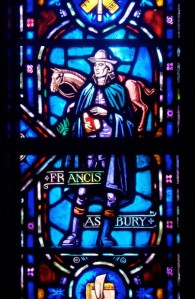
Stained glass window of Francis Asbury installed at The Upper Room, Nashville, Tennessee.

Stained glass window of Francis Asbury installed at The Upper Room, Nashville, Tennessee.

Bishop Francis Asbury was one of men sent by John Wesley to spread Methodism in America, which he did on horseback from 1771 for 45 years. His message, the heart of Methodism, was to spread the gospel and serve people – heart and hand, faith and good works. When the Francis Asbury Society began construction on their new headquarters, a few years ago they envisioned a stained glass window in the center loft space of the building.
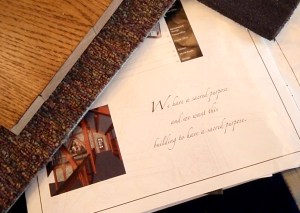
Campaign booklet showing original stained glass image with materials for interior design choices, taken at the studio while working on the new stained glass design.

Campaign booklet showing original stained glass image with materials for interior design choices, taken at the studio while working on the new stained glass design.

The overseeing president contacted my father about fulfilling the stained glass project, but upon hearing their desired image, he recommended a different stained glass studio that would be able to work with their desire for a realistic memorial image. After FAS contacted the other studio, the commissioning body still wanted my father to do the stained glass but now they were interested in changing their desired design to a more stylized symbolic image of a Celtic trinity knot, to be interpreted by the artist. They were familiar with The Power of Images and wanted, rather than to honor a person who spread a message, to commission an image of that mysterious message. This was interesting to my father, who then contacted me in Stirling to determine if we wanted to work collaboratively on the project. We both knew the organization and its founder and president, and we both liked the idea of working on a Celtic trinity knot, for its design potential, cultural heritage, and its theological meaning.

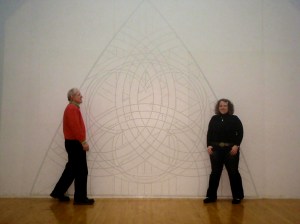
The evolving design included a fairly symmetrical geometric modern triquetra with interlocking trefoil, woven through a ring, all superimposed over and interacting with the background of three three-dimensional crosses mirroring the timberframe beams of the building in which it was to be installed.

The stained glass design is about the Trinity, the triune Christian Godhead constubstantial hypostates and relationship between God the Creator, Christ the Messiah, and the Holy Spirit, which is the central mystery distinct to Christianity. Without unnecessarily delving into Trinitarian theology, a simple explanation of the mystery of the trinity is important to understanding why a Christian ministry institution would desire to have this image prominently displayed. This same-essence-different-persons as monotheistic God is not only unique to Christianity but, simplified, is the essence also of Christianity. The illustration of this abstract theological concept by way of triquetra (Celtic trinity knot) and trefoil (architectural triad) is more easily accepted in visual terms than verbal complexity, and it is put forth with aesthetic beauty that is inviting to the viewer.

Like Dewey suggests, this art is experienced as a normal activity, not set apart or autonomous from human living. In fact, this particular stained glass window is installed in the midst of clerical work, scheduled meetings, publications, people in vocation. Unlike Dewey suggests, this art is also experienced spiritually – not set apart from so-called secular living but rather as part of holistic living including the thoughts and the feelings of a spiritual nature. Art can be a spiritual aesthetic experience, not excluded from everyday experience, but rather an everyday experience because it is a spiritual experience, in other words being and doing are not mutually exclusive; it is pragmatic because it is theoretical. This stained glass window can be experienced as artists’ co-creation of visual expression, as theological mystery being wrestled and glorified, as a purely pleasurable moment in passing by, as a creedal affirmation of faith, or even as an invitation to experience the verbally indescribable. It is not so relative that it is not personal, but it is so personal that it is relative.

For visitors to the Francis Asbury Society headquarters now, the stained glass window cannot be missed; as one enters through the front door into the main lobby, the window is centered overhead on the balcony above the main floor entry. Details throughout the building echo the trinity knot motif with wood inlay in the banister woodwork and the unique table configuration in the main meeting room. This stained glass window is here because it cannot not be here. Without it the building would be lacking in visual structure as well as theological foundation. There is a blurring of the sacred/secular where, in this space, the tedium of work becomes infused with the light of something holy while visual theology becomes part of the mundane rituals of work.
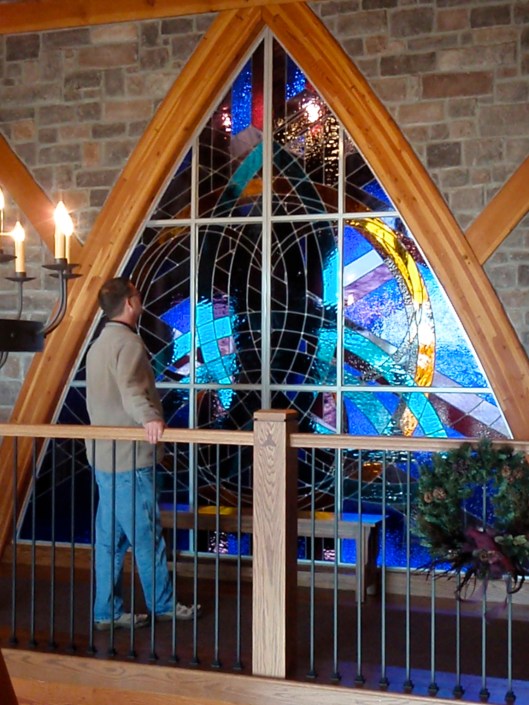
FAS stained glass window installed, shows scale, completion, and detailed woodwork.

FAS stained glass window installed, shows scale, completion, and detailed woodwork.

All photos © Paige Medlock Johnson.
Myths and Superpowers: “Metaphysical” Superheroes?

10 Tuesday Jun 2014

Posted by Dr Rajalakshmi Nadadur Kannan in Critical Religion, University of Stirling

≈ 6 Comments

Tags

Batman, Critical Religion, DC Comics, Mahabharata, Marvel Comics, mythology, myths, Ramayana, superheroes, Superman

This blog post is primarily about the language surrounding “mythology” “myths” and along the lines of the thinking behind the Critical Religion Association, “religion”. I look at these terms as tools for categorization using stories of superheroes.

In 80s and 90s India, most available comics available were stories taken from “Hindu mythology” such as Ramayana and Mahabharata or stories based on these works in books such as Amar Chitra Katha. Also popular were the Jataka Tales, a collection of Buddhist moral stories. On the television front, we had two state-run television channels and programs on South Indian channels were dubbed versions of Hindi programs produced mostly in Delhi, the capital city of India. Dramatized adaptations of Ramayana (produced by Ramanand Sagar) and Mahabharata (produced by B. R. Chopra) were televised during these two decades. The personification of Hindu deities and demons, the grandeur of the production and film-sets, and the visualization of these stories (that until then were only narrated orally) in these shows was awe-inspiring. As is common for “mythology”, several different television and film adaptations of both Ramayana and Mahabharata have followed since; however, the early versions set the standard for how subsequent adaptations would be made. What has prompted me to write about superheroes and their superpowers is primarily the language that we use to describe on the one hand, “Hindu mythological” stories and on the other, stories of caped-crusaders produced primarily in the West. What I want to explore here is how the language of “mythology”, “myths”, and “miracles” puts the stories of Rama and Krishna in a different league from that of, say, Batman, Superman, etc. Superheroes in these contexts are defined or understood as someone with ‘higher mode of being’ transcending the mundane human lives; indeed as Indologist Wendy Doniger O’Flaherty puts it, ‘an enlightened sage’ who transcends the ‘world in which reality is defined by normal, social, conventional human existence’ (1980: 97).

The television shows Ramayana and Mahabharata portray central stories surrounding the lives of the Hindu deities Rama and Krishna, respectively. These stories include some of their heroics that establish their identities as deities amongst humans and thus, set them apart. For example, in an article that discusses the “myth” and “reality” of such stories, O’Flaherty gives an example of a story about Krishna: when Krishna, as a toddler, was caught eating mud by his mother, she asked him to open his mouth. He did, to reveal the entire universe, signifying that he was the embodiment of everything in this universe. Or the story where Krishna protects his devotee Draupathi by providing her with clothing when the cousins of her husbands attempt to humiliate her by disrobing her, as this video shows.

There are numerous such stories in Ramayana and Mahabharata (and other similar works classified as “Hindu mythology”). O’Flaherty, her problematic language aside, makes an important argument, that “mythology” made into a field of study has forced stories such as the above to fit within the framework of “myths” that need to have a function on a practical level because they concern deities (1980: 93) and are classified as “religious myths”. In doing so, these myths must then prove ‘whether or not there really is anything “out there,” and, if so, what it is’ (1980: 93). This, I contend, is primarily because, as flagged above, the language that is used to describe the stories of these deities, i.e., “myths” and “mythology”; that is, “myths” that need to within the framework of human rationality.

O’Flaherty argues that a definition of both “myth” and “reality” cannot be pinned down, but these terms are used as such: while “myth” refers to those experiences that are seen as metaphysical, “reality” is seen as pertaining to the physical world where “natural sciences” dominate (1980: 94). It is this construction and resulting understanding that problematizes how we understand stories surrounding the deities. By classifying what is perceived as metaphysical as “myth” or as the opposite of the physical world or natural sciences, stories of the deities are automatically classified as “religious” and supernatural. What then happens is a “mystification” of these stories as if they belong to a realm that is beyond human cognition or imagination. Richard King, whilst tracing the origins of the term “mysticism” as a Western construct, argues that “mysticism” is seen as pertaining to perceptions of God or deities, that is then seen as ‘antithetical to rationality’ (1999: 25). Using the term “miracles” because deities are involved makes these stories a mystified, otherworldly phenomenon: not in the sense of fiction, but as something that is supernatural. The mystification that derives from seeing these characters as “religious” pushes them towards a “religious-secular/scientific” dichotomy, in which attempts to “prove truth” automatically falter due to the false categorization. This is, of course, not to say that audiences believe that the superheroes in the DC Comics and Marvel Comics universes really exist or that the superpowers of these heroes are “rational”. There is a general level of acceptance and understanding that these characters are fictional; therefore, they enjoy a certain amount of legitimacy as fictions.

Of course, both “mythologies” and superhero comics to a large extent suspend reality or what we perceive as reality. As O’Flaherty argues, the purpose of these “mythologies” is for the superhero to reveal the tribulations in mundane human existence, and ways to resolve them (1980: 97). There are thus similarities between deities in the “mythologies” and the superheroes of the comics’ universes. In my view, Rama, Krishna, and other Hindu deities can be seen as superheroes, and to distinguish these stories from other superhero comics is problematic. The distinction is based on, as I have shown above, the distinction we make between “mythologies”, which as soon as deities are involved, is classed as “religious” or “spiritual mythology”. To categorize “mythology” as such then prompts us, with our problematic understanding of the category “religion”, to question whether these stories are “true”. We then ask “did it really happen?” The idea then is that if we cannot prove that it really happened, it is untrue and therefore, a “myth”.

Thus what I am pointing to is the binary categorization that results from pseudo-empirical tests of proof; whatever is seen as “religious” must be empirically provable as science (supposedly) is; if it is not, it is “mythology” – and therefore, superficial. Instead, we must see these stories as something beyond empiricism and/or otherworldly mystification, recognizing the role that miscategorization plays in our interpretations.

More than the One Ring? Tolkien, faith and critical religion

18 Sunday May 2014

Posted by Francis Stewart in Critical Religion, University of Stirling

≈ Comments Off on More than the One Ring? Tolkien, faith and critical religion

Tags

C S Lewis, faith, Hobbit, Lord of the Rings, religion, Tolkein

Interest in the world of Middle Earth is riding high again with the successful Hobbit films currently being released by Peter Jackson a decade after his adaption of the longer story The Lord of the Rings. Both stories, and others (personally I am hoping Jackson takes on ‘The Children of Hurin’), were written by John Ronald Reuel Tolkien (J.R.R. as he preferred, or Ronald to his friends) whom many know was an Oxford professor of philology and mythology. What is perhaps less well known is Tolkien’s approach to his personal faith and his understanding of religion which he infused all his stories, indeed his created world of Middle Earth with.

J.R.R. Tolkien lost his father when he was 4 years old. His mother, Mabel, responded to his death by converting to Catholicism. This resulted in tension and ostracism from her Unitarian and Methodist family with the consequences that she moved her two sons to live in the countryside outside Birmingham and worked hard to sustain them. She provided their early education but succumbed to complications arising from diabetes when Tolkien was 12 years old. The Catholic Church took them in and provided for both boys’ education in good schools. For Tolkien, Catholicism took on “the place in his affections that she had previously occupied.” (Carpenter, 1977, p50)

As is well-documented, Tolkien began to create his world of Middle Earth, and indeed to write the beginnings of what would become ‘The Silmarilion’ during his time serving in the trenches in World War 1 (he was badly injured during the Battle of the Somme). His experiences in the war caused him to become focused on the questions of good and evil in man and the notion of forgiveness, with redemption being the ultimate expression of it.

After the war he was appointed first to Leeds then to Oxford where he remained for the rest of his career. He was joined by numerous scholars and writers the most famous probably being Clive Staples Lewis (C S Lewis author of the Narnia tales). Another was Charles Williams, a poet and author who was fascinated by Christian mysticism and alchemy. These men, along with various others at different points, formed the group known as The Inklings who met once or twice a week in a pub to discuss language, read their current writings and receive criticism and then to debate matters of faith and ideas. Of them all Tolkien was closest to Lewis and was devastated when Lewis turned from his agnostic path back to his Ulster heritage of Protestant Anglicanism.

Although a devout Catholic, Tolkien was critical of any notion of an absolute or universal religion and he frequently chided Lewis for treating religion as a sacred thing that existed in its own right and place in the world. Tolkien lamented that this was a childish understanding of faith. In one of his many letters (he was prolific as a letter writer) to Lewis in regards to his book ‘Christian Behaviour’ he takes Lewis to task for treating all Muslims are being the same as each other, while demanding that they recognise the variety that exists within Christianity. He refers to the use of Muslims as a counterfoil for Christianity as “a stinking red herring” (Carpenter & Tolkien, 1981, p60) by Lewis to disguise the presumption that religion exists because it exists and cannot therefore be challenged or altered. In the same letter he continues to reprimand Lewis for ignoring that irreligious folk live and behave in moral ways as determined by their laws, their society and their own conscience.

Partly in reaction to Lewis and partly because he genuinely believed what he was arguing, his own writings contain no explicit reference to religion at all, but rather they deal with vague matters of faith. He viewed this as a necessary form of freedom if faith was to survive and be relevant in the world (both the physical world he lived in and the imaginary world he created). So, for example, in a letter to W. H. Auden he outlined that he does not deal in absolutes such as good and evil but rather in perceptions. He writes; “The Eldar and the Numenoreans believed in The One, the true God, and held worship of any other person to be an abomination. Sauron desired to be a God-King, and was held to be this by his servants.” (Carpenter & Tolkien, 1981, p243) He reasoned that each acted according to their own perception and so for each their cause was right. He then continues to liken it to his current world of wealthy bosses who rule over the masses who must live in fear and squalor while the state (he later changes this to state-God) promises them that doing so will ensure “peace and abundance and … mutual esteem and trust.” (ibid p244) It is unknown how Auden responded to this as the letter resulted in a personal visit rather than a written response.

For Tolkien religion was a term he was uncomfortable with (and of course he would have known its etymology intimately in a variety of languages) and he did not want the concept of it to be overt in his writings and his imagination. He reasons for doing so were complex, they were bound up with the death of his mother, the experiences on the battle fields of the First World War, and his mistrust of a rising ‘secular’ state that he thought worshipped only ‘damned capitalism, money and power’. He wanted to create as realistic a world as possible, it was to be his gift to his country (to replace his lament that England has no mythology) and for Tolkien religion as a concept was a false one and so had no place in Middle Earth. This cue he took from Old Norse and Celtic mythology in which aspects of faith were suffused within everyday aspects of life rather than a separate institution. (Shippey, 2000, p174) In the midst of the phenomenal writings, the spectacular films there is an important message that continues to speak to the work, interests and purpose of Critical Religion.

Lest we forget or are forgotten

11 Tuesday Feb 2014

Posted by Francis Stewart in Critical Religion, University of Stirling

≈ Comments Off on Lest we forget or are forgotten

Tags

art, Christian, Critical Religion, Northern Ireland, religion

In 2013 Richard Harries’ “The Image of Christ in Modern Art” was published. In his book he outlines four specific criteria for considering a piece of modern art as being ‘religious’. They are:

  1. All genuine art has a spiritual dimension, just by being good art.
  2. It is possible to point to the work of believing Christians regardless of their subject matter because it is still an expression of faith.
  3. It expresses or evokes certain characteristics associated with the Christian faith such as redemption, forgiveness and loving kindness.
  4. It is related to in some way, traditional Christian iconography. (Harries, 2)

Harries exploration of modern art having to come to terms with and express a seismic rupture as well as contend with expressing faith in an increasingly secular society is laudable and the book is recommended on that basis (it would make an nice companion piece to Tarnas’ Passion of the Western Mind for undergraduates). However, there are a number of areas where issue has to be taken with the treatment provided within the text. For the purposes of this posting I am going to focus on the four criteria and relate them to the specific context of Northern Ireland.

The first criteria immediately rings alarm bells, what is genuine art? Can art exist that is not genuine but false? A quick read through the introduction and first chapter quickly reveals that what Harries means by good art is high art, there is an added layer of exclusivity to the art under consideration. Why then does high art have a spiritual dimension, and low art, by implication, not? The third criteria could have a blog posting on its own on the basis of why are those qualities associated with Christianity alone, when they exist in other contexts including secular ones? However Harries does make it clear he is only dealing with ‘Christian art’ and the Christian faith so I leave that for another time.

It is with the second and fourth criteria that I want to focus in on. Both assume that personal faith, religion to be a distinct and separate thing capable of motivating an individual by force or will. The fourth criteria further assumes a timeless quality and universalism to iconography and its images and symbols. Neither seem to realise, or acknowledge, as Nietzsche did that art is the highest form of expression of the human spirit (The Birth of Tragedy). As such an expression it carries a clear intent for the artist regardless of how well that translates to the viewer. What the viewer interprets comes from his own perspective. Finally, art and artistic expressions are not encapsulated forms of religious expression. In his posting Per-Erik Nilsson argued that:

religion and secularism are contingently articulated categories bound to power and ideology … these articulations have been used to legitimate Western politics and expansion (colonialism, neo-colonial politics and imperialist ambitions).

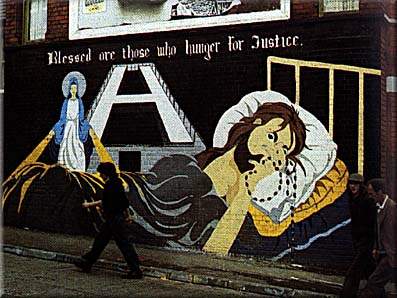
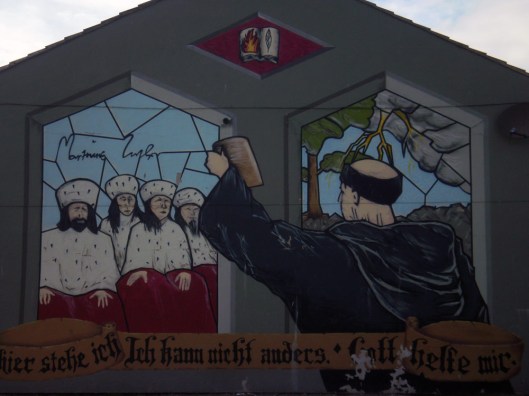
In Northern Ireland we have a long tradition, on both sides of the divide, of painting wall murals. These are often imbued with what Harries would consider elements of traditional Christian iconography or imagery. Below are two such, the first from Hopewell Crescent in the strongly loyalists Lower Shankill area of Belfast. It depicts Martin Luther nailing his treaties to the Wittenberg door and has a banner stating in German “Here I stand. I cannot help it. God help me. Amen” (Camera did not capture the Amen which is lower down).

Hopewell Crescent, Lower Shankhill Road, photo © Francis Stewart

Hopewell Crescent, Lower Shankhill Road, photo © Francis Stewart

The second is from the nearby Republican area of Divis Street. It depicts the Virgin Mary standing over a dying hunger striker who is saying his rosary and contains the script “Blessed are those who hunger for justice.”

Virgin Mary watches over a hunger striker

Virgin Mary watches over a hunger striker

Are these forms of Christian art as Harries would perhaps argue (although given they are not high art he may well desist) or are they rather an example of Nilsson’s articulations of categories bound to power and ideology? I would argue for the latter, there are clear political messages in both – the giving of one’s life through starvation for a cause one believes in, and a defence of the very essence of Protestantism, which in this context means a defence of one’s community and right to remain British.

What I would argue about these murals is that they are a means of remembering the past and ensuring that one’s current struggles are not forgotten. Tom Shippey (writing of the works of Tolkien, but none the less pertinent) reminds us:

The very fragility of record in such societies makes memory all the more precious, its expressions both sadder and more triumphant. (Shippey, 97)

The religious imagery, if one can call it that, is used in these murals as a means to an end there is no distinct religious or spiritual impulse behind them. They serve the purpose of telling the past when those in authority or power will not listen. I do not agree that those in weaker positions are voiceless, they are perfectly capable of speaking; those in positions of power must learn to listen. Michael Marten reminds us:

What we need is a realistic exploration of ‘historically specific acts of resistance’ to avoid silencing the subaltern. (Marten, 231)

In creating these murals, the people of Northern Ireland are finding a way round the deaf ears of those in power. They are telling and retelling their history, speaking of their hopes for the future, speaking out against injustices done on them and in the process adding to the further division of the country and the re-entrenchment of their own communities. These are not forms of spiritual or religious art but an engagement with critical religion in that they demonstrate the entire interdependancy of religion, secular, political and power and the tangled web they weave.

——

Richard Harries, The Image of Christ in Modern Art, (Surrey: Ashgate, 2013).

Michael Marten, “On Knowing, Knowing Well and Knowing Differently: Historicising Scottish Missions in 19th and Early 20th Century Palestine” in Ellen Fleischmann, Sonya Grypma, Michael Marten and Inger Marie Okkenhaug, Transnational and Historical Perspectives on Global Health, Welfare and Humanitarianism, (Kristiansand: Portal Books, 2013) p210 – 238.

Tom Shippey, J.R.R.Tolkien Author of the Century, (London: HarperCollins, 2000).

The ‘Secularity’ of Neoliberalism in India

20 Monday Jan 2014

Posted by Dr Rajalakshmi Nadadur Kannan in Critical Religion, University of Stirling

≈ 1 Comment

Tags

caste, economics, India, neoliberalism, secular

The on-going campaigns for the upcoming 2014 Parliamentary elections in India have put Mr Narendra Modi as the National Democratic Alliance candidate (NDA) headed by the right-wing political party, Bharatiya Janata Party (BJP). The coalition currently in power, the United Progressive Alliance (UPA) headed by the Indian National Congress party, has been mired in various corruption scandals, a reason for increasing favorability for the NDA. But Mr Modi has been a very controversial politician. As a four-term (and current) Chief Minister of the north-western state of Gujarat, Mr Modi has been accused of expressing discriminatory opinions against minorities, specifically, Muslims. He is a member of the right wing Hindutva group, Rashtriya Swayam Sevak. In fact, a year into his first term as the Chief Minister in 2002, Gujarat saw a period of horrific communal violence that began when Muslim groups were accused of burning a train coach in Godhra that killed Hindu activists, which spiraled into violence against Muslim communities. Mr Modi has long been dogged by allegations that he refused to prevent the post-Godhra retribution committed against the Muslim communities after the train-burning incident.

Despite such a controversial history, Mr Modi’s polls numbers are indicating an increase in popularity and favorability as the next Prime Minister of India. As Desai has argued in this article, there is an issue of middle-class voters not opposing (at least openly) the Hindutva ideology of Mr Modi and the BJP. Importantly, Mr Modi’s campaign rhetoric has touted the neoliberal economic policies that he adopted in his home state of Gujarat that has seen significant growth of its economy. He has presented this as a divide between caste and religion on the one hand and development on the other; and he is presenting himself as a candidate pro-development. Thus, neoliberalism is used to show the seeming ‘secularity’ credentials of Mr Modi. He has repeatedly argued that his ideology of ‘inclusivity’ has been central to Gujarat’s trade policies, thereby ‘leveling the playing field’ for all and transcending differences in caste and religious identities. In fact, such a notion was put forward by CNN’s Fareed Zakaria, a popular Indian-American proponent of neoliberalism, who has argued that Gujarat’s (and in fact, India’s) economic growth has transcended political, caste and religious differences. To an electorate experiencing a series of corruption scandals under the UPA government and stagnant economic growth, one can see why this rhetoric seems appealing.

However, this raises a question whether neoliberalism can be seen as a ‘secular’ ideology that transcends those identity markers in India that are often associated with ‘religion’ such as the caste system. The question of understanding economics as ‘secular’ science has been dealt with on many occasions in this Critical Religion blog. My focus here is to reflect on what understanding of neoliberalism pertaining to India one should consider. On the ‘new India’ that Zakaria sees as emerging, he wrote:

Starting in the early 1990s, New Delhi has been overturning the license-permit-quota raj and opening up the economy. The result is an India that is quite different from the one its founders might have imagined—a motley collection of communities, languages, and ethnicities living together in an open political and economic space.

This kind of narrative furthers the idea that Friedman argued in his now famous text, The World is Flat, that somehow, ‘secular’ economics would triumph and transcend the underdevelopment that exists on the ground because of ‘religion’, specifically caste and closely associated with that, class. Critiques of Mr Modi have pointed out how uneven the development brought in by neoliberalism in Gujarat has been. For instance, Desai argues that despite Mr Modi’s claims, his economic policies have benefitted the already existing middle-class Hindu communities whilst poverty and malnourishment has affected minority communities, especially the Muslim communities. Similarly, an article in First Post has argued that the Dalits continue to experience discrimination in society.

Workings of neoliberal policies are embedded in the social context. To look at these economic policies as the ‘secular’ solution towards development is problematic. Both Mr Modi and Mr Zakaria are disembedding the capitalistic benefits of these policies for their own ends. Within the context of India, neoliberal policies do not transcend caste or class identities but are shaped by them and politicians who have the power to administer and shape these policies. This is not to mean that the UPA government, as a ‘secular’ alliance, would have made these policies work better for minority communities. The ‘season of corruption scandals’ certainly did not leave the electorate reassured. But looking at neoliberalism as something that is removed from its social contexts, as Zakaria does in his essay, only lets campaigns such as Modi’s reframe the narrative to conceal the reality on the ground, that neither these policies nor Modi’s approach ensure ‘inclusivity.’ Zakaria himself says “Economic growth has created one more common element in the country—an urban middle class whose interests transcend region, caste, and religion,” which begs us to question, what about those communities that are being left behind? What is even more problematic with the Modi campaign and the BJP is that in addition to ‘lower’ class and caste communities being left behind, the BJP’s Hindutva connection reframes neoliberal development into a development of Hindu communities by a) emphasizing the superiority of the ‘Hindu’ identity; b) deliberately leaving other minority communities behind.

Hence, it is important to scrutinize (as some news outlets, such as the ones I have referenced above, have been doing) the rhetoric of the Modi campaign to ensure that development is not presented as an abstract concept that would render certain communities voiceless.

A Profession of Imaging Religion

13 Wednesday Nov 2013

Posted by pmedlockjohnson in Critical Religion, University of Stirling

≈ 1 Comment

Tags

art, Heidegger, Robert Sowers, stained glass

Robert Sowers (1923-1990) created some of the most remarkable stained glass windows in the US during the twentieth century, including the 30,000 panel American Airlines wall at what is now called JFK Airport.  His work in 1960 was the largest stained glass window in the world at the time.  Terminal 8 stood for 48 years then was demolished for remodeling in 2007, and along with it, the enormous window.  One source reports people referred to the airport terminal as ‘The Cathedral’, when in fact, Sowers was a pioneer stained glass artists creating major commissions outside the church. It was demolished less than five decades after its commissioning with suggestions to turn pieces of its glass into key chains for airline employees.

Stained glass reached its height of glory in the medieval period when the average person would not have much exposure to vibrant colors and use of light outside the church.  Their experience in the church would have made a physical and spiritual impact.  The actual light translated in illuminated visual images was analogous to the scriptural light of God overcoming the evil or chaos of darkness.

The transition from Romanesque to Gothic architecture is most evidenced in the Abbey of St. Denis from the late 12th century under Abbot Suger, who wrote on the theological significance of architectural decisions:

Thus, when – out of the delight in the beauty of the house of God – the loveliness of the many-coloured gems has called me away from external cares, and worthy meditation has induced me to reflect, transferring that which is material to that which is immaterial, on the diversity of the sacred virtues: then it seems to me that I see myself dwelling, as it were, in some strange region of the universe which neither exists entirely in the slime of the earth nor entirely in the purity of Heaven; and that, by the grace of God, I can be transported from this inferior to that higher world in an anagogical manner.  [Thiessen, 2005, p116]

Sainte-Chapelle, Paris (photo by P M Medlock Johnson)

Sainte-Chapelle, Paris (photo by P M Medlock Johnson)

Gothic architecture achieved verticality and light by developing certain structural elements (pointed arch, rib vaulting, flying buttresses); this skeletal structure vastly opened up wall space for windows.  Stained glass windows were designed to vertical extremes that translated light in color, altering worship atmosphere and illustrating biblical theology.  The makers of stained glass knew the limits and possibilities of the material with which they worked in such a way that they could facilitate the optimal brilliance of the finished piece by means of the media.  These craftsman knew not only color theory, but that of glass that permits, prohibits, translates, and radiates light.  What would a red piece do next to blue rather than clear when sunlight burns through it?  What piece would dominate, or recede, or pierce the air?  What combination would confuse or enhance the image and the visual experience?  Or the worship experience?  What would affect the communication and reception of the image, which was generally a biblical message for the common person unable to read the Word.  Stained glass of Gothic architecture either illustrated the entire bible, as Sainte-Chapelle has for eight centuries, or a main theme of sinful humanity with hope of salvation through Christ.  Alternately, some windows center Christ within purposefully arranged references to other parts of scripture demonstrating rich theological cross-referencing and skilled thoughtful design.

Two factors led to a major shift in the stained glass profession from its height of glory in the Middle Ages to becoming a ‘lost art’ in the Renaissance and Reformation.  First, art making became less material-inspired and more imitative of easel painting.  Second, iconoclasm (‘image breaking’) of the Protestant Reformation and Dissolution of Monasteries questioned visual imagery as a scriptural violation rather than theological hermeneutic, and effectively removed stained glass from Christian architecture.

But it did not disappear forever.  Sir Herbert Read writes, “In our own time, as part of a general return to aesthetic integrity, the art of stained glass has been reconsidered and, indeed, rediscovered.  The guiding principle of translucency has been re-established, and, as in the Middle Ages, the greatest artists of our time have experimented in this medium.”  [Sowers, 1954, p8]  He could rightly foresee glass as an important element of architecture: hiding unsightly views and coloring space, honoring the integrity of art forms, and turning public spaces into inspiring places.  In addition to modern artists such as Matisse and Chagall turning from paint to glass, stained glass of the Craft Movement (especially Morris in England, Mackintosh in Scotland, and Wright in America) restored the art from its medieval glory to a contemporary aesthetic, and positioned it as a major element of modern architecture.

Robert Sowers writes, “When art is working it heightens both the materiality and the fantasy of the image; the two are fused in exaltation.  But when the material is excited to no purpose, or the image rooted in no material there can be no deep-rooted art.” [Sowers, 1954, p28] His own record-breaking Terminal 8 stained glass window was contracted to Olde Good Glass in New York City to be dismantled and reclaimed into new objects for public sale.  Was he wrong?

Stained glass has been installed and removed from religious and secular institutions for seemingly different reasons: sacrilege and outdatedness; it means too much and it means not enough.  Perhaps there is an underlying threat worth questioning that only the material can shed light on: glass is an antithetical mediatory material.  Isobel Armstrong says we need to work through the paradoxes and contradictions inherent in glass, saying,

They are perceived at a purely formal or aesthetic level unless they generate a “restlessness”, which both reorders a problem and the mind that works on it.  This mediation is, in Heidegger’s words, “the form of the very thinking which thinks itself”.  It is “the conceiving of oneself—as the grasping of the not-I”.[Armstrong, 2008, p12]

The stained glass process (photo by P M Medlock Johnson)

The stained glass process (photo by P M Medlock Johnson)

Humans do not like to grasp the not-I, and if stained glass positions the viewer in such tension, even when crafted in awe-inspiring otherworldly visual ways, it will be removed only to be reinstalled elsewhere.  The stained glass profession has thrived and dwindled, but what it professes will not be extinguished.  The artistic profession of stained glass making not only revived, but returned its focus to the inherent qualities of the glass.  Where stained glass orders chaos by assembling broken pieces into a structured design that illuminates a space with intentionality, it continues to embody the relevance of a timeless yet cutting-edge visual hermeneutic.

Resources

  1. Armstrong, Isobel.  Victorian Glassworlds: Glass Culture and the Imagination 1830-1880. Oxford: 2008.
  2. Sowers, Robert. The Lost Art: A Survey of One Thousand Years of Stained Glass. NYC: 1954.
  3. Thiessen, Gesa Elsbeth. Ed. Theological Aesthetics: A Reader. Grand Rapids/Cambridge: 2005.

Remembrance: “The battles we remember…”

05 Tuesday Nov 2013

Posted by Kat Neumann in Critical Religion, University of Stirling

≈ Comments Off on Remembrance: “The battles we remember…”

Tags

Audre Lorde, Dorothee Sölle, remembrance, war

On the run-up to Armistice Day – and the numerous other days that are marked by public commemoration – I want to think about the focus of our remembering. During the first years of having come over to Scotland from Germany especially, Armistice Day, and the dozens of war memorials, as well as the never ebbing rhetoric that would equate “the Nazis” uncritically with “the Germans”, I found public expressions of commemoration both unhelpful and disturbing. I have since changed my attitude and this is largely to do with a change of focus in what these kinds of public acts may also achieve. I want to take my cues from a lesson learnt in a poem (see below) by the late German theologian, activist and poet Dorothee Sölle (1929-2003), titled “Memories of audrey lorde” (Loben ohne lügen, Berlin: Fietkau, 2000:47; my translations). Maybe it is a problem of the “late-comer” generations, such as myself, that all we seem to recall with poppies etc. is that there was – or if we let ourselves be made conscious of it, that there is – war, with many victims no less. Despite much protesting and campaigning for innumerable causes of lived and living injustices, we lose sight of a vision for justice expressed in the solidarity with the dead, and our connection to the past and “its” struggles more generally – be that in the context of a military war, on the side of soldiers or civilians, or the many other battles faced in day-to-day living that make public commemorations of the dead so powerful.

Audre Lorde (1934-1992) – the anniversary of her death (from cancer) is only weeks away – was a Caribbean-American poet and activist. The kinship between Sölle’s and her activist concerns, especially on questions of emancipatory movements is striking, despite their radically differing contexts. Audre Lorde, as a Black, lesbian Feminist living through the American civil rights movement seems to have so little in common with the White, German academic theologian and writer, despite her spokes-role in the German Peace movement. And yet, their ties go beyond the mutual recognition of the struggles and pains with cancer (Sölle’s close writer-friend Heinrich Böll (1917-1985) is subject of various of Sölle’s poems; he died of cancer). Their poetic engagement and their belligerent verse is testament to a love for justice that makes hopeful.

While “Memories of audrey lorde” is interesting in structure as much as in content from the outset, it is the finishing words that I want to draw on most closely in view of this brief exposition. In Protestant theology the task of translation, and of continuous retranslation, holds a special place. The poem speaks with candour about what visions are lasting and outlasting the existential threat posed by death and fear in living. Although there is of course a need for awareness of the fears and the deaths suffered, in past and current wars, military or otherwise, commemorative events fall short in their own trajectory if they stop at giving information on the extent of past hardships. Meditating past suffering by oneself, too, can be a dangerous game. In the poem, noting that fear becomes ‘less and less important’ (l.4) the fear of death is undercut by a personal integrity that cares for ‘our vision’ (l.23). While Lorde’s quote in the opening lines is taken from her work The Cancer Journals (San Francisco: Aunt Lute Books, special ed. 1997:13), it is not a defeatist perspective onto death we are reading, but it is commonly understood to purpose individual empowerment in face of terminal illness. The way Sölle prefaces her prayer with these lines, and shifts their emphasis in her strugglesome desire to share in this perspective is particularly notable in the cross-over from ‘me’ to ‘our’: ‘i am not free / to use my power / for our vision’ (ll.21ff.). The markers strewn throughout the text of that which makes the poetic persona unfree vary – ecological, physiological and social – at heart cancer stands in for a whole range of fears that perpetually cloud the vision of the poetic persona. The reader who suddenly finds her (or him)-self amidst this ‘our’ of the vision is no better off. Elsewhere Lorde says: ‘Our visions begin with our desires’ (Claudia Tate, Black Women at Work, New York: Continuum, 1983:107) The poem then becomes a contribution, in its desired tribute to Lorde’s suffering, for breaking down the isolating grip of pain and death which Lorde’s rejection of being defined by cancer elucidates. Suddenly, fear is not everything, and we readers are no longer alone.

Identifying herself in relation with other people’s struggles, also their struggle for life against illness, the poetic persona locates the strength of overcoming fear for oneself (and the fear for others) in the collective vision, of being towards one another, and thus, not being reduced to the material dimension of the body as a conglomerate of bodily functions. In this sense, the transcendence bespoken by the poem in existential terms finds retranslation into the theological vocabulary by the name ‘eternity’ (l.30). Eternity gathers together both the living and the dead. This is not a vision of heaven in an afterlife that is in temporal terms everlasting, it is an existential qualification of a theological concept that evaluates personal involvement in such a way as to see the potential of a person not at the measure of their inhibitions and fears, or their in- or disabilities. Eternity is the recognition of being part and party to every living being, even unto and beyond “individual” death. It is then the continuity with others, rather than dull repetitiveness that marks out the stability commonly associated with the word eternity.

In the context of a ‘Memory of audrey lorde’ (l.1), this memory is not rooted in past reflection, recalling fragmentary passages of times gone by, rather it is a creative encounter with the text that is itself the product of retranslation, or presencing, occasioned by the text. Audre Lorde’s vision, courage and encouragement remain a living voice in the body of the poem. This creation does not eradicate the pains felt by those who mourn. But it co-memorates, it shapes them for those too far removed in time and situation to realise these losses first hand. Bringing to life that in past struggles death is not necessarily defeat, I say, let us re-member once again.

—-

Memories of audrey lorde [LL 47]

      When i dare to be powerful
to use my strength in the service of my vision
then it becomes less and less important
whether i am afraid

I am afraid my sister
the sun is becoming poisonous without protective shell
the breath is becoming short more asthma for everyone
and the dreams go astray

It does not matter
you say to me
your fear
is not the most important thing about you

But i cannot let go of fear
it is after all the cancer that has eaten you up
and my brother
and my women friends cancer wants
fear holds me captive
sometimes i get time off
for a while
but i am not free
to use my power
for our vision

It is less and less important
if you are afraid
you say to me

Ach i say once more
it is as if you had
translated anew
the word eternity

Jackie Kay’s encounter with double-consciousness and religion

30 Wednesday Oct 2013

Posted by fionadarroch2013 in Critical Religion, University of Stirling

≈ Comments Off on Jackie Kay’s encounter with double-consciousness and religion

Tags

Christian, double consciousness, Glasgow, Jackie Kay, Nigeria, Scotland, Vijay Mishra, W. E. B. DuBois

Jackie Kay was born in Edinburgh in the 1960s to a Nigerian father, and a white mother from the Highlands. She was adopted by a white couple who were active members of the Communist party. And she is a graduate of, and holds an honorary doctorate from, the University of Stirling. She is the author of novels such as The Trumpet (Picador: London, 1998) and collections of poetry such as The Adoption Papers (Bloodaxe Books: Northumberland, 1991). She has recently published her witty and heartfelt memoirs, Red Dust Road (Picador: London, 2001), about her upbringing and being reunited with her birth parents. The opening chapter is an amusing account of her first meeting with her birth father in a hotel room in Nigeria, which raises fascinating questions about ‘religion’, and identity:

And now we’re in the room. I’m about to have a conversation with my birth father for the first time.

Jonathan is moving about from foot to foot, shifting his weight from side to side, like a man who is about to say something life-changing. He begins: ‘Before we can proceed with this meeting, I would like to pray for you and to welcome you to Nigeria.’ I feel alarmed. Extreme religion scares the hell out of me. It seems to me like a kind of madness. But it is obvious to me that Jonathan won’t be able to talk at all if I try and skip the sermon, ‘OK, then,’ and he says, ‘Sit, please.’ And I sit.

He plucks the Bible from the plastic bag. Then he immediately starts whirling and twirling around the blue hotel room, dancing and clapping his hands above his head, then below his waist, pointing his face up at the ceiling and then down to the floor, singing, ‘O, God Almighty, O God Almighty, O God Almighty, we welcome Jackie Kay to Nigeria. Thank you…’ He does some fancy footwork. He’s incredibly speedy for a man of seventy-three. He’s whirling like a dervish.

I shift uneasily in my seat. Christ Almighty, my father is barking mad…

When I tell my mum about it on the phone, down an incredibly clear line from Abuja to Glasgow, how he doesn’t want to tell any of his children, and how I must remain a secret, how he feels I am his past sin, she says: ‘By God, did we rescue you!’ (Kay, 2010: 3-11).

As an academic in Scotland specialising in critical religion and culture, and in postcolonial literature, what do I do with this extract? As a teacher, and a researcher, here are some of the questions I would start with: How do we make sense of the concept of ‘religion’ that is portrayed? What does it tell us about national identity, about Scottish identity? What role does the humour play? How can this whole extract inform us to think creatively about writing about religion and postcolonial literature?

In many ways, the reader is presented with the meeting of European rational thought, and non-western modes of thought. The awkwardness of this incredibly personal moment makes us laugh. For Jackie Kay this is the meeting with the fabric of herself, her ancestry, and therefore a significant part of her identity, an identity that is also rooted in European and Scottish rational thought, an identity that rests on a safe distance maintained between religious and secular spaces. The imposition of this almost ecstatic religious display within the confines of a Hilton hotel room leaves Jackie Kay in a state of semi-consciousness: “I’ve zoned out now, drugged by his voice. I go in and out of consciousness like somebody who’s very ill. I can’t see properly” (Kay, 2010: 6). Kay playfully suggests that she has succumbed to a religious trance and is loosing grip on her post-Enlightenment, rational, secular self. I am intrigued by the complexity and contradictions of this exchange; the banal yet often embedded notion of appropriate religious behaviour or the impact of colonial violence? Are we laughing because we can safely sit in our armchairs knowing that we are choosing not to believe, or that we at least know how to contain our religious self appropriately? Or what about what Kay sees, which is the crude imposition of Christianity on African culture leaving behind a ludicrous mimicry and madness. To classify Jonathan’s display as a colonial mimicry is to subjugate and ‘exoticise’ his voice again, but this time by the western (postcolonial) academic. Graham Huggan talks about the risk that the marketing of postcolonial literature takes by ‘replicating the exotic consumption of otherness’ (Huggan, 2001: 37). Is our laughter merely a crude consumption of this display of ‘otherness’?

Mary Keller states that if we, as western academics, continue to correlate the word ‘religion’ with the word ‘belief’, we continue to limit our understanding of “religiousness in the modern world”. She writes: “those whose religiousness is expressed in their work, in their wars… or in public displays have slid into the anachronistic space of backwardness. They are suspected of being mentally needy because they cannot contain their bubble of belief properly” (Keller, 2002: 7). Kay’s diagnosis that her father is indeed insane makes us laugh; it makes us laugh because we are uncomfortable with this inappropriate display of religiousness, and made reassuringly comfortable again with Kay’s playful diagnosis of her birth father being mentally needy, so we can section this display off into a safe category, mentally ill.

But there is a more personal story, with sadness and humour, which goes beyond academic categorisations and theories. Kay’s upbringing as a black child, with white parents, in a predominantly white suburb of Glasgow, gave her an identity of difference, of both wanting to belong and wanting to understand her difference more fully. She describes the moment she arrives in the Igbo village of her ancestors and father. She takes off her shoes and walks down the red dust road:

The earth is so copper warm and beautiful and the green of the elephant grasses so lushly green they make me want to weep. I feel such a strong sense of affinity with the colours and the landscape, a strong sense of recognition. There’s a feeling of liberation, and exhilaration, that at last, at last, at last I’m here. It feels a million miles from Glasgow, from my lovely Fintry Hills, but, surprisingly, it also feels like home (Kay, 2010: 213).

But then only hours later, her affinity with the land is shaken as the local villagers, look at her and gather around her saying “Oyibo”, meaning white person:

I spent some of my childhood wishing I was white like the other kids and feeling like I stuck out like a sore thumb; and now in Nigeria, I’m wishing I was black and feeling like I stick out like a sore thumb. It’s the first time in my life that I have properly understood what it means being mixed race (Kay, 2010: 216).

This neither-nor identity, or what W. E. B. DuBois called “double consciousness”, (DuBois, 1903/1994: 2) leaves Kay searching for her multiple homelands. She is one of many ‘hyphenated bodies’, to take Vijay Mishra’s term (Mishra, 1996), from diasporas across the world. In Kay’s case, this trauma is even more astute for it is the personal separation from her birth parents.

Jackie Kay’s memoir demonstrates and celebrates the complexity of Scottish identity and culture; a place that, especially now in the eve of the referendum on Independence, is even more aware of its borders, of its imaginary and real homelands scattered around the world, and its relationship with the imperial centre. Jackie Kay allows us to see that its beauty is in its fluid borders and global presence.

—-

Works cited:

  • W.E.B. DuBois The Souls of Black Folk (New York: Dover Publications, 1903/1994).
  • Graham Huggan The Postcolonial Exotic: Marketing the Margins, (London: Routledge, 2001).
  • Jackie Kay Red Dust Road (London: Picador, 2010).
  • Mary Keller The Hammer and the Flute: Women, Power and Spirit Possession (Baltimore: John Hopkins University Press, 2002).
  • Vijay Mishra “The diasporic imaginary: theorizing the Indian diaspora” in Textual Practice 10 (3) 1996: pp. 421 – 447.

Auden’s O: The Loss of One’s Sovereignty in the Making of Nothing

30 Wednesday Oct 2013

Posted by Andrew W. Hass in Critical Religion, University of Stirling

≈ Comments Off on Auden’s O: The Loss of One’s Sovereignty in the Making of Nothing

Tags

book, concept of zero, nothing, zero

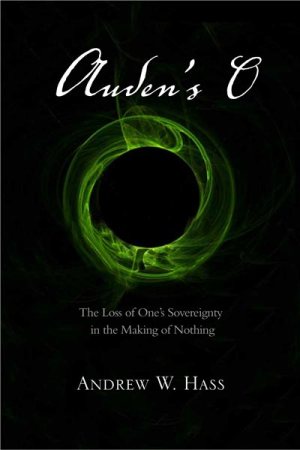
I am delighted to announce the publication of my new book, Auden’s O: The Loss of One’s Sovereignty in the Making of Nothing, published by SUNY Press, 2013.

Andrew W. Hass, Auden's O

Andrew W. Hass, Auden’s O

The publisher writes: “In this groundbreaking, interdisciplinary history of ideas, Andrew W. Hass explores the ascendency of the concept of nothing into late modernity. He argues that the rise of the reality of nothing in religion, philosophy, and literature has taken place only against the decline of the concept of One: a shift from a sovereign understanding of the One (unity, universality) toward the “figure of the O”—a cipher figure that, as nonentity, is nevertheless determinant of other realities. The figuring of this O culminates in a proliferation of literary expressions of nothingness, void, and absence from 1940 to 1960, but by century’s end, this movement has shifted from linear progression to mutation, whereby religion, theology, philosophy, literature, and other critical modes of thought, such as feminism, merge into a shared, circular activity. The writer W. H. Auden lends his name to this O, his long poetic work The Sea and the Mirror an exemplary manifestation of its implications. Hass examines this work, along with that of a host of writers, philosophers, and theologians, to trace the revolutionary hermeneutics and creative space of the O, and to provide the reasoning of why nothing is now such a powerful force in the imagination of the twenty-first century, and of how it might move us through and beyond our turbulent times.”

There will be more about the book in forthcoming blog postings, but in the meantime, you may be interested in my earlier postings on this topic: ‘The Squaring of Zero’ part 1, part 2.

Here Be Dragons: the quest for academic credibility

21 Monday Oct 2013

Posted by Jonathan in Critical Religion, University of Stirling

≈ 3 Comments

Tags

academia, BASR, EASR, Elder Scrolls, field research, Nine Divines, phenomenology, religious studies, Skyrim

At the recent BASR/EASR conference at Liverpool Hope University I spoke about dragons. My paper was on the application of Ninian Smart’s dimensions of religion to the Nine Divines. The Nine Divines is the principle “religion” to be found in the Elder Scrolls video game series and it has no meat-world presence. My argument was that the Nine Divines as a religion met all the dimensions that Smart detailed and that there were no logical grounds upon which we should not consider it a religion of as much legitimacy or reality as any meat-world counterpart (i.e. Hinduism, Islam, etc.). In short, the Nine Divines is an example of what Smart characterises as an Imperial religion: a ‘relatively loose’ organisation ‘with cities and regions for instance having their own priesthoods and cults’ (1996:237).

There was a certain amount of ludicrosity to the whole affair, something I felt acutely as I did my field research from the comfort of my own armchair. On more than one occasion I was forced to stop and ask myself “is this serious?” I mean, how many field researchers have had to deal with the problem of troll attacks as they travel to investigate what sort of items have been left as offerings at a shrine? It certainly doesn’t feel very phenomenological to bury your axe into a bandit’s face. However, this in itself was part of what fascinated me about the whole exercise. As ludicrous as it all was, going through Smart’s dimensions I found no impediment to say that the Nine Divines isn’t a real religion. The fact of the matter is that applying our scholarly assumptions and categories to the religion of a video game throws up interesting challenges that we might not have considered if we restricted ourselves to roaming the meat-world. The main question I raised in my paper was that despite the fact that there are various discussions about the reality or unreality of gods, spirits, or what have you, no scholar has every stopped to consider the reality or unreality of the practitioners. No definition of religion I can think of stipulates that the practitioners of that religion, however defined, have to have meat-world presence.

This is just the tip of the iceberg of a plethora of questions that are raised by treating the Nine Divines as a real religion. I didn’t have the time to mention them all in my paper and it is not my intention to go through them here. Rather, I want to comment on the “ludicrosity” of the whole affair. Being such a large conference with nearly eight panels running simultaneously at a time, the panel in which I presented my paper did not have a particularly large audience and none of them were prominent academics (as far as I was aware). That, and technical difficulties that led to a limitation upon discussion, meant that there wasn’t really a chance to get a feel for how other academics responded to my paper. While the other papers were also on video games I think I am the first to suggest this sort of study. So to a certain extent the ludicrosity of the study was passed by until later that evening.

Later I was among the contestants for a recording of the second RSP Christmas Special (you can hear me make a fool of myself at the first one here). During the game, which had a large audience definitely featuring some prominent academics, I was joking with my colleague David that unless he started asking questions on Skyrim (where the latest Elder Scrolls game is set) I wasn’t going to know very much. I had already fluked the question on the books of the Bible and was then stumped by a question on the Unification Church. It was during this aside that I happened to get a glimpse at some of the prominent academics who were listening to our brief exchange. It was then that the idea of ludicrosity returned to me. The looks I saw can only be summed up in one way: “Is this guy serious?” I don’t mean to criticise them for giving me those looks or thinking in that manner. I can completely sympathise with them because on one level if I had been in their position I would probably be thinking the exact same thing.

However, as a theory driven scholar driving home that we should all be phenomenologists I am both blessed and cursed by a generality in the academic market place. I can, in theory, be dropped into any number of locales and teach any number of introductory style courses for the study of religion. But, if the recent adverts for academic positions are anything to go by, no one wants the general theorist, they want specialists in a particular topic (Islam usually[1]). And as “theory and method” no longer seems to appear as a “concrete” specialism I would have to say that I specialise in video games. Yet if those looks were anything to go by then that specialism isn’t going to serve me very well either. We have supposedly proclaimed the death of the World Religions Paradigm, and yet academic post after academic post is advertised for positions framed on that very paradigm. “Don’t think in terms of WRP,” we are told, “but that’s how we’re going organise our departments.” Credible academia seemingly depends on an idea we’ve abandoned.

I do not wish to criticise those who would think that the study of video games in Religious Studies isn’t a credible activity. I understand their scepticism. We’re breaching new territory, charting a region on the social scientific map that we may very easily fall off. William Sims Bainbridge, for example, has already been writing on the topic for some time but his recent work has been descending into an apologetic transhumanism (see this blog post for example) which would incite many of us to use that most dirty of RS swearwords: “Theology!” And certainly the same could be said of treating the religions of video games in themselves if we are not careful. But I have no intention of promoting the Nine Divines as a religion – that is the province of a number of emerging Facebook groups – and I am instead intrigued by the analytic value of such a study. To give another example, another paper from the conference made heavy use of Lyons et. al’s concept of “overimitation” (2007) to explain religious rituals. Using this concept to compare ritual worship in the Nine Divines and other meat-world instances we can see just how problematic the idea of “overimitaiton” is for social science. In fact it is on the very demonstration of this point that credibility depends.

But in saying this two forms of credibility are beginning to emerge. On the one hand there is academic credibility, proving that the study of video games as I have gone about the task is valid social science. On the other hand there is employment credibility, proving that religion and video games is worth a teaching position in a university. And we cannot simply assume that appeasing one side will appease the other. There is a difficult and tentative line to be followed in reaching a sense of “credibility” that can satisfy both sides of the line. On the social scientific map, it seems, credibility can only be found on that part that reads: “Here be dragons”.

References

Smart, N. (1996); Dimensions of the Sacred; London, Harper Collins

Lyons, D. et al. (2007); “The Hidden Structure of Overimitation” in PNAS 104; pg.19751-19756


[1] It was somewhat depressing that one of the catalogues from the publishers present at the conference devoted a full fifteen pages to books on Islam where the nearest rival (Christianity) could only muster four as if all we talk about these days is the one religion.

← Older posts
Newer posts →

Recent blog postings:

  • When Regular PCR Tests Become Penance: Agamben, Biopolitics and Critical Religion  2 September 2022
  • Butler, gender performativity and religion 4 August 2021
  • Logic in Magic, and Human Cognition: Towards a new theory 17 March 2021
  • Politics of Love: Secularism, Religion, and Love as a Political Discourse 18 November 2020
  • The Contagion of White Christian Libertarianism and America’s Viral President 30 October 2020

Frequent blog tags:

academia Africa art Bible Biblical criticism body capitalism categories Christian church clash of civilisations concept of zero crisis Critical Religion culture economics economic theory education epistemology female genius feminism freedom of religion gender global higher education Hindu Hinduism humanities impact India interdisciplinarity interfaith dialogue international relations Islam Israel Japan Jew law liberal education managerialism Middle East mission history modernity music Muslim Naomi Goldenberg negation Northern Ireland nothing Palestine patriarchy performance politics postcolonial power REF religion religion-secular binary religious education religious freedom religious observance religious studies ritual sacred schools Scotland secular spiritualities stained glass theology United Kingdom university University of Stirling vestigial states women

Follow us on Twitter

Tweets by CriticoReligio

‘Like’ us on Facebook

‘Like’ us on Facebook

Our blog is published in association with

Ekklesia

Top Posts & Pages

  • Home
  • What is Critical Religion?
  • Goldenberg, Naomi
  • Ekklesia
  • Events
  • Butler, gender performativity and religion
  • Cyborgs or Goddesses? Donna Haraway, Human Resources Management and the coming of the Performative Absolute
  • Scholars
  • When Regular PCR Tests Become Penance: Agamben, Biopolitics and Critical Religion 
  • Fitzgerald, Timothy

The Critical Religion Association…

... an international scholarly association pioneering intellectual engagement with questions on 'religion' and related categories.

About this site

This site is mostly maintained by Dr R Nadadur Kannan. Please contact us with any queries.
You can keep in touch with our work on Twitter, on Facebook, and through our mailing list.

About the blog

The Critical Religion blog is a shared (multi-author) blog.
The views represented are the personal views of individual authors and do not represent the position of the Critical Religion Association on any particular issue.

Copyright and Funding

Please note that all text and images on this site is protected by copyright law. Blog postings and profile texts are the copyright of their respective authors. We warmly welcome links to our site: each page/blog entry includes a variety of convenient sharing tools to help with this. For more information, see the note at the bottom of this page. Please do not reproduce texts in emails or on your own site unless you have express written permission to do so (if in doubt, please contact us). Thank you.

For a note about funding, see the information at the bottom of this page.

The CRA and the CRRG

The Critical Religion Association (this website) emerged from the work of the University of Stirling's Critical Religion Research Group created in early 2011. Interest in the CRRG grew beyond all expectations, and the staff at Stirling sought to address requests for involvement beyond Stirling by creating the CRA as an international scholarly association in November 2012. The CRRG passed on the blog and other key content to the CRA, and this is being developed here.
The CRRG website is now devoted exclusively to the scholarly work of the staff at the University of Stirling.

Critical Religion online

Apart from this website, the Critical Religion Research Group also has accounts elsewhere online:
- we are on Twitter;
- we are on Facebook;
- we have audio on Audioboo;
We will soon also offer video.

RSS feeds

  • RSS - Posts
  • RSS - Comments

Administration

  • Create account
  • Log in
  • Entries feed
  • Comments feed
  • WordPress.com

Blog at WordPress.com.

  • Subscribe Subscribed
    • The Critical Religion Association
    • Join 178 other subscribers
    • Already have a WordPress.com account? Log in now.
    • The Critical Religion Association
    • Subscribe Subscribed
    • Sign up
    • Log in
    • Report this content
    • View site in Reader
    • Manage subscriptions
    • Collapse this bar
 

Loading Comments...