• Home
  • What is Critical Religion?
  • Blog
  • Events
  • Scholars
  • Links
  • Recordings
  • Organisation
  • Ekklesia
  • Contact

The Critical Religion Association

~ Critical Approaches to the Study of Religion

The Critical Religion Association

Tag Archives: Critical Religion

Tibetan self-immolation between religious practice and political statement

20 Monday May 2013

Posted by Sihaya in Critical Religion, Erasmus University of Rotterdam

≈ 1 Comment

Tags

Critical Religion, moral, politics, religion, self-immolation, Tibet

The first self-immolation in Tibetan society in the modern era took place in exile in Delhi, India in 1998 as a Tibetan Youth Congress hunger strike was broken up by Indian police. Since then, five more Tibetans have set fire to themselves in exile and a growing number continue to do so in what is considered the occupied territory of Tibet. Since February 2009 more than 100 Tibetans have set themselves of fire within the Tibetan Autonomous Region (TAR). The slogan gathering all these acts of self-sacrifice are gathered in the image in an article published in The Economist last year of ‘Tibet on Fire’. According to such a view self-immolations enact the ‘burning issue’ of the Tibetan issue in order to remind the world about the situation of Tibetans and their long history of exile. But are self-immolations political acts or are they the expression of religious ideals? While the self-immolations have a clear political goal, dramatically calling for attention towards Tibetans from the western world they are also religious acts, deeply embedded in Tibetan Buddhism. That seems to be a paradox, because how can a religion that deeply discourages of violence agree with such an extreme form of suicide?

It cannot be contested that self-immolations are political in nature. Indeed many initiators of such acts call for unity within Tibet: You must unite and work together to build a strong and prosperous Tibetan nation in the future. This is the sole wish of all the Tibetan heroes. In the view of those who agree with this political statement unity is needed in front of the divisive policies of the Chinese government and also in front of the disagreement of how to approach Tibetan independence from exile. The latter extrapolates between the non-violent approach which for the past half of a century has been advocated and implemented under the authority of the Dalai Lama and the more impatient approach of Tibetan youth who feel that non-violence is not an answer.

Violence committed towards the self is not only the middle way between these two options, as it might at first seem. It is a practice that is embedded if not encouraged by Tibetan Buddhism and its ideas of ultimate giving, selflessness, sacrifice of the self for the others. The religious expression of these ideas is the ritual of gCod where the symbolic sacrifice of the body is used as a way of severing attachment to existence (Stott 1989). But an even more pronounced expression of the value of self-sacrifice can be found in Shatideva’s Bodhisattvacharyavatara, a text often taught at public occasions by the Dalai Lama. This text explains in details the attributes and actions of a bodhisattva, the enlightened being who is working for the benefit of other.  Here the exchange of the self for others is a main idea:

At the beginning, the Guide of the World encourages/ The giving of such things as food’ Later, when accustomed to this,/One may progressively start to give away even one’s flesh. (Shantideva and Batchelor 1999:63)

In this perception the renunciation to the body and to the flesh symbolizes the renunciation to the self. The self, accompanied by a feeling of individuation is considered the highest impediment on the spiritual path. In order to reach enlightenment the self and its importance must be diminished, destroyed. This can be done through meditative practices but also rather literal forms of self-sacrifice. While in order to attain spiritual benefit renunciation to the self must take place as an offering to the benefit of other, it is foremost the one who makes the sacrifice who reaps the benefits. In this way, as the Dalai Lama turns the argument around, caring for others is the way of being truly selfish. Thus, by sacrificing oneself one can be truly selfish: through thinking only of others and sacrificing the self for other, one can actually reach high spiritual attainments (The Dalai Lama and Cutler 1999).

However, it is not the promise of spiritual attainment that motivates Tibetan self-immolators. Rather it is the ideal of collective freedom and independence that motivates these acts. Although these two seems like articulating a political goal, transforming self-sacrifice into a political act, once more religious and political goals are crossfertilizing each other. Many Tibetans who have contributed to a burning Tibet express a wish for Tibetan unity, wishing to be free to practice Tibetan Buddhism and listen to the teachings of the Dalai Lama. Meanwhile, however, they become heroes who apply in practice the ideal of the bodhisattva while fighting for their rights towards religious practice. With this attitude self-immolations make a superior moral claim upon collective freedom and independence, making it difficult for the Chinese to respond.

Although self-sacrifices through fire are not unique either to Asian cultures nor to Buddhism, the specific intersection of political and religious goals in the Tibetan context is unique. Tibetan self-immolations are actions taken for the welfare and benefit of others. This presents a special case to Talal Asad’s approach in which he considers the religious and political as mutually defining each other (Asad 2003). The case of Tibetan self-immolations throws light on the way categories of religion and politics are constructed and implemented as a transnational political statement made with the help of acts of compassion. The heroism of Tibetans rests on moral superiority of their political statements backed up by religious principles of ultimate giving.

Bibliography

  • Asad, T (2003) Genealogies of religion, The Johns Hopkins University Press: Baltimore and London
  • Santideva and Batchelor, S. (1999) The Bodhisattva’s way of life, LTWA: Dharamsala
  • Stott, D. (1989) 
Offering the body: The practice of gCod in Tibetan Buddhism, Religion 
19:3
  • The Dalai Lama and Cutler, H. (1999) The art of happiness, Hodder Paperbacks: Londonreligion
Critical Religion and Economic Discourse

06 Monday May 2013

Posted by Dr Brian W Nail in Critical Religion, University of Luxembourg

≈ Comments Off on Critical Religion and Economic Discourse

Tags

crisis, Critical Religion, economics, sacred, secular

In Britain and throughout much of Europe, the “age of austerity” persists. Likewise in America the economic future remains enveloped in political turmoil and fiscal uncertainty. It appears that the western world has begrudgingly entered a new economic age. The ever-changing predictions of economic advisers and politicians have in many cases proven to be little more than fruitless surmising.  Like Samuel Beckett’s Estragon, who removes his boot anticipating some hidden object to appear from the emptiness within, politicians in Britain and America have desperately sought to relieve themselves of the collective weight of national deficits and public spending only to find that despite these efforts—“There is nothing to show.” As difficult economic decisions are contentiously deferred in the hope of better times to come, it is perhaps worth considering the possibility that like Godot the economic stability we long for is not destined to arrive. Notwithstanding our present difficulties, now is not the time to adopt a position of economic apocalypticism.

While political factions in Britain and America struggle to reassert the social and economic hierarchies of the past, scholars from numerous disciplines have begun to vigorously investigate alternatives to the prevailing ideologies which have underwritten western society’s approaches to managing the costs of existence. If scholars working in the humanities have something to say about cultural production and the values of contemporary society, then it seems more than reasonable that they may be capable of making important contributions to current economic debates. Critical Religion may be able to offer certain intellectual resources for critiquing the political and economic models which are currently being outstripped. But in order to open up the field of economics to alternative modes of discourse, it is necessary to challenge the intellectual and disciplinary boundaries which have historically served to distance modern socio-economic theory from other forms of intellectual inquiry.

In an essay entitled “Knowing Our Limits” (2010), Rowan Williams suggests that executing a theological incursion into the field of economics entails a critical investigation of the language and epistemological assumptions which constitute the study of economics:

In asking whether economics and theology represent two different worlds, we need to be aware of the fact that a lot of contemporary economic language and habit doesn’t only claim a privileged status for economics on the grounds that it works by innate laws to which other considerations are irrelevant.  It threatens to reduce other sorts of discourse to its own terms—to make a bid for one world in which everything reduces to one set of questions (2010, p.20).

Williams’ assessment of the totalizing force of economic discourse may just as easily be applied to his own discipline of theology—formerly known as the “The Queen of the Sciences”. To avoid a mere inversion of the relationship between economics and theology, the notion of Critical Religion provides a vital starting point for examining the heterogeneity that exists between seemingly disparate modes of secular and religious discourse. One way of challenging the privileged status of economic theory is to excavate the theological and religious principles upon which this supposedly secular science has been established. In doing so it may be possible to uncover the ways that religion and secularity are at times complicit in western society’s efforts to construct and justify social and economic hierarchies.

It is not coincidental that the field of Critical Religion has emerged during a time of religious as well as economic crisis. Times of crisis have the potential to instigate positive cultural and intellectual transformations. Presently, the absolute triumph of so-called secular reason over religious faith has not only failed to come to pass in western society; religion and secularity have found themselves in a common state of disarray. Over the past decade, the secularization thesis has not been proven false because religious thinkers and secularists have somehow made peace with one another; instead, the economic and political foundations underlying the conflict between these mimetic foes have shifted dramatically.

Influential thinkers such as Jürgen Habermas and numerous others have already begun to explore the notion of post-secularity as a way of describing not simply the historical epoch which has followed postmodernity, but rather the specific challenges that religious and secular institutions currently face as they renegotiate their claims to moral truth and political authority. Noting the frustration which many theorists, critics, philosophers, and economists experience when faced with the problem of religion’s survival, Hent de Vries argues, “The post-secular condition and its corresponding intellectual stance consist precisely in acknowledging this ‘living-on’ of religion beyond its prematurely announced and celebrated deaths” (2006, p.7). Because religion survives within contemporary society in increasingly spectral forms, De Vries suggests that “In order to track its movements, new methodological tools and sensibilities are needed” (2006, p.7). In his recent book On the Sacred (2012), Gordon Lynch takes up the task of elaborating a new approach to detecting the continuing presence of religion in society. Lynch reconfigures the traditional opposition between religion and secularity by arguing that various manifestations of the sacred form the basis of all social life. The sacred, according to Lynch, may be defined “by what people collectively experience as absolute, non-contingent realities that exert unquestionable moral claims over the meaning and conduct of their lives” (2012, p.32). He argues that human rights, the responsibility of caring for children, and nationalism, may all be considered sacred forms which are common to both religious and secular life.

However, the category of the sacred does not simply represent that which society seeks to protect or preserve—as the work of René Girard has so effectively evinced, the sacred also represents that which is unquestionably sacrificable. In a sacrificial economy, the individuals who are most likely to suffer at the expense of prevailing notions of the sacred are those who exist on the margins of society. The practice of Critical Religion not only offers certain intellectual benefits which comes from exploring the boundaries between various disciplines; but it also offers an opportunity to respond to a pressing social responsibility to critically question the strategies by which religious and secular communities have sought to secure for themselves a tomorrow which is less than certain for many. By acknowledging the heterogeneity of religion and the ambivalence of so many cultural manifestations of the sacred, Critical Religion is capable of bringing to light the myths and rituals which underwrite our most problematic forms of economic decision-making.

In his contemplation of the future of religious poetry in a post-secular age, the poet Michael Symmons Roberts suggests that the intellectual relativism that characterized much of the literary and academic discourse of postmodernism has declined in recent years—“Politically and financially the world is a volatile place, and relativism will no longer do. Above all, perhaps, our exit from the hall of mirrors is driven by ecological concerns. Relativism simply collapses in this context” (2008, p.71). Moral and intellectual relativism is of course not the solitary contribution of those various strands of cultural and critical theory which have come to represent postmodernism. However, Roberts’ larger point remains important: the most significant epistemological questions of our time are inspired by all too real ontological challenges. In this regard, the field of Critical Religion is uniquely positioned to apply the modes of critique and cultural analysis, which are the legacy of postmodern discourse, to the task of elaborating alternative ways of inhabiting a world where existence costs.

Some (Mainly) Very Appreciative Comments on Brent Nongbri’s “Before Religion”

06 Monday May 2013

Posted by Naomi Goldenberg in Critical Religion, University of Ottawa

≈ 1 Comment

Tags

Arabic, Bengal, Brent Nongbri, Critical Religion, Greek, India, Khasi, religion, review, Roman

Some (Mainly) Very Appreciative Comments on Brent Nongbri’s Before Religion: A History of a Modern Concept (New Haven and London: Yale, 2013).

In Before Religion: A History of a Modern Concept (Yale: 2013, Brent Nongbri makes a significant contribution to Critical Religion that will be useful to both students and theorists. This is a clear and carefully written book, well researched and informatively referenced. Nongbri’s strength lies in his feeling for antiquity. With precision and skill, he reviews English translations of the word religion in influential early Greek, Roman and Arabic texts to argue that the term is an anachronism supporting the conventional notion that ‘religion’ refers to a recognizable and timeless phenomenon. Although such insight will be familiar to readers of the works of Timothy Fitzgerald, David Chidester, Richard King, Russell McCutcheon et al., Nongbri’s account is particularly notable for its sustained clarity and judicious selection of ancient source material.

Nongbri tells us that his questioning of the universality of “religion” began when he realized that the word did not exist in the Khasi language his father grew up speaking in northeastern India. Instead of referring to specific “religious” ideas or behavior that could be distinguished from “secular” varieties, “ka niam”, the Khasi term his father offered as an equivalent to religion, simply means “customs” in a broad sense. Further inquiry revealed that niam is actually a Bengali term signifying “rules” or “duties.” This discovery about his paternal tongue forms the paradigm that Nongbri identifies again and again in his investigation of ancient sources. As he leads his readers through myriad texts of early history, he points to the absence of “the modern concept of religion” and how the insertion of the word misrepresents authorial intentions.

Nongbri structures his arguments memorably around a few well-articulated themes. His chapter titled “Some (Premature) Births of Religion in Antiquity” is especially effective. Under this heading, he refutes claims that “religion” emerged in reference to the Maccabean revolt, in Cicero’s rhetoric, in Eusebius’ texts, or in Muhammed’s innovations. He also does an impressive job of showing that the tenets Tomoko Masuzawa identifies in the nineteenth century as formative for a discourse of world religions are actually well underway in the seventeenth century in the work of Alexander Ross et al.

Nongbri is convinced that the study of antiquity could be improved if “students of the ancient world [were] … to work on generating a better vocabulary for talking about the various ways that ancient peoples conceptually carved out their worlds, a better means of describing the clusters of practices and beliefs outlined by ancient authors…”(p.53). He writes that the task is not one of finding a better word for “it” – i.e. of uncovering what “religion” meant in antiquity – but rather of realizing that there never was an “it” in the first place. Nongbri believes that if his advice were heeded, we would not wind up with more “slightly tweaked” books about early religions, but rather with more specific and insightful studies on such subjects as “Athenian appeals to ancestral tradition, Roman ethnicity, Mesopotamian scribal praxis, Christian and Muslim heresiological discourses, and other topics that will encapsulate and thoroughly rearrange those bits and pieces of what we once gathered together as ‘ancient religions’ ”(159).

I suggest that Nongbri’s counsel for reforming the study of ancient history should be applied throughout the field of Religious Studies. Nongbri hesitates to recommend such an approach to scholars of contemporary “religions.” Instead, he concludes his book with what I find to be a contradictory and confusing call to “think outside of our usual categories” (159) by being aware that whenever we use the word ‘religion’ we are employing a “second-order” redescriptive concept. Surprisingly, Nongbri says that such a conscious – yet, to my mind, impossibly acrobatic – use of the term could even have some benefits in the study of antiquity. Thus, he momentarily argues against the thrust of his own conscientious analysis in his conclusion.

Despite this brief retreat from the implications of his critique, Nongbri succeeds in building a solid case for historians of antiquity to purge their intellectual toolbox of a distorting anachronism. In addition, his book also points to similar confusions and misrepresentations that occur with the use of ‘religion’ in reference contemporary times when the word is imposed on non-Western cultures like his father’s or when scholars continue to use rhetorical ploys such as “embedded religion” to reinscribe religion as “eternally present” (152).

The argument that Nongbri frames so clearly and competently in relation to ancient history is applicable in present times and possibly more urgent. By assuming that religion is an eternal and universal “it” that identifies a bounded sphere of human life, distinct from what we term “politics” or “economics” or “the secular,” we are doing more than hampering our understanding of epochs in the past. We are also obscuring our ability to see through the veils of ideologies that currently surround us. The task of lifting these veils, or, at least, of making them less opaque is one way to conceive of an objective for “Critical Religion” – an aim that Nongbri’s work helps to further.

Approaching contemporary Christian faith in the Western academy

12 Tuesday Feb 2013

Posted by Kat Neumann in Critical Religion, University of Stirling

≈ 9 Comments

Tags

Christian, Critical Religion, liturgy, religious studies, spiritualities

Our general efforts of bridging the gap between our own socio-cultural parameters in research of other faith traditions no doubt has developed its own tradition and its own ethics of interdisciplinarity. It might then be necessary to reflect on the fact that aside from phenomena such as New Age or so-called sectarian fringe groups in society, it is also important to take stock of the course taken by once dominant and normative traditions, notably the Christian churches. In many ways their practices continue to be pervasive to many formative choices in constructing a symbolic imaginary – be that consciously in affirmation or rejection, subconsciously in modi of repression, or pre-consciously, i.e. without a prior awareness that elements adopted within a socio-cultural or political symbolic have had Christian “religious” origins. This is in part what the Critical Religion project is seeking to address.

The bold declaration of a “post-Christian secular” West, as has been elaborated across various fields and disciplines, has changed the influence and public emphasis ascribed to the institution of the Church (I mean this at a conceptual level, where denominational differences merely amount to a diverging implementation of its institutional character). Heralded almost as a revolutionary struggle to destabilise the institution(s) and its (their) insidious hierarchies, secularisation ushered in an era of research in alternative forms of spirituality (itself a crucial buzz-word), that was to displace the institutional, traditional religiosity of a former age. The phrase “I’m not religious, but…”, to my mind, stems from this particular antagonism between a view of traditional Christianity as naive and ritualistic, and the emergence of a popular, deregulated “spiritual search” which aims to find a relationship to “something sacred” in life, free-from disciplinary boundaries, a peculiar form of religious diet. Our postmodern sensibilities thrive on this kind of absolved freedom that does not need to submit to the regulation of the norm, does not have to answer to the need of the many. “I’m not religious, but…” is an idiom that identifies the wish for spiritual liberation without the risk of material relationship. In other words, each to their own!, even if that means rendering personal spirituality in splendid isolation, both from society and the demands of the public, as well as ultimately from an encounter with oneself as another. ‘I positively feel, in my hideous modern way that I can’t get into touch with my mind’ (as Katherine Mansfield wrote in her Journal (ed John Middleton Murray, NY: McGraw-Hill 1964 repr., p82).  There is no encounter with an o/Other, only a reflection of one’s own urge of spiritual transcendence into nothingness.

What does and what can a critical view on the Christian tradition reveal standing outside of its institutional hierarchy, if not altogether outside its disciplinary conceptions? The history connecting the two institutions, academy and church, is long, and fraught with its own struggles of independence from theology and divinity faculties. The disciplinary differentiation between, for example, theology and (what has become known as) “religious studies”, was seen to follow the trend implicit in the secularisation of the academy that would posit critical rigour and scientific validation of varying research perspectives into competition with each other. The plurality of methods in the field of religious studies amplifies the problematic (and capitalist) ideological assumptions that become apparent when researching questions of institutional power, so tangible in matters ecclesial. Whereas the former is free to identify its self-interest in the hermeneutical horizon that focalises on the church and aspects of Christian living, faith and doctrine, religious studies, in an attempt to question not only the very assumptions of what constitutes any of these elements in interaction with other socio-political and geo-economic concerns, it also has to reflect on its own validatory methods drawn from a range of fields outwith the parameters of classical theology. Thus, its perspectives often drive at a philosophy, psychology, sociology or anthropology in deconstruction of “religion”, instead of organising and constructing frameworks by which to orientate a religious ethics in view of a Christian conception of divinity.

The emphasis I put onto the ethical dimension of disciplinarity here is crucial to the way I rationalise the critical capacity and impact for research into Christian institutional life in the West at present. Ethics, with its emphasis on right relations, on the means of such relationship and the modalities of their interactions offers a sufficient model for conceptualising interdisciplinary inquiry at the level of the text and its metanarrative discourse. Not by chance did discussions on “secular theology” popularised in the works of, for example, John A. T. Robinson (Honest to God, 1963), Paul Tillich (Theology of Culture, 1964) and Dorothee Sölle (Christ the Representative, 1967) tie themselves to a discussion of the ethics of incarnation, establishing theological enquiry at the intersection between anthropology and sociology on the one hand and the political and ideological impact of the institution of doctrine on the other. Whereas philosophy of religion has paved a way for the inquiry into the role of doctrine, and much has been written within and outside of the theological faculty to consider the psychology of worship, I want to suggest that the route to situating the current state of the churches, as institutions and as instituting bodies to the life of participating believers, can be helpfully illuminated by a focus on liturgy, conceptually and practically. In its multidimensional engagement, liturgy can be understood to intersect with every aspect of Christian living, inside and outside strictly ecclesial spaces (Peter Cornehl offers an argument to this effect in Die Welt ist voll von Liturgie, Stuttgart: Kohlhammer, 2005). To be reading liturgy outside of a strictly theological concern, I suggest, not only allows investigation of crossing points between spiritual concern and physical embodiment, between individual participation and collective identity, and between a faithful repetition and innovative response to tradition, conceptualising liturgy also allows for a critical assessment from outside the institution that it perpetuates, and invigorates. Liturgy is an invitation to shift disciplinary emphases.

Creativity, academia and Critical Religion

17 Monday Dec 2012

Posted by Michael Marten in Critical Religion, University of Stirling

≈ 5 Comments

Tags

commodification, Critical Religion, human resources management (HRM), impact, Mihaly Czikszentmihalyi, neoliberalism, REF, United Kingdom, university

It is widely acknowledged amongst those who still care that academia in the UK is in very serious trouble.  The most infamous embodiment of the current malaise is a mechanism imposed upon universities by successive Westminster governments: a system of ‘research assessment’ driven by an ideology of neo-liberal commodification.  Until 2008 it was called the Research Assessment Exercise; it now operates under the equally Orwellian name of the Research Excellence Framework (REF).  Readers fortunate enough to be unfamiliar with the blight that is the REF may need an explanation: universities submit publications by their scholars to subject-oriented panels of academics, who will assess their relative ‘excellence’, awarding them scores from 1-4 to indicate just how ‘excellent’ they really are.  An accompanying ‘environment’ narrative describing how wonderful these scholars’ departments are is also assessed, as are so-called ‘impact studies’ (the devising of specious measurements of the supposed ‘impact’ of academic work upon non-academics, an idea that barely works in the classical sciences, never mind the humanities).  From all this, an overall score for the department will be given.  That score, in turn, will determine the funding that the state gives each university, though perversely, the exact methodology for that decision has not (yet) been made public.  Of course, many academics and most university bureaucrats have strong vested interests in these outcomes.

The broader ramifications of the REF are apparent in numerous contexts, long before the REF submission deadline at the end of 2013.  Most universities appear to have appointed yet more managers, directors and deputy principals whose primary responsibility is to maximise their institution’s overall score for the REF.  It goes without saying that many of these people are on salaries that far exceed those of the academics they are supposed to be ‘helping’.  Varying levels of competency, transparency and accountability characterise such institutional engagement, as conversations with almost any UK academic will verify.  The REF and its implementation corrodes the UK academic environment on all levels: for example, Phil Davis shows how citation records are being falsified in order to improve the supposed relevance of texts.

One of the most important elements of academic thinking to suffer in this context is interdisciplinarity.  The REF’s structures barely cope with scholars who cross traditional disciplinary boundaries, such as those working in Critical Religion.  A quick look through the list of scholars involved in the CRA highlights the nature of the boundaries issue: literature, gender, law, postcolonial studies, art, history, politics, philosophy, music, and a raft of other disciplinary descriptors feature prominently.  Critical Religion is in substantial part about questioning the boundaries and categories that are seen to exist in different contexts, and related to that, to interrogate the power relations underpinning these categories – who benefits from categorisations and whose position is strengthened by maintaining them?  Whether this be about interrogating ‘politics’ (e.g. here) or ‘gender’ (e.g. here) or ‘interreligious issues’ (e.g. here or here), there are innumerable categories that cannot simply be maintained in their present form without distorting the nature of human relationships.  This thinking has its origins in ‘religious studies’, but perhaps the Critical Religion Association should have been called the Critical Categories Association!

These crossings form an integral part of the creative process.  I have written here before on interdisciplinarity: it often involves a kind of creative thinking that needs a certain kind of space to be available.  No scholar I know can squeeze meaningful engagement with their research into half-an-hour between lectures.  Creativity needs a different kind of space, a space that may well lead, for example, to a loss of a sense of time or awareness of one’s immediate surroundings.  In my own writing, I sometimes find myself working through the night on a chapter or an essay, not realising that I have completed 8 or 10 hours of intensive work – and outside it is becoming daylight again.  These creative periods can lead to substantial leaps forward that push in some way at previous understandings, giving birth to new ideas or imagining new ways of interpreting old problems.  As I have argued on my personal site, academic creativity is not substantially different to creativity in other contexts, though the forms it takes may differ.  Mihaly Czikszentmihalyi calls this ‘flow’ – the creative energy that enables us to engage our creativity to the full:

As Czikszentmihalyi explains, entering a state of creative ecstasy presupposes certain training and experience.  In an academic context, the degree pattern – undergraduate, taught postgraduate, and doctorate – is a way of developing this experience.  Creativity, however, also needs more than just technical prowess, precisely because transgressing boundaries requires imagination: after all, the boundaries that we are seeking to overcome are frequently ossified and maintained (whether consciously or unconsciously) by vested interests.

The REF directly hinders this creativity, as do the endless funding applications we are expected to pursue (given the ridiculously low success rates, they’re largely pointless), the mindless form-filling for TRAC, and so on (Ross McKibbin eloquently describes some of the other manifestations of commodifying academia).  These are mechanisms ‘human resources’ management (HRM) deploys in order to control the transgressive creativity of academic research.  After all, although the REF ostensibly encourages ‘international level’ creativity that HRM desperately seeks to control, the REF’s regimentation of research activity maps onto HRM’s aims.  Hindering interdisciplinarity, requiring endless completion of ‘accountability’ exercises, and rewarding only certain kinds of work… all minimise the spaces needed for ‘flow’ – or even kill them off altogether.

And yet these things will not last: as David Jasper once remarked, we may one day be remembered for writing an important book, but we will not be remembered for our funding applications.  As the REF deadline draws ever nearer and overpaid managers exercise ever more unwanted pressure on academics, I sincerely hope that mechanisms of solidarity, perhaps through the union or the CDBU etc., can enable resistance to these attempts at commodification to flourish.  If we care about our universities, we need to resist, not least by constantly reaffirming that the preservation of creative ‘flow’ leading to boundary transgressions are the things that really matter.  In so doing, we may yet manage to subvert the rampant managerialism that is destroying higher education.

(I would be interested in comments that discuss more specific ways in which this might happen…)

——-

Warm thanks to Jason Theaker (photographer and academic at Bradford University, who sent me the video link in relation to a discussion about this image and text), and to Alison Jasper and Richard Roberts for helpful comments on a draft text).

Critical Religion and Female Genius

10 Monday Dec 2012

Posted by Bashir S. in Critical Religion, University of Stirling

≈ 1 Comment

Tags

Christian, Critical Religion, female genius, feminism, patriarchy, religion, secular

What are some of the implications of the discussion of critical religion for feminist and gender theory making?

If part of the rationale for critical religion is to explain the ways in which the terms ‘religious’ and ‘religion’ frame and perpetuate forms of colonialist or western-centred thinking and acting in the world, then there is a clear connection: the nature of colonial discourse and the manner of its practices, have commonly been aligned with forms of Christian theological authority, carried in wide ranging missionary activity throughout the world.  The gendered binaries of spiritual/material or spirit/flesh, derived from or supported by Christian theologies, still haunt us in the tendency to regard women and the female as better fitted for certain roles that tend to be less well rewarded in terms of money and influence.  Recent analyses of the colonial subject/other strongly resonate with feminist and gender analyses of the hegemonic, patriarchal subject/other; woman like the non-westerner continues to be viewed as hostile, constantly in need of control or repression as they threaten the structures and boundaries that colonial, heteropatriarchal societies set up to maintain their privilege and security.  The force of male normativity, often still difficult to detect, continues to hinder and hamper attempts to level the playing field.

In this context, it seems that a sizeable proportion of western feminists have also found the binary categories of ‘religion’ and ‘the secular’ – i.e. what is critiqued within discussions of ‘critical religion’ – useful, on the grounds that it allows women to dissociate themselves from powerful ‘religious’ – i.e. arbitrary – justifications of male authority. In a hopeful manner, they have  put their faith in the autonomous exercise of reason that produced this distinction at the beginning of the European enlightenment, because here at least in the realm of so called ‘secularity’ they believe there is some chance of proving themselves the equal of men.

But of course forms of hegemony are resilient and deeply rooted.  Even when the idea of a divine warrant for female culpability – and thus for the blameworthiness and moral inferiority of all women as daughters of Eve – began to lose its hold  on the popular imaginary, there were still plenty of other ways to challenge a woman’s free access to what might be called equitable female subjectivity.  In my book, Because of Beauvoir, I look, for example, at the notion of ‘genius’ as one way in which the idea of male superiority has been sustained from the earliest years of European Romanticism right down to the 2010 Channel 4 series, Genius of Britain.  In this series about key British scientific figures, four male and one female commentator – physicist, Kathy Sykes  – present the ‘genius of Britain’ in relation to a series of exclusively male figures: Christopher Wren, Robert Hooke. Robert Boyle, Isaac Newton, and Edmond Halley.  The fact that such an obvious gender imbalance provoked little if any disquiet at the time – are there really no British women in the field of science worthy of the title, ‘genius’? – seems significantly to support my argument; male hegemony cannot be neatly isolated within so-called ‘religious’ entities like ‘the Christian Churches.’

At the same time, is it just or fair to represent all women who call themselves Christians, for example, as either victims of, or collaborators with patriarchy?  In my book I focus on four women writers, who might qualify as female geniuses all of whom have strong connections with English Christianity; drawing on ideas proposed by Julia Kristeva and Christine Battersby amongst others, that our western idea of ‘genius’ has been overwhelmingly gendered as male in the past and that this needs to change.  Kristeva boldly claims that the achievement of an equitable subjectivity within the context of an unavoidable male hegemony, is itself a matter of genius.  She herself nominates three notable women – philosopher, Hannah Arendt, psychoanalyst, Melanie Klein and writer, Colette – but her definition of genius in each case, stresses the sense in which they bring their creative ideas and actions to birth without denying those things that make them female – pre-eminently in the value they apportioned to the desire and embodiment of the non hegemonic fe/male which are discounted in definition by the male.

In other words, this redefinition of genius, opens the title up to a much increased range of women and forms of creative activity by going beyond the disembodied and god-like, and frequently also melancholic and isolated configuration of  towering masculine genius, whose work contributes to a normatively male culture and economy; it can include both women scientists working with mixed gender teams and women giving birth to children and educating them.  And of course, it can include women who are inspired as visionaries as well as by revolutionary or highly critical movements of all kinds.  What comes into being as a result of this female genius can have just as profound an impact for one person or many of different genders, but more significantly, it is, above all, the joyous achievement of forms of female subjectivity in unpromising circumstances that are not usefully divided up and evaluated as either ‘secular’ or ‘religious’.

Blurring the boundaries – punk rock and religion

03 Monday Dec 2012

Posted by Francis Stewart in Critical Religion, University of Stirling

≈ Comments Off on Blurring the boundaries – punk rock and religion

Tags

Charles Taylor, Critical Religion, Dan Laughey, faith, Gordon Lynch, John Storey, punk rock, religion, spiritualities

Ever walked into a music shop? What do you find? Shelves or boxes – depending upon your predilection for large stores or small independents – which are labelled with the music ‘type’ found within. Metal, jazz, country, rock, pop, opera, classical and everything in-between. Why? On the simple premise that it makes it easier to find the type of music you want and so increase the likelihood of expenditure on your part. What is the danger of presenting music in this manner? It makes discovery much harder and exploration much less likely. You go straight to the genre you like, find what you want, have a quick look around for anything else in that genre and then head straight to the tills. Potentially missing out on undiscovered gems in other genres, classics that influenced the music you liked or even simply misfiled music.

Rock and roll has always inspired tribalism, the music genres being one manifestation of this. On a larger scale there were the mods versus the rockers, the bikers versus the hippies and the punks versus basically everything and anything! Despite its love and promotion of various notions of anarchy, punk itself is replete with labels. Terms such as crusty punk, surfer punk, skater punk, street punk, hardcore punk, 77 punk, and straight edge punk and so on are rife. Why? To delineate borders, to define identities, and to attempt to create order and control in a world which can all too easily be wrested from them by profit focused companies.  What is the danger of presenting identity in this manner? It assumes that identity, behaviour and presentation is rigid and definable, it assumes a shared understanding and therefore tradition of these identity labels, it creates a necessary ‘other’ within a subculture and finally it actually results in co-option and control being easier to obtain for large companies.

Identities are not static, but fluid as cultural theorists John Storey and Dan Laughey and sociologist of religion Gordon Lynch have argued. The boundaries between cultural and/or subcultural affiliation have become significantly less rigid and defined. It is now quite common, almost expected, that individuals will merge one or more – sometimes disparate – identities within their overall sense of self.  The multi-faceted sense of self and identity formation is partly a feature of the consumerist, choice based West, partly a feature of the rise in significance of the self/individual and partly as a result of globalisation.

This has forced a re-think on what do we mean, understand and intend in utilising terms such as ‘world religions’, ‘religion’, ‘sacred’ and ‘secular’. In conducting my own interviews amongst straight edge punks in the UK and the USA (2009 – 2011) the issue of what we mean by these terms was repeatedly raised, discussed in depth and featured prominently in graffiti, tattoos, flyers and band imagery.

As much as punks utilise labels they are carefully chosen and carry a deep significance. Each denotes an important political or musical derivation that enables deviance and recognition in addition to the more negative connotations outlined above. For example, surfer punk was the term attached to the punks who came from the Huntington Beach area of Orange Country and were involved with the sport. It denoted the difficulty and danger of surfing that particular area of the California coast. The ultra-aggressive stance of these punks demonstrated this new culture of physical extremism, which they rode as one would a wave. Would the same careful labelling be applied to terms and concepts such as ‘religion’?

Overwhelmingly, a sharp distinction was expressed by between ‘religion’ and ‘faith’ (UK) or ‘spirituality’ (USA). This is perhaps unsurprising given punks’ stance of rejection of tradition – both real and imagined – in favour of creating something new. ‘Religion’ was applied when interviewees were referring to traditional religious institutions, texts, authority figures and evangelising individuals. In contrast ‘faith’ and ‘spirituality’ were used to describe the individual believer(s), specific practises which did not fall under one religion or another, personal beliefs and really interestingly, punk rock itself!

Punk clubs were spoken of as sacred spaces and attendees got agitated with those whose behaviour desecrated that, in their opinion, or disrespected it. Bands, specific musicians and other individuals important to the local scenes were spoken of with reverence and defended vehemently. Punk rock itself became a form of desacralised salvation for many interviewees. A form of salvation that is essentially a secular yet sacred good that has both personal and collective benefits and ramifications. A result of refusing a strong delineation between sacred and profane, religious (or spiritual) and secular; it relies on muddying the waters so to speak, blurring the boundaries.

Naturally punks would not achieve this in isolation, it is not even a stated goal of theirs. Instead they are feeding off and into a long history in the West which Charles Taylor identifies as moving from a position of belief in a specific god being the only option to a belief in any god (or none at all) as one option among many. The individual becomes the centre rather than a divine being or a numinous spirituality. Concurrently society has continuously removed authority from the divine or the ineffable and simultaneously wrested it from the hands of the institutions that function under the auspices of the divine, placing it instead in secular institutions and communities.

Consequently religion as the interviewed punks define it – practices, rituals, authority figures and to an extent ideology, can no longer be assumed to be succinctly definable or corralled into a specific notion. Instead we now face a vast range of human practices which are overlapping and do not function as religious or secular solely or discreetly. And so much like a growing subculture or indeed music shop, we have to ask, are new labels now needed, or can we do away with labels once and for all? The punk ethos of “question everything, accept nothing” seems somewhat apt here!

——–

Laughey Dan. Music and Youth Culture. Edinburgh: Edinburgh University Press, 2006

Lynch Gordon. After Religion. London: Darton-Longman-Todd, 2002

Storey John. An Introduction to Cultural Theory and Popular Culture. Essex: Prentice Hall / Harvester Wheatsheaf, 1997

Taylor Charles. A Secular Age. Harvard: Belknap Press, 2007

Book launch: Alison Jasper’s “Because of Beauvoir: Christianity and the Cultivation of Female Genius”

28 Wednesday Nov 2012

Posted by CRA Editor in Critical Religion, University of Stirling

≈ 1 Comment

Tags

Critical Religion, female genius, feminism, Simone de Beauvoir

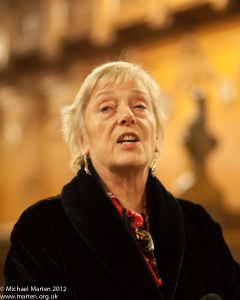
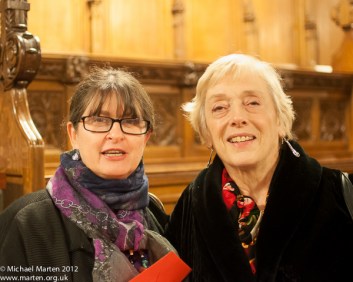
Dr Alison Jasper, Prof. Ann Loades

Dr Alison Jasper, Prof. Ann Loades

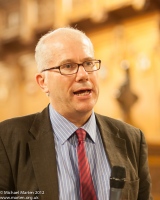
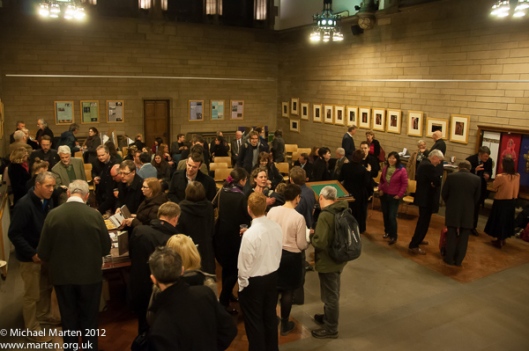
Eighty people came to Glasgow University Chapel for the launch of two books on 21. November, one by our own Alison Jasper, Because of Beauvoir: Christianity and the Cultivation of Female Genius, the second by her husband, David Jasper, The Sacred Community: Art, Sacrament, and the People of God, both published by Baylor University Press (Waco, Texas), 2012.

Prof. David Jasper

Prof. David Jasper

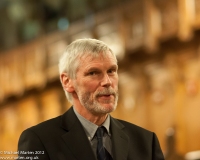
David introduced a number of speakers, beginning with Professor Nigel Leask, Regius Professor Of English Literature at the University of Glasgow, who welcomed all.

Prof. Nigel Leask

Prof. Nigel Leask

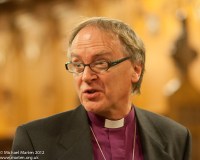
Right Rev. Richard Holloway, former Bishop of Edinburgh, then spoke of David’s book, commending it for its careful examination of the liturgical community and the place of the community in the church and the world.

Rt Rev. Richard Holloway

Rt Rev. Richard Holloway

Right Rev. Gregor Duncan, Bishop of Glasgow and Galloway, spoke in similarly warm terms of David’s contribution to contemporary theology.

Rt Rev. Gregor Duncan

Rt Rev. Gregor Duncan

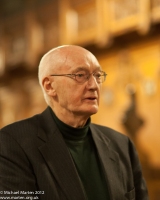
Professor Ann Loades, CBE, Professor Emerita of Durham University, and Prof. Richard Roberts, Visiting Emeritus Professor at Stirling and a member of the Critical Religion Research Group, both addressed the publication of Alison’s book.  Professor Loades commented:

I have read the book with admiration … it is beautifully organised and written, and entirely original both in its conceptual framework (female genius) and in the examples you use… the fight for the recognition of what women have and continue to do is no joke, as we wll know.

Prof. Ann Loades

Prof. Ann Loades

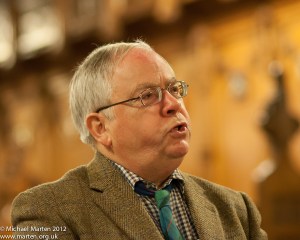
Professor Roberts placed Dr Jasper’s book in the wider context of Simone de Beauvoir’s argument, picking up particularly on de Beauvoir’s description of the male lack of empathy for the situation of women (‘It is… a difficult matter for man to realize the extreme importance of social discriminations which seem outwardly insignificant but which produce in woman moral and intellectual effects so profound that they appear to spring from her original nature’; The Second Sex, 1953/1988 edition, p26).  Marriage, motherhood and sacrifice became reified metaphors in this context.  And yet it is precisely this context that enables ‘female genius’ to achieve being and creativity.  She describes,

… the surprising complexity of many singular lives in which female genius is achieved in the pleasures of a courageous and creative dialogue with the problematic structures created as a consequence of male-normative perspectives. (Jasper, p41)

Prof. Richard Roberts

Prof. Richard Roberts

There is, therefore, a world of female achievement to be explored before the past sixty years, and Jasper does this using a variety of approaches, but with a particular emphasis on Julia Kristeva’s thinking.  Using four women as case studies – Jane Leade (b. 1624), Hannah More (b. 1745), Maude Royden (b. 1876) and Michèle Roberts (b. 1949) – she shows how they have ‘all been formed in some way by Christianity, its praxis, its beliefs, or its ethical and aesthetic sensibilities’, and all can be regarded as examples of female genius: ‘the struggle to avoid being objectified within male-normative contexts while seeking to engage genuinely with “the other”, including men.’ (p. 75)  This approach to female genius, Jasper argues,

tries to do justice to the full complexity of the lives of women who struggle against the consequences of male-normative frameworks of value while also managing to create new relationships and think in new ways that keep the temptations and perilous dangers of that framework itself clearly in focus. (p. 75)

Professor Roberts cited Jasper’s closing lines from the book:

…contemporary feminist discourse needs to recognise that we do have a past that informs a present and our ongoing discussions with each other, globally, in much more complex ways than merely in terms of a negative – for example, Christian – legacy, thankfully disposed of.  To ignore the challenging and insightful ways in which women have shown themselves able to engage with the Christian imaginaries of the past is, once again, to diminish and trivialize their capacity to survive, to struggle to contest, and thus to flourish even in the most inauspicious circumstances. (p. 158)

He praised Jasper for not letting go of de Beauvoir’s original question: ‘What is a woman?’, lauding her contribution in this book to the ongoing emancipatory discourse and the clarity with which questions of ‘religious women’ were discussed.

Professor Loades summarised her thoughts: ‘Dr Jasper’s new book is… refreshing to read in its attention to overlooked examples of ‘female genius’ – we look forward to more.’

Alison Jasper has written a short blog posting about Female Genius that you may wish to (re)visit.  Warm thanks to Professors Loades and Roberts for help in writing this update.

Visitors to the Jaspers' books launch

Visitors to the Jaspers’ books launch

Note that Heather Walton has also commented on Because of Beauvoir on the International Society for Religion, Literature and Culture website.

Law, Critical Religion, and the Importance of Semantics

26 Monday Nov 2012

Posted by Gabrielle Desmarais in Critical Religion, University of Ottawa

≈ 9 Comments

Tags

Critical Religion, freedom of religion, law, new religious movements, religious freedom, wicca

I often hear it said that the contributions of scholars in critical religion are “merely semantic”; that problematizing the category of religion and the meaning of the word “religion” an academic context has no bearing on the understanding of religion “on the ground”. The meaning of “religion”, many argue, is fluid and dynamic, and so the definition and approach of scholars studying it must reflect this. No single definition applies to “religion”, nor should there be, as people use the word to mean different things. In short, many argue that studying the idea of “religion”, and the implications of the word itself, have no real practicality beyond the academy.

I would like to offer a brief rebuttal to that argument, using as an example laws concerning “freedom of religion”. Provisions for freedom of religion have become the norm for Western democracies and their bills of rights (such as in the Canadian Charter of Rights and Freedoms and the First Amendment to the United States Constitution), but there are several reasons why these provisions might warrant re-examination. Below, I will draw from my knowledge of North American case law to demonstrate how critical religion may be invaluable to moving towards a more nuanced understanding of the issue.

If a citizen presents a case to Canadian (or American) courts claiming their right to freedom of religion was infringed, either by another citizen or by an institution, one of the first steps in the legal process is to determine if the claim is legitimate. If the plaintiff is not a member of a recognized religion, the court must first determine if their practices qualify as “religion”. Otherwise, a case for rights infringement cannot be made. How does the court determine whether the plaintiff’s religion qualifies as such in the eyes of the law? It does so by looking at the definition of the word “religion”.

One of the main problems lies in the fact that constitutional documents which proclaim freedom of religion in North America do not describe or define “religion”. In both Canada and the United States, the interpretation of “religion” has been left to the courts. These rely on two sources of information to form this interpretation. The first consists of previous and pertinent case law, if it exists. Secondly, the court calls upon expert witnesses who can attest to the legitimacy of a claim based on their academic knowledge of religion. It is the academic understanding, and not a common or “lay” understanding, of the category “religion” that is privileged.

Still, the Supreme Court of Canada has done its best to use expansive definitions; in the landmark 2004 case Syndicat Northcrest v Anselem, it ruled that religion “is about freely and deeply held personal convictions or beliefs connected to an individual’s spiritual faith and integrally linked to one’s self-definition and spiritual fulfilment [sic], the practices of which allow individuals to foster a connection with the divine or with the subject or object of that spiritual faith.” The issue here is that, despite their best efforts to be inclusive, courts fail to realize that using vague language does not divest the concept of “religion” from its Christian and colonial history. Even the words “beliefs” and “faith” stem directly from a Christian rhetoric.

That the definition of “religion” is left up to the interpretation of courts has not shown to have a substantial impact on traditional religions like Protestant Christianity, because they are easily recognizable as “religion”. However, the question of whether religious practices are considered official or acceptable can still be disputed, as Winnifred Sullivan demonstrated beautifully in her book The Impossibility of Religious Freedom. The narrowness of the definition may present problems for new groups that identify themselves as “religion”, but are not recognizable as such to the court.

An example that comes to mind is Wicca. A tradition that emerged in the 1950s and spearheaded by retired civil servant Gerald Gardner, Wicca is an un-institutionalized earth-based new religious movement that focuses on the immanence of the divine in nature. Wicca has no official tenets of faith, no designated clergy or standard ritual format, and no fixed location of worship. Wiccan groups have had considerable difficulty proving to the government (Canadian or American) that they are legitimately religious, for these reasons.

When determining whether Wicca is a religion in the eyes of the law, the semantics of “religion” are incredibly important. The large majority of Wiccan groups who qualified for tax exemption in the United States designate themselves “churches”, or describe themselves using words like “faith” and “beliefs”. In Roberts et al. v Ravenwood Church of Wicca, the granting of tax exemption for religious reasons was delayed by Justice Jordan, dissenting, who stated:

While the majority opinion states that the Wiccan church does not believe in the devil, I do not believe it conforms to the traditional concept of a religion as embraced in the preamble of our State Constitution and as expressed in the Pledge of Allegiance to the flag of the United States. This nation was founded “under God,” not the “karmic circle.”

If guarantees to “freedom of religion” are granted only if a person’s religion is recognized, yet the definition of “religion” relies on Christian rhetoric, are the provisions really ensuring freedom of religion? Should provisions for “religion” exist at all? These are questions I will examine in more detail in my upcoming Master’s thesis.

The work of scholars in critical religion may indeed concentrate on the semantics of “religion”, but it is far from being “merely” an academic issue. The meaning of the word “religion” and the language used to regulate that definition are at the forefront of the constitutional cases about new religious movements. While it is perhaps unlikely that critical religion will prompt an amendment of provisions for “freedom of religion”, the continued work of scholars in the field may inform those expert witnesses called to consult in these cases, and thus help shape the legal understanding of human rights in the process.

Who defines religion in the colony?

19 Monday Nov 2012

Posted by Alexander Henley in Critical Religion, University of Manchester

≈ 1 Comment

Tags

Christian, Critical Religion, Lebanon, Muslim

(This entry is a reflection on a recent workshop discussion with Professor Ahmed Ragab and Dr Aria Nakissa at Harvard’s Center for Middle Eastern Studies.)

On 1 September 1920, French General Henri Gouraud proclaimed the new state of Lebanon, or Grand Liban, from the steps of the Palais des Pins in Beirut.  He did so, as he took care to remind his audience, ‘In the presence of the Lebanese authorities, the sons of the most illustrious families, [and] the spiritual heads of all confessions and all rites’.  Photographs of the event (e.g. here) show Gouraud flanked by these ‘spiritual heads’, with places of honour given to the Maronite (Christian) patriarch on his right, and the Sunni (Muslim) mufti on his left.  The Frenchman used this highly symbolic foundational moment to consecrate the notion of Lebanon as a consensus between its Christian and Muslim communities, represented by patriarch and mufti.

The extraordinary paradox here is that this confessional representation performed two apparently contradictory symbolic feats.  It intentionally and overtly lent the authority of these two religious leaders to the legitimation of the state.  Yet at the same time it subtly and perhaps unwittingly (re)created the religious leaderships that these two gentlemen were seen to embody, precisely by presuming them to hold the authority to represent ‘the Christians’ and ‘the Muslims’.

Ilyas Huwayyik, the man styled by the Maronite Church as Patriarch of Antioch and All the East, was addressed by General Gouraud as ‘the Grand Patriarch of Lebanon’.  Notwithstanding the dozen or more non-Maronite Churches that now found themselves within Lebanon’s borders, many of which had protested the new state, Huwayyik and his successors ever since have been treated in state protocol and public discourse as spiritual head of all Lebanon’s Christians.

On Gouraud’s other side was Mustafa Naja, the Mufti of Beirut, a judicial functionary appointed by the Ottoman Sultan to produce fatwas, written legal opinions.  The son of a Beiruti perfume-seller, Naja’s daily routine involved issuing fatwas to the public from a market-stall near the central mosque; holding a regular study circle in the mosque and participating in Sufi gatherings; championing an Islamic educational charity; and helping at his father’s stall in the souq.

Naja resisted General Gouraud’s designs on him.  Proudly loyal to Arab nationalism, the sheikh had initially refused to attend the celebration of a Lebanese state.  The general is said to have threatened him with deportation.  At the Palais des Pins, the reluctant Naja was symbolically cast as the Patriarch of Lebanon’s opposite number, implicitly now the Mufti of Lebanon, religious leader of the country’s Muslims.

The French offered Naja the official title of ‘Mufti of the State of Greater Lebanon’, but he rejected it right up to his death in 1932.  Nevertheless, he had been set on the national stage and a continued public role came to be expected of him not only by the colonial authorities but also by Lebanese Muslims seeking representation.  Gouraud had orchestrated an iconic image of a national Grand Muftiship, and in the decades after 1920 that image would become an institutional reality.  Naja’s successor, Muhammad Tawfiq Khalid, took the title ‘Mufti of the Lebanese Republic’ and built up a national religious administration with an impressive Beirut headquarters that became the hub of a newly self-identifying confessional community.

This story seems in many ways a striking example of the transformative power of the colonial language of religion.  John Zavos has shown representation as the means by which religion or religions were objectified in India, with the colonisers’ creation of new public spaces as a key part of that process.  In Lebanon, as in India, ‘representation translated into power through the articulation of firm, clearly recognizable communities’.*  A French colonial official’s selection of Mufti Naja to represent one of Lebanon’s religions, as equal and equivalent to the representatives of other religions, gave the mufti power and articulated a new Muslim identity as a religious community.

The mufti would not previously have been called a ‘religious leader’.  Indeed his office would not have been described as ‘religious’ in the modern sense: his role was judicial, salaried from a public budget and serving society at large.  Similarly, Sunni Muslims in Ottoman society were simply ordinary citizens; they did not organise or conceive of themselves as a community in contradistinction to others.

The translation of the modern Western concepts of religion and religious into the Arabic words dīn and dīnī was accompanied by an exponential increase in their use, and an even more marked rise of the plural adyān.  Only in the modern era was Middle Eastern society said to comprise a number of adyān; and were ministries dedicated to ‘religious affairs’ (al-shu’ūn al-dīnīyya), staffed by ‘men of religion’ (rijāl al-dīn).  The Mufti of Beirut was gradually elevated to leader of this religious corps (ra’īs al-silk al-dīnī), and finally to religious leader of the community (ra’īs al-tā’ifa al-dīnī).

But just because change happened during this period, must we assume it was all driven by colonialism?  The usage of dīn has no doubt changed, but were there not similar concepts in pre-modern Islamic societies?  ‘You have your dīn and I have my dīn‘, says the Qur’an.  Classical jurisprudence opposes dīn and dunyā, the material world.  The Ottoman notion of milla recognised the rights of non-Muslim communities.  And the role of muftis – while judicial – was not merely legal in the modern sense: it was to define the proper practice of Islam.

The critical religion school has taught us to see the colonial invention of world religions and their relegation to private space.  But an emphasis on the bulldozing force of secular colonial power may obscure the resilience of local histories.  Mufti Naja may have been an unwilling participant in the colonial enterprise, but the rise of state muftis across the Middle East suggests that he was an obvious, not an arbitrary, choice for leadership.  Whoever defined religion in the new Lebanon, its result was not marginalisation from a secular public sphere but by contrast the empowerment of new religious leaders and a lasting ambiguity over the nature, boundaries and even the possibility of ‘secular’ politics.

—-

* Zavos, John (2010), ‘Representing religion in colonial India’, in Esther Bloch, Marianne Keppens, and Rajaram Hegde (eds.), Rethinking Religion in India: The colonial construction of Hinduism (London: Routledge), 56-68: 66.

← Older posts
Newer posts →

Recent blog postings:

  • When Regular PCR Tests Become Penance: Agamben, Biopolitics and Critical Religion  2 September 2022
  • Butler, gender performativity and religion 4 August 2021
  • Logic in Magic, and Human Cognition: Towards a new theory 17 March 2021
  • Politics of Love: Secularism, Religion, and Love as a Political Discourse 18 November 2020
  • The Contagion of White Christian Libertarianism and America’s Viral President 30 October 2020

Frequent blog tags:

academia Africa art Bible Biblical criticism body capitalism categories Christian church clash of civilisations concept of zero crisis Critical Religion culture economics economic theory education epistemology female genius feminism freedom of religion gender global higher education Hindu Hinduism humanities impact India interdisciplinarity interfaith dialogue international relations Islam Israel Japan Jew law liberal education managerialism Middle East mission history modernity music Muslim Naomi Goldenberg negation Northern Ireland nothing Palestine patriarchy performance politics postcolonial power REF religion religion-secular binary religious education religious freedom religious observance religious studies ritual sacred schools Scotland secular spiritualities stained glass theology United Kingdom university University of Stirling vestigial states women

Follow us on Twitter

Tweets by CriticoReligio

‘Like’ us on Facebook

‘Like’ us on Facebook

Our blog is published in association with

Ekklesia

Top Posts & Pages

  • A Sociology of Religion Category: A Japanese Case
  • Myths and Superpowers: “Metaphysical” Superheroes?
  • Home
  • Francesca’s Buried Biblical Treasures
  • Is there anything good to be said for 'Religion'?
  • Barbato, Melanie
  • Postmodernism, postcolonialism, and the private property society
  • McCutcheon, Russell T.
  • Henley, Alex
  • Blurring the boundaries – punk rock and religion

The Critical Religion Association…

... an international scholarly association pioneering intellectual engagement with questions on 'religion' and related categories.

About this site

This site is mostly maintained by Dr R Nadadur Kannan. Please contact us with any queries.
You can keep in touch with our work on Twitter, on Facebook, and through our mailing list.

About the blog

The Critical Religion blog is a shared (multi-author) blog.
The views represented are the personal views of individual authors and do not represent the position of the Critical Religion Association on any particular issue.

Copyright and Funding

Please note that all text and images on this site is protected by copyright law. Blog postings and profile texts are the copyright of their respective authors. We warmly welcome links to our site: each page/blog entry includes a variety of convenient sharing tools to help with this. For more information, see the note at the bottom of this page. Please do not reproduce texts in emails or on your own site unless you have express written permission to do so (if in doubt, please contact us). Thank you.

For a note about funding, see the information at the bottom of this page.

The CRA and the CRRG

The Critical Religion Association (this website) emerged from the work of the University of Stirling's Critical Religion Research Group created in early 2011. Interest in the CRRG grew beyond all expectations, and the staff at Stirling sought to address requests for involvement beyond Stirling by creating the CRA as an international scholarly association in November 2012. The CRRG passed on the blog and other key content to the CRA, and this is being developed here.
The CRRG website is now devoted exclusively to the scholarly work of the staff at the University of Stirling.

Critical Religion online

Apart from this website, the Critical Religion Research Group also has accounts elsewhere online:
- we are on Twitter;
- we are on Facebook;
- we have audio on Audioboo;
We will soon also offer video.

RSS feeds

  • RSS - Posts
  • RSS - Comments

Administration

  • Create account
  • Log in
  • Entries feed
  • Comments feed
  • WordPress.com

Blog at WordPress.com.

  • Subscribe Subscribed
    • The Critical Religion Association
    • Join 178 other subscribers
    • Already have a WordPress.com account? Log in now.
    • The Critical Religion Association
    • Subscribe Subscribed
    • Sign up
    • Log in
    • Report this content
    • View site in Reader
    • Manage subscriptions
    • Collapse this bar
 

Loading Comments...