• Home
  • What is Critical Religion?
  • Blog
  • Events
  • Scholars
  • Links
  • Recordings
  • Organisation
  • Ekklesia
  • Contact

The Critical Religion Association

~ Critical Approaches to the Study of Religion

The Critical Religion Association

Category Archives: University of Stirling

Book launch: Alison Jasper’s “Because of Beauvoir: Christianity and the Cultivation of Female Genius”

28 Wednesday Nov 2012

Posted by CRA Editor in Critical Religion, University of Stirling

≈ 1 Comment

Tags

Critical Religion, female genius, feminism, Simone de Beauvoir

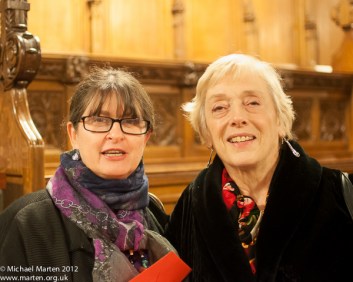
Dr Alison Jasper, Prof. Ann Loades

Dr Alison Jasper, Prof. Ann Loades

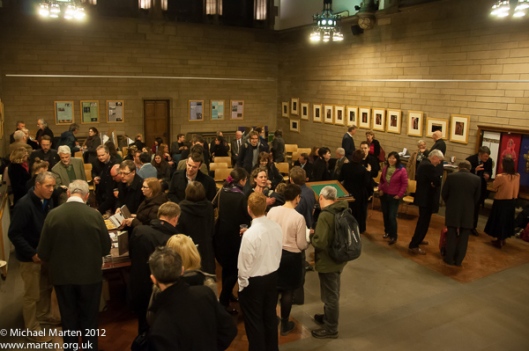
Eighty people came to Glasgow University Chapel for the launch of two books on 21. November, one by our own Alison Jasper, Because of Beauvoir: Christianity and the Cultivation of Female Genius, the second by her husband, David Jasper, The Sacred Community: Art, Sacrament, and the People of God, both published by Baylor University Press (Waco, Texas), 2012.

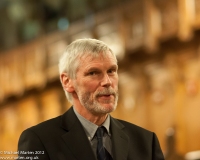
Prof. David Jasper

Prof. David Jasper

David introduced a number of speakers, beginning with Professor Nigel Leask, Regius Professor Of English Literature at the University of Glasgow, who welcomed all.

Prof. Nigel Leask

Prof. Nigel Leask

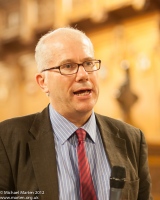
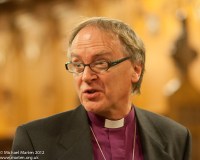
Right Rev. Richard Holloway, former Bishop of Edinburgh, then spoke of David’s book, commending it for its careful examination of the liturgical community and the place of the community in the church and the world.

Rt Rev. Richard Holloway

Rt Rev. Richard Holloway

Right Rev. Gregor Duncan, Bishop of Glasgow and Galloway, spoke in similarly warm terms of David’s contribution to contemporary theology.

Rt Rev. Gregor Duncan

Rt Rev. Gregor Duncan

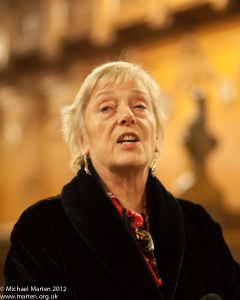
Professor Ann Loades, CBE, Professor Emerita of Durham University, and Prof. Richard Roberts, Visiting Emeritus Professor at Stirling and a member of the Critical Religion Research Group, both addressed the publication of Alison’s book.  Professor Loades commented:

I have read the book with admiration … it is beautifully organised and written, and entirely original both in its conceptual framework (female genius) and in the examples you use… the fight for the recognition of what women have and continue to do is no joke, as we wll know.

Prof. Ann Loades

Prof. Ann Loades

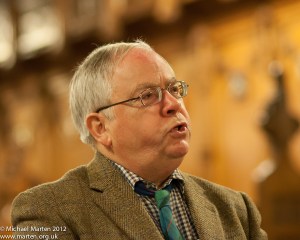
Professor Roberts placed Dr Jasper’s book in the wider context of Simone de Beauvoir’s argument, picking up particularly on de Beauvoir’s description of the male lack of empathy for the situation of women (‘It is… a difficult matter for man to realize the extreme importance of social discriminations which seem outwardly insignificant but which produce in woman moral and intellectual effects so profound that they appear to spring from her original nature’; The Second Sex, 1953/1988 edition, p26).  Marriage, motherhood and sacrifice became reified metaphors in this context.  And yet it is precisely this context that enables ‘female genius’ to achieve being and creativity.  She describes,

… the surprising complexity of many singular lives in which female genius is achieved in the pleasures of a courageous and creative dialogue with the problematic structures created as a consequence of male-normative perspectives. (Jasper, p41)

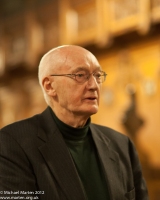
Prof. Richard Roberts

Prof. Richard Roberts

There is, therefore, a world of female achievement to be explored before the past sixty years, and Jasper does this using a variety of approaches, but with a particular emphasis on Julia Kristeva’s thinking.  Using four women as case studies – Jane Leade (b. 1624), Hannah More (b. 1745), Maude Royden (b. 1876) and Michèle Roberts (b. 1949) – she shows how they have ‘all been formed in some way by Christianity, its praxis, its beliefs, or its ethical and aesthetic sensibilities’, and all can be regarded as examples of female genius: ‘the struggle to avoid being objectified within male-normative contexts while seeking to engage genuinely with “the other”, including men.’ (p. 75)  This approach to female genius, Jasper argues,

tries to do justice to the full complexity of the lives of women who struggle against the consequences of male-normative frameworks of value while also managing to create new relationships and think in new ways that keep the temptations and perilous dangers of that framework itself clearly in focus. (p. 75)

Professor Roberts cited Jasper’s closing lines from the book:

…contemporary feminist discourse needs to recognise that we do have a past that informs a present and our ongoing discussions with each other, globally, in much more complex ways than merely in terms of a negative – for example, Christian – legacy, thankfully disposed of.  To ignore the challenging and insightful ways in which women have shown themselves able to engage with the Christian imaginaries of the past is, once again, to diminish and trivialize their capacity to survive, to struggle to contest, and thus to flourish even in the most inauspicious circumstances. (p. 158)

He praised Jasper for not letting go of de Beauvoir’s original question: ‘What is a woman?’, lauding her contribution in this book to the ongoing emancipatory discourse and the clarity with which questions of ‘religious women’ were discussed.

Professor Loades summarised her thoughts: ‘Dr Jasper’s new book is… refreshing to read in its attention to overlooked examples of ‘female genius’ – we look forward to more.’

Alison Jasper has written a short blog posting about Female Genius that you may wish to (re)visit.  Warm thanks to Professors Loades and Roberts for help in writing this update.

Visitors to the Jaspers' books launch

Visitors to the Jaspers’ books launch

Note that Heather Walton has also commented on Because of Beauvoir on the International Society for Religion, Literature and Culture website.

The breadth of Critical Religion

09 Friday Nov 2012

Posted by Timothy Fitzgerald in Critical Religion, University of Stirling

≈ Comments Off on The breadth of Critical Religion

Tags

Chicago School, Critical Religion, economics, Friedrich Hayek, Karl Polanyi, Ludwig von Mises, Naomi Klein, politics, The Shock Doctrine

We have asked Timothy Fitzgerald to write a short piece reflecting on why we want to broaden the Critical Religion work that we are doing, and so he seeks here to examine the wider significance of Critical Religion.

The relevance of Critical Religion

The first issue to mention is relevance: that ‘critical religion’ is not only concerned with ‘religion’ as a category, or with religious studies as a discipline. We are equally concerned with other leading categories such as ‘politics’, ‘economics’, ‘political economy’, and the ‘nonreligious secular’. In fact one element of our position is that these apparently separate categories are really parts of a system of representations which have no meaning in themselves, but rely on an under-lying binary construction with the religion-secular dichotomy as its constitutional expression. What we have developed is a theory, a method and an attitude towards the critical deconstruction of modern categories. We therefore claim relevance for interdisciplinary work throughout the arts, humanities and social sciences. This is because we are questioning the ideological components in the disciplinary structures of the academy as a whole, and the ways these act for the maintenance of liberal mythology more widely.

When someone says or writes that they are studying ‘politics’, for example, we have our own line of questions about what this could mean. The questions are rather similar to the ones we would ask if someone claimed to be studying ‘religion’ (or economics). This approach converges well with – but goes constructively further than – much critical and postcolonial theory. Yet it makes unwelcome reading (judging by some of the reactions which have been encountered) for those who are deeply invested already in the established disciplinary structures, and feel that their careers might be damaged if they question the basic assumptions which their discipline works with.

We have sympathy with academics in that position, but the logic of argument raises problems with the arbitrariness of many over-lapping domains. It suggests that the divisions which keep academics corralled in separate departments, journals, conferences, and professional organizations share at least one rarely acknowledged purpose, which is to stop us noticing each other’s work. Specialization, say between ‘religion’, ‘economics’ and ‘politics’, reifies segments as though each had an independent reality of its own, related by only by externalities, rather than by an organic encompassment of all analytical parts in the whole. We are thus encouraged to proceed in a way reminiscent of the Indian fable of the blind persons each holding one part of an elephant. The one holding the trunk or the tail or the hoof or the ear will imagine the whole in terms of that part. This presumably (and to stretch the metaphor) is what is meant by ‘the elephant in the room’, when all one has is the trunk or the tail or the ear or some other part of the joined-up anatomy of the organic whole in one’s hands.

A term like politics is sufficiently ubiquitous to appear as an intuitive reality of everyday life. Through the eyes of politics specialists, just about everything will seem political. To me the category looks like an ideological place-holder for whatever the dominant interests require from its deployment. By looking at the historical processes whereby the modern categories religion and politics were invented through mutual exclusion since the late 17th century, we can see how an illusion of positive knowledge arises. The emergence of political economy as a secular science complicates but adds additional force to our account.

We would therefore welcome contributions from colleagues in politics, or economics, or any other discipline such as International Relations to explore this. We are not looking for some kind of illusory feel-good victory, but for dialectical innovation through shared work with any colleague in any discipline who understands (but does not necessarily agree with) our paradigm.

Self-regulating markets, the All-Male Holy Trinity, and other Divinities

One feature of our own standpoint is that markets are the mystified objects of a faith-system not essentially different from what are typically classified as ‘religious’ beliefs. We agree with the position of activists in the global pressure group On the Commons, that the emergence of the myth of political economy as the ‘really real’ is a grave and present danger to global survival. The concept of self-regulating markets may be as incomprehensible to us as the Holy Trinity appears to have been to Isaac Newton and John Locke – both apparently anti-Trinitarians – even though to believers in both cases such doctrinal formulations have been inherited or adopted as the real truth. The theology of liberation through the self-regulating market – a theology represented (without a trace of irony) as the science of economics – requires for its self-realisation the methodical (or unmethodical) destruction of what Karl Polanyi referred to as the ‘social substance’. Polanyi published his book The Great Transformation in 1944, the same year as another important book, The Road to Serfdom by Friedrich Hayek, which had such an influence on Ronald Reagan, Margaret Thatcher, the IMF and so on. Neo-liberal readings of this and other works published by the Austrian school (see, for example the excellent Ludwig von Mises webpage) can be connected historically and theoretically to Milton Friedman and the Chicago School, whose activities have been described by Naomi Klein in The Shock Doctrine.

These books represent two powerful but very different readings of the historical emergence of liberal economic ideology. The central difference being that Hayek (unlike Polanyi) thinks markets are spontaneously emergent forces of nature which were ‘discovered’ by Richard Cantillon or Adam Smith sometime in the early 18th or even late 17th century. Polanyi instead narrates the often violent processes (very close to what Marxists mean by primitive accumulation) whereby powerful people passed laws which created artificial markets through dispossession of the means of subsistence. These processes continue today on a vast scale – some readers may have visited a country like India and witnessed its truly shocking disparities of wealth, and the huge social dislocations which have been occurring there as a result of the globalising mischief of market dogma and the ideological illusions that self-maximisers and self-regulating markets are the natural, rational, unavoidable and unstoppable conditions for progress and liberty. A central aim of this webpage is to identify and interrogate the globalising discursive mechanism behind the production of this naturalized orthodoxy.

What is ‘political science’?

01 Monday Oct 2012

Posted by Timothy Fitzgerald in Critical Religion, University of Stirling

≈ Comments Off on What is ‘political science’?

Tags

David Wearing, Political Studies Association, politics, religion, terrorism

In my last blog posting, I addressed the question of the “world of politics” , relating  to questions of arbitrariness, construction, and performativity.  Here I want to develop thoughts on questions of the ‘science’ of ‘political science’.

The crib-sheet provided by the Writing Center at Chapel Hill that I mentioned in my last posting explains that the development of general principles and theories by political scientists reflects an attempt to describe and analyze in a neutral, objective and scientific way the struggles and fighting of interest groups:

Although political scientists are prone to debate and disagreement, the majority view the discipline as a genuine science. As a result, political scientists generally strive to emulate the objectivity as well as the conceptual and methodological rigor typically associated with the so-called “hard” sciences (e.g., biology, chemistry, and physics). They see themselves as engaged in revealing the relationships underlying political events and conditions. Based on these revelations, they attempt to state general principles about the way the world of politics works. Given these aims, it is important for political scientists’ writing to be conceptually precise, free from bias, and well-substantiated by empirical evidence. Knowing that political scientists value objectivity may help you in making decisions about how to write your paper and what to put in it.

This assumption of scientific neutrality and objectivity is questioned by David Wearing, a political science writer in a 2010 Guardian newspaper article How scientific is political science?

The prevailing view within the discipline is that scholars should set aside moral values and political concerns in favour of detached enquiry into the mechanics of how the political world functions. This often involves borrowing the trappings of the natural sciences in attempts to establish generalizable theories of causation through the testing of hypotheses. To the extent that this activity has a purpose beyond the establishment of knowledge for its own sake, it is to place that knowledge at the hands of policymakers who, in the light of the political scientist’s advice, may then make political and moral judgements as they see fit.

Wearing here points to the problems with these claims, not because he denies the value of rigour and objectivity as far as one can attain it, but because in the final analysis he sees moral commitments and priorities inevitably entering into the equation:

I have yet to be convinced by the idea that the study of politics can be apolitical and value-neutral. Our choice of research topics will inevitably reflect our own political and moral priorities, and the way in which that research is framed and conducted is bound to reflect assumptions which – whether held consciously, semi-consciously or unconsciously – remain of a moral and political nature.

So the problem here is that the study of politics is itself political though it pretends not to be. Wearing gives as an example the field of terrorism studies and the way its practitioners focus on non-state rather than state actors, and define the problem in terms of madcap terrorists (frequently described and probably misdescribed by others as ‘religious terrorists’)) and not in terms of the moral culpability of western states. In the case of Iraq for example, Wearing points out that in the 1990’s the UK helped maintain a sanctions regime that resulted in the deaths of hundreds of thousands of citizens, around half of them children under the age of five. Yet out of many articles published in International Relations journals during this period, only three were concerned with the appalling effects of the sanctions. For Wearing,

It is difficult to see why choosing to investigate state terrorism would be ‘political’, while choosing not to would be non-political, or why discussing the effect of sanctions on Iraqi society constitutes any more of a moral choice than choosing not to do so. The suspicion must arise that, when some scholarship is described as too political or too polemical, what is really meant is that it is insufficiently consistent with, or too critical of, mainstream priorities and assumptions.

Wearing has made some important observations here about the problem of excluding value judgements from description and analysis. He also questions the restriction of the methodology of studying politics to a domain like the hard sciences, in which value judgements are typically deemed to be excluded. However, though Wearing intends to correct an error in the understanding of what ‘political science’ is, or what it can legitimately be, we can note that he is not questioning the discursive field  of ‘politics’ or ‘the political’, or the validity of a political science in the first place. And why should he? He like many others might find the question counter-intuitive.

The theme for the up-coming 63rd Political Studies Association Annual International Conference in Cardiff (25 – 27 March 2013) – The Party’s Over? – “speaks to a number of senses in which assumptions and modalities that have hitherto underpinned political life, and political analysis, may no longer be sustainable”. This alarm note is unpacked by a number of more specific questions. The general thrust of these questions concerns the decline of European and especially US dominance and prosperity, and the rise of China and other emergent powers. This is obviously a theme of major significance, and one that needs the serious debate that the PSA are inviting. My own question, however, is whether ‘the party’s over’ for the very idea of a world of politics in the first place?

I am sceptical about the very idea of a universal domain of politics, and what it means to claim that such a world exists. I suggest that ‘the world of politics’ is as much a faith-imaginary as those beliefs typically attributed to ‘the world of religion’. Its mythical status is elided by an ideological illusion which I want to explore. In many publications I have raised mirror-image issues with a supposed ‘world of religion’ endlessly propagated by academics, the media, politicians and others (most recently in Religion and Politics in International Relations: the Modern Myth, Continuum, 2011). In what sense do these putative worlds exist? And how would one discriminate objectively between a religious and a political world? It is to these questions that I turn in my next blog posting.

What is politics?

11 Tuesday Sep 2012

Posted by Timothy Fitzgerald in Critical Religion, University of Stirling

≈ Comments Off on What is politics?

Tags

Aristotle, economics, John Locke, politics, religion

In thinking about politics, a chance encounter with an excellent pedagogical website at The University of North Carolina at Chapel Hill, College of Arts and Sciences provides me with a starting point. In order to help students to write essays on “Political Science” and other topics, The Writing Center performs a valuable on-line service to pedagogy, a service which can be appreciated and profited from by readers, students and also lecturers such as myself in different parts of the world. Much of the practical advice on writing essays is excellent, and shows a high level of pedagogical competence. And they do this for a whole range of subjects, not only Politics. However, the advice given by the Writing Center embeds an uncritical and widely disseminated discourse about politics which in turn reflects the dominant structure of faculties in the university and the wider assumptions of modern America. These assumptions may be internalised and adopted by students in many different countries. My comments are not intended as criticism of the services offered by that webpage. My concern is both more general and more specific than this, with the theoretical and methodological problems in isolating and defining a domain of politics or political science in the first place.

The Writing Center at Chapel Hill has posted the following student-friendly hand-out on its webpage explaining what politics is:

At its most basic level, politics is the struggle of “who gets what, when, how.” This struggle may be as modest as competing interest groups fighting over control of a small municipal budget or as overwhelming as a military stand-off between international superpowers.

Politics is here characterized in terms of “struggle”, “interest groups”, and “fighting over control”.  Political science is constituted by the description and analysis of such struggles. This summary of politics, necessarily brief given the practical task of essay writing, but one which might be reproduced in many student essays around the world, indicates a specific domain characterised by conflict and competition over resources which might have been the subject matter of economics, human geography, social anthropology, religious studies and other disciplines as well. Furthermore, this characterization of politics in terms of competition over scarce resources may imply an assumption about ‘human nature’ which could itself be contested. It could be, for instance, that some historically-identifiable orders of power and theories of the good life have legitimated practices which promote radically different conceptions of human flourishing. While it is probably true that human life has always been characterized by contestations of power and conflict over resources, it should be held as a possibility that the contemporary celebration of individualistic self-interest requires an ideological illusion to make it seem more credible than alternative systems of collective representations. We can observe this very explicitly in modern liberal economic ideology, which, by placing self-interest at the centre of its theorizations, seems to have  greatly contributed to the very conditions of inequality, scarcity and want that economists hope to ameliorate. Its promotion of an ideology of individual self-interest, and the globalizing liberal belief that selfishness and greed promote an overall harmony of interests, may itself be partly the cause of the massive impoverishment of vast numbers struggling for survival in so-called developing nations, and the rapid degradation of the environment. Unfortunately, faith in progress acts as an ideological filter which makes the possibility of falsifying the paradigm seem counter-intuitive. It is in the context of these thoughts that I will go on in future blogs to ask why political theorists incessantly remind us that our ‘political’ categories come etymologically from Greek, and that Aristotle is the one who gave us the basis for modern political theory.

What then do political scientists do?

According to the advice given by the Writing Center at Chapel Hill,

Political scientists study such struggles, both small and large, in an effort to develop general principles or theories about the way the world of politics works.

This raises at least two significant issues.  Firstly, we might ask: in what sense does such a world of politics exist? “The world of politics” is not itself an observable phenomenon but a more-or-less arbitrary demarcation of the spectrum of human agency.  I say arbitrary, because – like the equally indeterminate ‘world of religion’,  there are no boundaries to what can and cannot be described as politics. There are no objective  limits, independent of the agent’s own imagined assumptions, which can tell you where a political practice ends and a religious or economic (etc.) practice begins. When I say ‘the agent’s own imagined assumptions’, I do not mean a purely subjective, solipsistic imaginary. I mean that there are no boundaries existing independently of what specific dominant interest groups and their control of media of communication declare there to be. For example, when Jefferson made his Declaration of Independence, it was precisely that, a declaration. He and a growing class of like-minded Americans were articulating an aspiration, not a fact. He was rhetorically promulgating a new imaginary world order. This new world order would be characterised by nation states protected from ‘religion’ by written constitutions which declare human rights. These human rights are part of the inherently rational order of the world, and are delivered to us through natural reason unfettered by traditional religious superstitions which deny such freedoms.

This Lockean imaginaire, which is encapsulated in his concept of ‘the state of nature’,* is essentially no different from a powerful myth which acts as a charter for action.  So when political scientists claim to be describing and analyzing the world of politics, I take it that they too are really making a proclamation about a world which ought to exist, rather than making objective descriptions about a world independent of our desires and intentions. They are in effect inventing and re-inventing ‘politics’ as they speak about it. I feel the same scepticism about the existence of such a world as I feel when religionists claim to be describing and analyzing a world of religion. I have discussed many cases of these apparently factual descriptions about religion which, on closer inspection, turn out to be constructing the objects of their own research. Beneath the blarney of neutral objectivity and precise description and analysis, they are constructing and reconstructing the imagined objects themselves, a reified idealization ‘politics’ which depends on the (often unconscious) exclusion of a mirror-image construction of another reified idealization, ‘religion’.

The second significant issue that I want to raise here relates to the question of objectivity and the question of ‘science’.  I will discuss this in the next blog posting. I also want to discuss the origins of ‘political theory’ in Aristotle, and why, despite the etymological connections which are incessantly flagged up by those looking for a respectable origin for their discipline,  modern politics seems to have little to do with the Greek master.

* Locke develops his concept of ‘man in the state of nature’ in various works, especially his Two Treatises on Government (1688 [1690]).  It is an exercise in theoretical abstraction intended to show that his own belief in the values of liberal individualism is justified within his interpretation of natural law and natural reason. In short, the liberal bourgeois myth of the rational individual as the source of all value is given narrative shape in the form of Adam and his descendants. Elements of the Lockean myth are derived from various empirical sightings of Native Americans and other colonized peoples about whom he speculates.

Disorganised Religion? We need more of it!

27 Monday Aug 2012

Posted by Michael Marten in Critical Religion, University of Stirling

≈ Comments Off on Disorganised Religion? We need more of it!

Tags

Christian, colonial era, Critical Religion, Iona Community, religion, religion-secular binary, secular

I was recently invited to be part of a public conversation at Edinburgh’s Festival of Spirituality and Peace on the theme ‘Disorganised Religion’.  I was asked to offer comment on how I see understandings of ‘religion’ changing and to reflect on whether ‘disorganised religion’ is a helpful term to reflect on questions of religion.  The conversation was chaired by Ekklesia’s Simon Barrow, and Ian Milligan from Exploring Anabaptism in Scotland and the Bert community in Glasgow was the other discussant.  The event was sponsored by Ekklesia and the Iona Community.  This blog entry is a lightly-edited and slightly expanded version of my opening remarks, reflecting also some of the comments from the 60+ audience who came to the conversation; warm thanks to them for their insights.

If we’re thinking about ‘disorganised religion’, it presumes we know what we mean by ‘organised religion’, so I want to explore that a little bit before moving onto thinking about what ‘disorganised religion’ might be.

There is a long tradition in the West, at the latest from the 17th century onwards, of thinking of religion as being something distinct from other areas of life.  In the English-speaking world, this largely derives from Protestant thinking in the colonial context: Europeans went overseas and saw people engaging in what they thought were similar practices to ones they knew – so, for example, killing an animal in some apparently ritual form was seen as similar to an animal sacrifice in the Hebrew Bible, or kneeling and being still was seen as a form of prayer as described in the New Testament.  These things may not have been recognisably Christian because these people – in South America, Africa, or wherever – had obviously not heard of Jesus and the Christian God, but the Westerners understood these practices to be ‘religious behaviour’, even though that may have been a meaningless concept to the local people.  Nonetheless, these actions were being compared to and measured against what the Europeans already knew, and more than that, they were made to be like things the Europeans already knew (Edward Said, the Palestinian-American scholar, famously called this ‘Orientalism’).

From that, we have the beginnings of the so-called separation of church and state: actions and thinking seen as ‘religious’ was to be kept distinct from everything else, and ‘everything else’ was called ‘the secular’ – of course, these terms depend upon each other and if examined closely, have no consistent meaning.  It was but a short step to institutionalisation of this religious-secular distinction – through constitutions, for example – and ‘the religious’ became ever further removed from ‘the secular’, and correspondingly, the organisation of religion was seen as something that was distinct from the concerns of wider society.

So here we have one example of the ways in which thinking about ‘religion’ has changed.  On a related front, this event is being sponsored by the Iona Community, of which I am a long-standing Member, and from its early days, the Community has sought to overcome the distinction that I’ve just elaborated on.  It wanted to find ways to connect the church – by which it initially meant the Church of Scotland – to wider society, to overcome the distinction that I’ve just mentioned.  In the language of the Community, this was about connecting what people do in church on a Sunday and what they do at work on a Monday; today the Community tends to talk more about the connection between work and worship, between prayer and politics, between sacred and secular.  Of course, when the Iona Community was founded in 1938, there was a presumption that most people who describe themselves as Christian would be members of churches, but that is clearly no longer the case.  So the Community has in recent years been seeking to identify news ways of engaging, and that is where terms like ‘disorganised religion’ perhaps help us think about some of these issues.

From different backgrounds then – the Critical Religion analysis of the origins and consequences of much of our thinking about the artificiality of distinctions between ‘secular’ and ‘religion’, and the Iona Community’s attempts to find practical and honest ways of overcoming these distinctions – we can point to very exciting ways of thinking of the future of what ‘religion’ might be.  Disorganised, certainly, if that means a move away from a distinction between ‘the religious’ and ‘the secular’ that distorts and hinders the integration of all aspects of our lives.

Of course, such attempts to move away from these distinctions have long existed – and the Anabaptist tradition that Ian is connected to is a perfect example of this – even if the larger churches that aligned themselves to a greater or lesser extent with the ruling powers have found it much harder to move away from the religious-secular distinction.  The Iona Community is another expression of this, and as it has grown, members from other Christian traditions have joined, and they have often been less fixated on institutionalised forms of religion.  Anti-institutional and non-hierarchical traditions in particular have enriched the approach the Community has taken on a number of issues: an example of this is the leading of worship, which has long been a task that non-ordained people have undertaken.

In a wider context: our world is globalising in new ways – the colonial traditions that resulted in religious-secular distinctions are gradually giving way to new kinds of seeing the global.  Globalised economics still privilege the rich, and especially the rich West, but forms of interaction are changing: in a Western Christian context, for example, we can observe the introduction of fresh ways of being church that clearly derive from the Global South, whether this be music and liturgy or sometimes even forms of decision-making and governance; the Iona Community’s John L. Bell has been instrumental in doing some of this for English-speaking communities.  Much of this kind of change relates to people seeking to engage more fully in worship and live their lives in a way that is more consonant with their understanding of priorities.  Emerging church movements and radical alternatives to church are all key to this process, as for some people that can happen in traditionally organised institutions, for others it needs to happen outwith them.

Either way, there is no doubt that ‘disorganised religion’ – in the sense of overcoming the religious-secular divide – is a useful way of thinking about what it is that many people are seeking to do.  Because they almost always perpetuate the religious-secular divide, ‘religious institutions’ are in fact perpetuating their own marginalisation.  This in turn encourages strong reactions from many so-called secularists when such institutions are seen as failing ‘to keep to religious matters’.  We can observe this in the same-sex marriage debate currently taking place in Scotland: there is a clear majority of the population in favour of the government’s moves towards equality, but many institutional religious figures oppose these moves, often arguing (incorrectly) that they will be discriminated against if same-sex marriage is legalised.  This failure to recognise that the granting of privileges that the majority have to everyone is not discrimination but equality, simply furthers the marginalisation of these institutions in wider society and deepens the religious-secular divide.

So if disorganised religion is about subverting the very idea that a religious-secular divide exists, then we need much more of it!  We often hear people say they are ‘spiritual but not religious’.  What is often meant is that people want to do justice to a desire or a need for some kind of spiritual or transcendental experience but they want nothing to do with the institutions that have grown up around what is seen as ‘religion’.  Perhaps such people are finding ways of overcoming the divide between ‘religion’ and ‘secular’ and discovering new ways of being whole human beings.  Certainly, for those on the margins seeking to live out an integrated ‘disorganised’ life, there may be mistakes made and wrong turns taken – but that element of the human condition is also what makes such disorganisation so appealing and so necessary.

The Bible and Homosexuality – Guidance for the Perplexed

16 Monday Jul 2012

Posted by Bashir S. in Critical Religion, University of Stirling

≈ Comments Off on The Bible and Homosexuality – Guidance for the Perplexed

Tags

Bible, Critical Religion, homosexuality, power, theology

Recently I came across a new book that I thought shed some useful light on the issue of homosexuality from a Hebrew Bible perspective. The book is The Bible Now: Homosexuality, Abortion, Women, Death Penalty, Earth, by Richard Friedman and Shawna Dolansky. In fairly short space it sets out a summary of most of the major arguments about specific Biblical references to homosexuality in the Hebrew Bible, those Jewish scriptures which overlap to a considerable extent with the Christian Old Testament.

Firstly they are very clear that the law in the Biblical book of Leviticus (notably, Lev 18:22 and Lev 20:13) cannot simply be wished away (p. 26). So for those who regard the Hebrew Bible as their moral pole star, the prohibition on (male) homosexual behaviour in the Hebrew Bible has to be addressed. But at the same time, they argue that we cannot ignore the context of these references either. It is a very different context to that of most contemporary western readers. For one thing, people in the ancient near east did not make the distinction between homosexuality and heterosexuality as if it were a distinction between equal concepts. Heterosexuality was the norm across all these cultures. Homosexuality was not – as it is today in many parts of the world – a life-style choice or a marker of individual identity.

What these biblical prohibitions on homosexual behaviour seem to reflect in fact, is a widespread construction of sexual relations as relations of power; sexual encounters position each partner hierarchically according to whether their role is active or passive. So, for example, women are suitable sexual partners for men because their active domination by men has already been mystified in terms of their essentially inferior status. For the same reason, Friedman and Dolansky suggest, some encounters between men have also been socially condoned by association with this active/passive polarity.

The form of socially sanctioned homosexuality we know most about in the Western world – pederastia (boy-love) – existed as a more or less formalised system in Athenian society in the 6th to the 4th centuries BCE (p. 32). In this case, an older aristocratic male would court a young man of good family “much in the way a man might court a future wife” (p. 33), becoming his mentor and teacher, drawn by an attraction that was erotically charged even if not always acted upon. But tellingly, according to Plato (Symposium, 8,21), the young man – the eromenos – while respectful of his mentor – the erastes – was supposed to remain detached from his sexual passion. And once he reached adulthood and became his social equal, any continuation of a (passive/feminine) sexual relationship became shameful. In a similar way, Friedman and Dolansky look at references to homosexual acts between men in a number of other near eastern contexts containing similar associations between social status and sexual acts between men. (It is also interesting that Friedman and Dolansky insist that there is no prohibition on female homosexual acts in the Hebrew Bible.)

In other words, homosexuality, before the modern era, was always framed by considerations of social status and this forms the wider cultural background to the prohibtions on male homosexuality in the Hebrew Bible and the Christian Old Testament. However there is also an important difference; male homosexuality is absolutely prohibited in Leviticus 18 and 20. Friedman and Dolansky suggest that this has to do with the fact that the legislative text of which these prohibitions form a part – the Holiness Code (p. 34) – reflects a particular theology of the land. All the people who settle on God’s land, both Israelites and aliens, are bound by its ritual and moral law: “In the Holiness Code, there can be no homosexual acts at all in Israel, since by cross-cultural perception such intercourse would necessarily denigrate the passive partner and violate his equal status under God’s law” (p. 35). Even the servant and the foreigner in Israel are equal in God’s land. And, of course, it remains the case that what is seen as immoral in homosexual acts between men is not the nature of male homosexual desire in itself, but the potential violation of a social equal – an act that would pollute God’s land (p. 35).

In relation to the issue of homosexuality, the authors of The Bible Now, come down fairly and squarely in favour of reading the biblical text carefully and in line with principles of critical biblical scholarship. These principles are derived from the so-called ‘higher criticism’ developed first by European, principally German, University scholarship in the eighteenth and nineteenth centuries. These principles have formed the basis of most reputable western biblical scholarly interpretation since then – whether it is Jewish, Roman Catholic or Protestant. In other words, they are concerned with scientific approaches to history – what here is mythology and what can be cross checked with other evidence and source material from the same period and region. They take due care to learn and understand the original languages of the Bible so they can answer the question, what did the words mean in the original context and how does that differ from the translation? They discuss the genre and style of writing, conscientiously distinguishing, for example, between poetry, prose and law: “It is is one thing to tell a story about something. It is another to write a poem about it. And it is a very different thing to write a law that says ‘Thou shalt no do it!’” (p. 1). And finally, they recognise that all readers come to the text with an agenda, a desire to know God’s truth or to find the basis of a moral norm or to reveal the gendered, colonialist assumptions of previous readers. No reading is neutral; hermeneutics or the interpretation of scripture must scrupulously attend to the who, when and where of all readers.

This useful treatment of homosexuality in the Hebrew Bible ends on a timely note of caution “Our purpose is not to talk you into one side or the other in these matters. Our purpose is to reveal that this is not a matter for amateurs, and it is not easy. You cannot just open a Bible – especially in translation – and find an obvious answer.” (p.39) Friedman and Dolansky, both University professors and career academics are employed to do the work of the scholar and this is a lifelong task. This relatively short and accessible treatment of homosexuality in the Hebrew Bible represents the distillation of an extended period of individual training and reflection and an even longer period of institutional development within wider communities. If we cannot any longer sponsor the development of this kind of professional expertise and learning – and in the UK, University departments of Theology and Biblical Studies are in rapid decline – it is going to be much harder in future, to make sense of our cultural inheritance or in any sense, to profit from it.

The Squaring of Zero, Part II

09 Monday Jul 2012

Posted by Andrew W. Hass in Critical Religion, University of Stirling

≈ Comments Off on The Squaring of Zero, Part II

Tags

concept of zero, crisis, culture, negation

(This is Part II of a blog entry from last month. Comments are welcome below on both Parts.)

So where then does the symbol of zero enter our Western world? If we turn to the etymology of the word “zero” we will find a telling trajectory of its history. And the origins in fact turn out to be not from the West at all, but from the East. This perhaps should not surprise us, since we know that both Hinduism and Buddhism are much more embracing of the notion of nothingness or the void. The notion is built into the very roots of their thinking, since all reality first stems from and then returns to the void. We might even say that coming to terms with this void is the heart and soul of these systems of thought and practice, even in all their variations. Take for instance the Atman, the supreme principle of the universe in Hindu belief. This principle, as a total and all-encompassing infinity, is in effect identical with a pure nothing, since it is everywhere and nowhere at the same time. In coming to terms with this nothing one comes to term with both self and universe.

In India, the Sanskrit word for “empty” or “blank” is sunya. This sunya is transliterated, within the Indian system of numerology, as the idea of zero and indeed the symbol “0” as we know it today. If we think about the round circle, it suddenly takes on an appropriateness to the notion of nothing, even pictographically. For at the centre of its circumference is a blank, a void, an abyss. It as if we are peering into an empty chasm, brought into greater relief by the circumference, but of course a relief that is an inverse relief, with an infinite inversion.

This symbol and its idea then begins to move West. Sunya is transliterated in Arabic as çifr. The Islamic world picked up the zero form of O when they conquered India in the 8th century. From there they passed it on to the West. This development, one might argue, is one of the most essential and primary dividing lines between the Western and Arabic worlds, but one that is rarely if ever understood or acknowledged. For in accepting and adopting the concept of nothingness from their contact with India, the Arabic people, and the Islam they espoused, was in effect rejecting the Greek heritage. They were gainsaying the idea of logos and its conceptual tradition built up by the august Greeks, and gainsaying what came to be the ruling Aristotelian cosmological view, which had rejected any possibility of the void (even if, ironically, it was through medieval Arabic scholarship that Aristotle was re-introduced to the West). Islam could reconcile the idea of the nothing with the Abrahamic notion of void as it is presented in the first creation story of Genesis (the Elohimic tradition), without having to accept the Logos tradition that Christianity later appropriated from the Greeks, as in John’s reworking of Elohim’s void in John 1.1: “In the beginning was the Logos”. In permitting the void conceptually, there was thus little resistance to its use as a written symbol, and hence the zero entered into the Arabic system of numerical notation. This is the system the West inherited to replace the Roman numeral system, and still uses today. But the inheritance was not without its misgivings: originally zero, as “0”, was called the “infidel symbol”, since it admitted a concept that defied Christian orthodoxy. It was only after accounting systems required more sophisticated notation – and the rise of capitalism is extremely significant in this regard – that Western Christian resistance to the “0” eventually breaks down.

Finally, in its etymological development, çifr gives way to the Latin cifra or ciphra, from which we get our word “cipher”. From cipher we get zefiro or zephiro, which in turn, through cognate Latinate languages (French, Italian), becomes “zero”. (Connected to cifra is also the French word chiffre, which means “digit”.) Nothing then becomes official, at least in terms of accounting. And it becomes acceptable, at least in terms of a workable, if still dangerous, concept.

So from both the symbol and the word, we can see that zero is not something indigenous to the Hellenised West. Moreover, the passage back to its Eastern roots is one often fraught with tension and unease, or even, as we continue to see in today’s geo-political and geo-theological world, with division and conflict.


(To follow up in greater detail on the idea and history of zero, there are four key texts, all of which have helped to inform the discussion here: Brian Rotman, Signifying Nothing: The Semiotics of Zero (Macmillan Press, 1987); Robert Kaplan, The Nothing That Is: A Natural History of O (London: Oxford University Press, 1999); Charles Seife, Zero: The Biography of a Dangerous Idea (London: Souvenir Press, 2000); and John D. Barrow, The Book of Nothing (London: Vintage, 2001).)

Note that due to holidays, it may take time for comments to be approved and responded to, but it WILL happen!


In praise of messiness in writing history (Part II)

25 Monday Jun 2012

Posted by Michael Marten in Critical Religion, University of Stirling

≈ Comments Off on In praise of messiness in writing history (Part II)

Tags

dominant, epistemology, historicisation, Israel, mission history, Palestine, Rumina Sethi, subaltern, Zionism

Note that this is Part II of a two part blog entry.  Part I is available here, and should be read first.

Having discussed some examples of mission history in the Palestine context and pointed to ways of constructing knowledge of such histories, I want to explore some of the implications of using Law and Lin’s ideas:

We can see the knowing, knowing well, and knowing differently problematic very clearly when we add the term ‘transnational’ to our thinking about mission.  Of course, all missions were transnational by definition, but this has become a wonderfully trendy term in modern scholarship, and that almost automatically makes me somewhat suspicious of it.  It is perhaps problematic in this context because it presupposes that the people we are studying fit into a transnational context, and that this  term will automatically work when analysing their history.  It interests me, for example, that relatively few scholars who use the term seem to feel the need to define it, which I would argue is key to understanding what we are doing when we use it.  Not defining it means we are ignoring our own personal baggage in our writing, and after all, our historicisations are about precisely this: how do we study history, given that we live and operate in a particular context that is impinged upon by certain understandings of historicisation?

In part, I wonder if this is because we live in what is widely seen as a postcolonial, almost post-national-boundary-world (I should clarify that when I use ‘we’ I am thinking predominantly of Europeans, because that is my own privileged context; I can add that I identify as a white middle-class male which further adds to my societal privileges).  The European project, with all the faults it might have and the problems it is encountering at the moment, is dedicated to, in the very long term, diminishing the importance of national boundaries and moving towards a greater sense of cosmopolitanism, arising from the ashes of the devastation of Europe after World War Two.  In Rumina Sethi’s terms, this ‘decline of the nation’ is accompanied by a ‘corresponding expansion of the metaphor of marginalization’ which has ‘led to the embrace of concepts like diaspora, hybridity, difference and migrancy.’  All this is well and good, except that from a third world perspective – and contra the current fashion I think there is good reason to hold onto the ‘first’ and ‘third’ world concepts – these concepts ‘are all related to the growth of the global economy and have come to be seen in terms of new configurations of dominance.’  These are oriented along neoliberal, capitalist lines, and have included the co-option of postcolonial studies, originally intended as a liberatory practice, but blunted in Western academic circles, as Sethi cogently argues.  We can see this in the work of Homi Bhabha, Dipesh Chakrabarty, and Gayatri Spivak, to name just three well-known scholars I have used in recent years to explore issues related to missions.  Sethi argues – as I have done – that we cannot simply point to ambivalence (Bhabha) or sameness and difference (Chakrabarty) or particular understandings of reason (Spivak) to explain the world – what we need is a realistic exploration of ‘historically specific acts of resistance’ to avoid silencing the subaltern.  Hybridity and similar terms suggest that the third world is impacting in a meaningful way on the first world, and that the very real boundaries that exist – of global capital, gender, race, etc. – are being traversed, eroded even.  In an historically specific reading, we can see that this is not happening, and that it did not happen in such a clear cut way.

This is not to say that there was historically and is now no contact between the third world and the first world – there clearly was and is.  But the defining and re-defining of this contact is often taking place by the first world, and not the third world.  After all, we (see above!) are writing from the (relative) comfort of our first-world university contexts – and our first-world context has rarely spent much time asking questions like ‘how does this transnationalism look from (e.g.) Palestine?’  To make this point really drastically, we can see this in a contemporary context when we think of the shameful behaviour of Obama and other western leaders, paying obeisance to a 19th century ethnocentric imperial fantasy currently being implemented by Israel, whilst he and they seek to deride or co-opt the acts of popular resistance in Egypt, Tunisia, Bahrain, Syria, Palestine and elsewhere in the Middle East.  Equally, when we think of some of the contact the missionaries had, we see a similar pattern – for example, Sloan’s lecture to Palestinian Jews about the possible good that might emerge from the murder of their co-religionists in Europe was clearly explained in his terms, and we do not know what they thought.  We might think here of Spivak’s subaltern that cannot speak – but I think her silent subaltern is, or has too often become, a convenient western neoliberal myth – the subaltern always speaks, as Robert Young has pointed out, it’s just that the dominant doesn’t listen.  Stefanie van de Peer, a recently graduated PhD student from my own department, put it very eloquently in her thesis, noting that rather than the subaltern not being able to speak,

It is more likely that as outsiders, we have become so used to defining ourselves as the non-Other, non-subaltern, that we cannot include the Other subaltern in our understanding… I argue that the insiders have learnt to represent themselves, not by finding a voice – because they always had a voice – but by finding a listener, a spectator… Whether the subaltern’s message is communicated effectively depends on the receptiveness of all parties involved in the speaker/listener relationship.  I insist on the presence of a willingness in the receiver of the message to hear the subject speaking, to listen, to empathise.

By claiming the subaltern cannot speak, we are excused even pretending to show we are interested in what she is saying.  The subaltern may be criticising in words, in silence or in action what the dominant is doing, and she may be doing that very cogently in her own terms, but the dominant chooses to ignore her.  The danger with the language of transnationalism is that we ignore the voice of the subaltern altogether, in a self-congratulatory assessment of our – and our historical subjects’ – cosmopolitanism.  After all, we assume that crossing boundaries is always good, but what if transnationalism, through the furtherance of knowledge amongst the dominant or those close to the dominant, increases the ability of the dominant first world to subjugate the third world more effectively?  Is transnationalism still good under such circumstances?

Questions that then arise include: ‘how do we listen?’ and ‘how do we make the transnational element of our historicising work in a way that doesn’t silence the subaltern?’  This, I think, connects closely to the need to differentiate between the kinds of knowledge we are talking about: knowing, knowing well, and knowing differently.  We can point to the ways in which the missionaries did this kind of thing, but in terms of how we study what they did, it is about recognising how we do it in our specific historicisations, oriented as they are by time, space, gender, race, class etc.  The metaphysics of knowledge that implies objectivity needs to be recognised for the ideological position that it is, and we need to subvert it, or rather, allow others from the past or the present to subvert it: the institutional nature of power and its ‘hegemonic truth practices’ need to be, at the very least, revisited.  And we need to move beyond particular subjectivities that supposedly create alterities that want to do away with the real life messiness of participants, not least because these subjectivities are often gendered or racialised (even if we don’t think we see this).

And this messiness is important.  For example, it is not always clear what is meant in mission history by ‘religion’ and ‘secular’ in other contexts, or by the adoption of western-style medicine over against traditional practices, or the export of nursing practice from western Florence Nightingale-style hospital contexts to settings in the Middle East or Africa or anywhere else.  There is a need to see the messiness for what it is – we don’t always understand the religion/secular issue, Western and traditional medicine have co-existed, Nightingale practice was not adapted to specific contexts even when it was claimed it was, and so on.  In terms of ‘my’ Scots in Palestine: they were not formally part of the dominant, but they came very close – but at times they also interceded on the part of the subaltern.  The subalterns communicated with the missionaries, even if the missionaries didn’t want to hear the message (finding a bomb in your garden, whatever else it might be, is definitely a message!).  We might ‘know’ all this, but knowing it well also means knowing it differently and encompassing a broader reality that requires all three forms of knowing simultaneously: sometimes there will be an interpretation, sometimes multiple interpretations, and sometimes – though as Western scholars we have great difficulty admitting this – no interpretations.  Though we might struggle with it, recognising the messiness of historicisation is of critical importance.

Challenging how we think about historicisation is key to the way in which we interpret and understand the complicity of those who were part of the dominant rather than the subaltern, or at the very least, were closer to the dominant than to the subaltern.  Historicising under these circumstances automatically becomes transnational when we begin to try and approach situations we encounter from our archives with a view to thinking about how the subaltern engaged in resistance to the dominant – because in part this was about the subaltern doing precisely what the dominant was seeking to do, but often they were not doing it on the dominant’s terms.  For many subaltern actors, they learnt about the dominant through their encounter, and resisted accordingly by using and remoulding what the dominant was offering: becoming nurses themselves, for example, and taking on responsibilities in the missionaries’ hospitals – knowing, knowing well, and knowing differently, is about understanding and interpreting this kind of subaltern agency, about listening to the subaltern speak.  That this is disconcerting to the dominant should not be a surprise – but is also necessary.

The Squaring of Zero, Part I

13 Wednesday Jun 2012

Posted by Andrew W. Hass in Critical Religion, University of Stirling

≈ Comments Off on The Squaring of Zero, Part I

Tags

concept of zero, crisis, culture, negation

(This is Part I of a two-part posting. Part II will appear early next month, when the opportunity for comments will be made available.)

We have been thinking in past blogs about the nature of negation, and how it has ascended into the imagination of our culture and society not necessarily as something to be scorned or regretted, but as something with which to be, in some cultural, philosophical, or even religious form, reconciled. Of course its primary symbol, in terms of production, is the figure of zero. But before we can understand how this figure might work its way into and through our present world, we need first to ask, whence zero? For its history is by no means one we might expect.

If we go back to the beginnings of scripted language and numerology, zero was not necessarily there at the outset. The ancient Egyptians developed a system of accounting based on a pictography – notation in pictures. Of course with pictographic language, a positive referent is needed to which one can point in the world. But when it comes to an understanding of nothing, pictography is ill-suited. For how does one picture nothing? The whole point of nothing is that it cannot be seen. To envision it, it must be turned into something abstract, like a concept, beyond pictures. Now we know the ancient Egyptian civilization was famed for mathematics – their pyramids proved their excellence at geometry, the configuration of shapes through mathematical precision. And yet in all this excellence, they never required zero in their computations, and therefore never developed any corresponding symbol. This says as much about their cosmological and theological understanding as it does about their mathematical acumen. For from the Book of the Dead we learn that death was not about returning to an abyssal place of nothing. Significantly, the ferryman who transported the dead soul across the river to the netherworld denied passage to anyone “who does not know the number of his fingers”. This showed the importance of accounting: as accounting was important for the Pharaohs who exacted some form of taxation upon their people, so too in death it is important to know how to account for oneself. (One must be counted, it appears, even in the afterlife.) And so there was a deliberate avoidance of nothing, because nothing troubles the system of accounting, whether financial, philosophical or religious. It is therefore not surprising that the Egyptians developed such a sophisticated technique of bodily preservation upon death. Mummification, we might say, is a gesture against the void, or it is a gesture of containment and preservation against that which negates us. The pyramids, we remember, functioned as tombs. So it is that the shape of O, as zero, figures neither in the pyramidical shape nor in the afterlife. Zero would be a perilous ticket for the ferryman.

The ancient Greeks too did not have a symbol for zero. This might seem even more incredible, since they had a distinct predilection for conceptualising. But as early as the Presocratics, those philosophers who preceded Socrates and Plato, there was a general repulsion to the concept of nothing. Parmenides, for example, talked much about the concept of a changeless One, but was adamant about the impossibility for “what is not” to exist, or even to be thought of. He therefore instructs us not to think on it. And for the most part the Greeks heeded his instruction, and shunned thinking about the nothing altogether. If we consider Greek thinking from the Presocratics onwards, we know that so much emphasis is placed on ratio, on ordering things in relation to one another. This is inherent in their term “logos”, which is accompanied by the notions of rationality and proportionality. (Ratio is part of the rational.) Reality then, underwritten as it is by logos, must remain accountable, or countable. The Pythagoreans were extreme in championing countability, to the point where reality in fact becomes number. But zero does not figure in this reality. In Greek logic (the logic of logos) zero cannot be a number as such. For the “0” introduces a void, and voids, by definition, cannot be counted. It is void of all quantification. If the cosmos is structured upon the logos, even a quasi-divinised Logos, which allows us to think rationally about it, to speak of it and (ac)count for it, it must remain positive. The idea of the nothing or of the negative cannot be part of the equation or the calculation. Thus like the Egyptians, the Greeks also did not develop any symbol for the naught in their numerology.

Nor did the Romans. Having been Hellenised by the Greeks, the Roman numeral system developed conspicuously without any figure for zero. And this from an empire who took accounting, and indeed taxation, to new and perfected heights across an extraordinary range of geography and peoples. This absence is felt throughout Roman culture, even in something as functional as their clocks: the Roman sundials were without a zero point, which means time was always positive – a god, in fact, like the Greek’s Chronos. This despite the fact that the sundial’s circular path outlined an “O”, the figure used elsewhere for the sign of nothing – a sign of the times to come, we might say, when the Roman numeral system proved inadequate, and the West had to turn and face its own nothing.

In praise of messiness in writing history (Part I)

30 Wednesday May 2012

Posted by Michael Marten in Critical Religion, University of Stirling

≈ Comments Off on In praise of messiness in writing history (Part I)

Tags

dominant, epistemology, historicisation, Israel, mission history, Palestine, Rumina Sethi, subaltern, Zionism

This is Part I of a two part blog entry.  Comments are closed here, but are open for Part II.

Scottish and Anglican missionaries in Palestine during the period from the First World War until the Israeli declaration of the state and the connected Palestinian Nakba of 1948 were determined, they continually argued, to stay out of the controversy and not take sides.  Palestine at this time was governed by Britain under a League of Nations mandate, with the theoretical aim of gradually enabling independence.  The growing Zionist movement and the resultant resistance of the local Palestinian Arab population characterised these years.  The missionaries’ job – to quote one of the missionaries of the time, George Sloan – was ‘to stand between Jew and Arab holding out a hand of friendship and brotherhood to each, seeking to draw each into fellowship and love with the other’.  For nearly three decades, the missionaries thought they could see arguments for both sides: for Jews, Palestine embodied the idea of an ancient homeland and relief from European persecution; for Arabs, there was a deep worry about losing their rights to their land to Zionists (even though the Scots doubted the Arabs’ ability to govern the country independently).  This idea of friendship to both sides was seen as core to Christian belief.  This was also expressed as ‘mutual toleration’ or ‘respect’ for ‘Muslim and Christian, Druse and Jew’.  Maria Småberg’s excellent doctoral thesis, published in 2005 by Lund University, describes the ‘ambivalent friendship’ of the Anglican church in Palestine at this time, and we can point to similar sentiments on the part of the Scottish missionaries.  In terms of theory and analysis, however, I would like to further develop some of her propositions.

Needless to say, the missionaries were rarely successful in their attempts to be ‘fair’ to both sides and to encourage friendship: at different times they were seen by both sides as extremely partial.  For example, some of the Jews in Hebron regarded Alexander Paterson, a missionary doctor, as an anti-Zionist.  Sloan felt himself to be in danger from what he called ‘Arab fanatics’ on at least two occasions, one of these involving a bomb being found in his garden.  In any case, many of their efforts to further ‘friendship’ were unsuccessful.  For example, a visit to Yemen gave Sloan the opportunity to see Jews and Arabs living alongside each peacefully, but when he published an article about this in the Palestine Post, it was prefaced with an editorial comment that it represented a minority view of the situation in Yemen, clearly suggesting it should be disregarded.  At other times, there was great wariness about Zionism, primarily because it was felt it might hinder the work of missionaries as well as make the position of any converts to Christianity from Judaism quite untenable, which was seen as a priority for the missionaries’ continued engagement.  At times this reached extreme forms, as this extract about Sloan from the 1943 General Assembly report of the Church of Scotland shows:

On one occasion he addressed in Hebrew a mass meeting of Jews in mourning for the slaughtered Jews of Europe.  After expressing the Church’s sympathy he went on “to make a challenging call to repentance in the style and partly in the very words of the Old Testament prophets.  This made a tremendous impression and the whole vast crowd listened in deep silence as I drove home to them the message.  I ended up by saying that if these calamities were the cause whereby there would be born again a new people of Israel, which would be in very truth a holy people, as God meant Israel to be, then the calamities would not have been in vain.  My address was widely reported in the Hebrew press next day.”

We might question, of course, the reason for the ‘deep silence’ of his audience, who may have resented somewhat the idea that the mass murder of European Jews in Nazi concentration camps could in any way be seen as a positive sign of God’s involvement with anyone.

In fact, the only space in which the Scots managed to achieve relative harmony and co-operation was in their own congregations, which consisted of a few Jewish converts mixed with Arab Christians – mostly ‘converts’ from the Greek Orthodox, Latin or other Eastern Churches (of course, as with other European missions, this did not make the Scots popular with their fellow Christians!).

It would be easy to dismiss the missionaries’ ideology of ‘friendship’ as naïve and unrealistic, but interpreting the engagement of the missionaries in such a complex situation as Palestine in the Mandate period in this way misses some key issues.

We can use contemporary educational theory, and in particular work carried out by John Law and Wen‐yuan Lin, to offer insights here.  They seek to integrate educational theory in postcolonial settings, reflecting on the differences between dominant and subaltern contexts.  I first came across their work through colleagues in the Critical Religion Research Group (A Jasper and J I’Anson) working on contemporary secondary school education, but it seems to me that this work can also be used in historical contexts.

Law and Lin point out that whilst subaltern contexts vary considerably, there is an overall stability to the Western legacy, which, thought not consistent or coherent, does reveal broad outlines that are similar.  In Mandate Palestine there is, of course, a dominant power – Britain – from whence the missionaries come, and they relate to various gradations of subalterneity in Palestine.  But the missionaries are also part of the subaltern, as I have shown in various publications.  Law and Lin identify the following key aspects to knowledge and communicating knowing from a broadly Western perspective of educational praxis:

  1. firstly, metaphysics: ‘The dominant Western knowledge traditions carry and reproduce a metaphysics that seeks to distinguish the world on the one hand from knowledge of that world on the other… in the Western scheme of things it is generally taken for granted that there is a world out there, a cosmos, that is ordered and structured… it is possible to gather knowledge about that world, to represent it, to debate the merits of different putative representations, and to arrive at provisional conclusions about its structure.’
  2. secondly, institutions: ‘Western knowledge traditions rest in and reproduce specific institutional arrangements.  These take many forms, and have changed profoundly since pre‐Socratic Greece…  Even so, for certain purposes the distinction between truth and power is sustained at least in rhetorical form, and this division is embedded in institutions… that reproduce and are reproduced by specific but hegemonic truth practices and their metaphysics, career structures, statuses, and systems for circulating knowledge.’
  3. thirdly, subjectivities: ‘… the Western tradition and its institutional arrangements also imply particular subjectivities.  Though breaches are legion, the normative expert is often taken to be [a] rational and intellectual subject who expresses truths about the world in symbolic form…  Competent subjects are thus those that reliably find out about and represent the world…  And, though this is a matter for debate and disagreement, as a part of this, in the normative case, the ‘personal’ emotions and bodily states of such subjects are Othered to the subordinate (and often gendered or racialised) category of ‘private life’. In the first instance, the assumption is that messy bodies get in the way of clean thinking.’

These lengthy citations are important: Law and Lin note that this is very broad, and, as they say, there are times when there are no Western-type of explanations and we need to be accepting of the messiness of a situation, even, and perhaps especially, when it doesn’t appear messy to the non-Western participant.  We know that knowledge is situated, and the point comes when the epistemology underpinning our situated knowledge needs to expand to accept something else beyond the confines of what it knows.  For many non-Westerners, holding a broad ontology together is not in the least messy – it simply involves different kinds of epistemology.  For example, there doesn’t always need to be a meta-narrative to a situation (which actually comes dangerously close to a structural determinist perspective on history) but because history as it has emerged as a discipline in the West is teleological in orientation, it usually tries to move towards a meta-narrative, and this can cause serious epistemological difficulties.

Knowing, therefore, is not just about epistemological awareness, which in any case is often gendered: the masculine is rational, cognitive, observational, whilst the feminine is turned into a ‘personal’ alterity.  Rather, we need to ‘know well’, to understand the diversity and confusion that manifests itself to us once we encounter Other worldviews, and to ‘know differently’, in other words, know what we are seeing in a different way.

Part II of this blog posting explores the scope and implications for such forms of knowing in the mission history context, and is available here.

← Older posts
Newer posts →

Recent blog postings:

  • When Regular PCR Tests Become Penance: Agamben, Biopolitics and Critical Religion  2 September 2022
  • Butler, gender performativity and religion 4 August 2021
  • Logic in Magic, and Human Cognition: Towards a new theory 17 March 2021
  • Politics of Love: Secularism, Religion, and Love as a Political Discourse 18 November 2020
  • The Contagion of White Christian Libertarianism and America’s Viral President 30 October 2020

Frequent blog tags:

academia Africa art Bible Biblical criticism body capitalism categories Christian church clash of civilisations concept of zero crisis Critical Religion culture economics economic theory education epistemology female genius feminism freedom of religion gender global higher education Hindu Hinduism humanities impact India interdisciplinarity interfaith dialogue international relations Islam Israel Japan Jew law liberal education managerialism Middle East mission history modernity music Muslim Naomi Goldenberg negation Northern Ireland nothing Palestine patriarchy performance politics postcolonial power REF religion religion-secular binary religious education religious freedom religious observance religious studies ritual sacred schools Scotland secular spiritualities stained glass theology United Kingdom university University of Stirling vestigial states women

Follow us on Twitter

Tweets by CriticoReligio

‘Like’ us on Facebook

‘Like’ us on Facebook

Our blog is published in association with

Ekklesia

Top Posts & Pages

  • Home
  • The Impossibility of Religious Freedom by Winnifred Fallers Sullivan: A Review
  • McCutcheon, Russell T.
  • Marten, Michael
  • The O of Giotto

The Critical Religion Association…

... an international scholarly association pioneering intellectual engagement with questions on 'religion' and related categories.

About this site

This site is mostly maintained by Dr R Nadadur Kannan. Please contact us with any queries.
You can keep in touch with our work on Twitter, on Facebook, and through our mailing list.

About the blog

The Critical Religion blog is a shared (multi-author) blog.
The views represented are the personal views of individual authors and do not represent the position of the Critical Religion Association on any particular issue.

Copyright and Funding

Please note that all text and images on this site is protected by copyright law. Blog postings and profile texts are the copyright of their respective authors. We warmly welcome links to our site: each page/blog entry includes a variety of convenient sharing tools to help with this. For more information, see the note at the bottom of this page. Please do not reproduce texts in emails or on your own site unless you have express written permission to do so (if in doubt, please contact us). Thank you.

For a note about funding, see the information at the bottom of this page.

The CRA and the CRRG

The Critical Religion Association (this website) emerged from the work of the University of Stirling's Critical Religion Research Group created in early 2011. Interest in the CRRG grew beyond all expectations, and the staff at Stirling sought to address requests for involvement beyond Stirling by creating the CRA as an international scholarly association in November 2012. The CRRG passed on the blog and other key content to the CRA, and this is being developed here.
The CRRG website is now devoted exclusively to the scholarly work of the staff at the University of Stirling.

Critical Religion online

Apart from this website, the Critical Religion Research Group also has accounts elsewhere online:
- we are on Twitter;
- we are on Facebook;
- we have audio on Audioboo;
We will soon also offer video.

RSS feeds

  • RSS - Posts
  • RSS - Comments

Administration

  • Create account
  • Log in
  • Entries feed
  • Comments feed
  • WordPress.com

Blog at WordPress.com.

  • Subscribe Subscribed
    • The Critical Religion Association
    • Join 178 other subscribers
    • Already have a WordPress.com account? Log in now.
    • The Critical Religion Association
    • Subscribe Subscribed
    • Sign up
    • Log in
    • Report this content
    • View site in Reader
    • Manage subscriptions
    • Collapse this bar
 

Loading Comments...